

Genitive: Horologii
Abbreviation: Hor
Size ranking: 58th
Origin: The 14 southern constellations of Nicolas Louis de Lacaille
One of the small southern constellations introduced by the Frenchman Nicolas Louis de Lacaille after he mapped the southern stars in 1751–52. Lacaille wrote that the constellation represented a pendulum clock beating seconds, as used for timing his observations. Lacaille introduced it on his first chart in 1756 under the French name l’Horloge, but this was Latinized to Horologium on the second edition of 1763.
The clock was imagined with a fully marked dial and even a seconds-hand, a remarkable feat for an area of sky that contains a sparse scattering of stars no brighter than fourth magnitude. In some representations its brightest star, Alpha Horologii, magnitude 3.9, marks the bob at the end of the clock’s pendulum, as in Bode’s illustration here, while others such as Lacaille himself placed Alpha on one of the driving weights. Horologium lies next to another of Lacaille’s new constellations, now known as Reticulum, which represented the diamond-shaped aperture in the eyepiece of his telescope that he used for observing transits of stars while timing them with the clock.
R. H. Allen, in his 1899 book Star Names, gave the constellation the double-barrelled name Horologium Oscillatorium, but Lacaille never called it that. It is unclear why Allen used the double name, since the original single-word name Horologium was well-established by the end of the 19th century when Allen wrote his book.
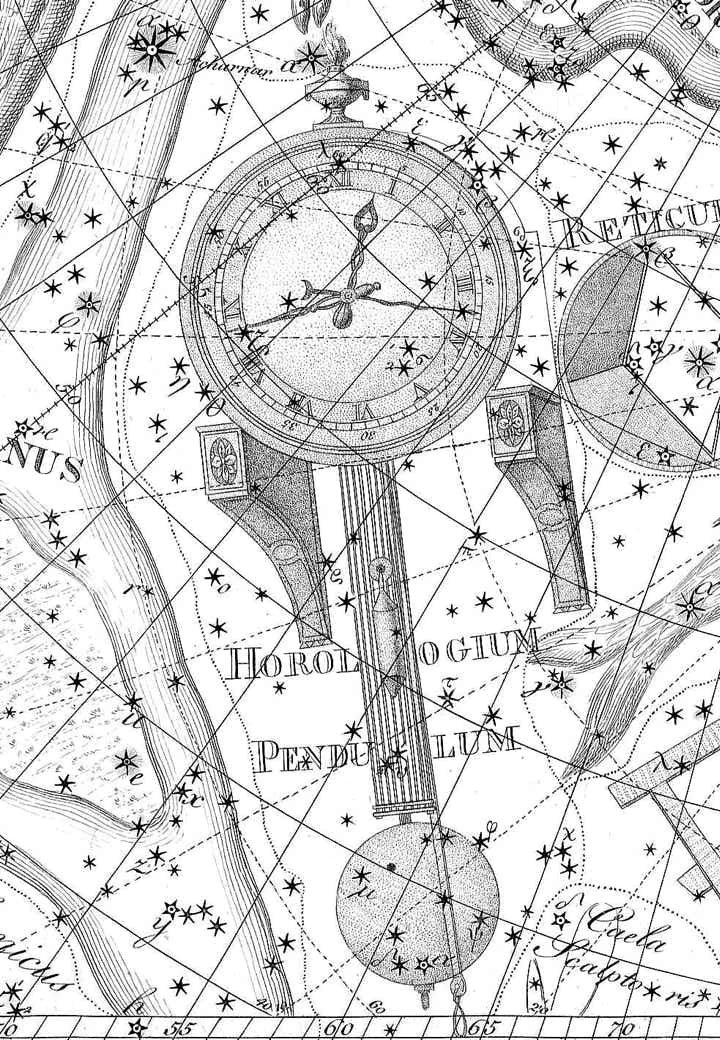
Horologium, shown as Horologium Pendulum, on Chart XX of Johann Bode’s Uranographia star atlas (1801). Bode showed it with a nine-rod gridiron pendulum, as invented by the English clockmaker John Harrison in 1726. Lacaille’s original depiction was of a much simpler design of the type originally invented by the Dutch scientist Christiaan Huygens in 1656.
© Ian Ridpath. All rights reserved

Lacaille described the clock as having ‘à pendule & à secondes’, a phrase that is somewhat ambiguous. In French the term ‘à pendule à secondes’ refers to a seconds pendulum, so either the inclusion of the ampersand is a typo or he was referring to the clock having both a pendulum and a seconds hand on its face, as he depicted it on his planisphere.