

HERCULES CONTINUED...
Death of Heracles
The death of Heracles is a true piece of Greek tragedy. After his labours, Heracles married Deianeira, the young and beautiful daughter of King Oeneus. While travelling together, Heracles and Deianeira came to the swollen river Evenus where the centaur Nessus ferried passengers across. Heracles swam across himself, leaving Deianeira to be carried by Nessus. The centaur, aroused by her beauty, tried to ravish her, and Heracles shot him with one of his arrows tipped with the Hydra’s poison.
The dying centaur offered Deianeira some of his blood, deceitfully claiming that it would act as a love charm. Innocently, Deianeira accepted the poisoned blood and kept it safely until, much later, she began to suspect that Heracles had his eye on another woman. In the hope of rekindling his affection, Deianeira gave Heracles a shirt on which she had smeared the blood of the dying Nessus. Heracles put it on – and as the blood warmed up, the Hydra’s poison began to burn his flesh to the bone.
In agony, Heracles raged over the countryside, tearing up trees. Realizing there was no release from the pain, he built himself a funeral pyre on Mount Oeta, spread out his lion’s skin and lay down on it, peaceful at last. The flames burned up the mortal part of him, while the immortal part ascended to join the gods on Mount Olympus. His father, Zeus, turned him into a constellation, which we know by the Latin name Hercules.
Heracles is depicted in the sky holding a club, his favourite weapon. Some people think that his 12 labours are represented by the 12 signs of the zodiac, but it is difficult to see the connection in some cases.
Stars of Hercules
Hercules is the fifth-largest constellation but is not particularly prominent. Alpha Herculis, a red giant star that varies from third to fourth magnitude, is called Rasalgethi, from the Arabic ra’s al-jāthī meaning ‘the kneeler’s head’, which it marks. The constellation’s brightest star is not Alpha but Beta Herculis, magnitude 2.8. Beta and Delta Herculis, named Kornephoros and Sarin, are his right and left shoulders respectively and his left arm extends towards Lyra. The four stars Epsilon, Zeta, Eta, and Pi Herculis form a distinctive quadrilateral known as the Keystone that outlines his pelvis. In some depictions, such as by Johann Bayer, Hercules was imagined holding a branch from the apple tree of the Hesperides in his outstretched hand. Johannes Hevelius, in his own atlas, replaced the apple branch with the three-headed monster Cerberus, while the English engraver John Senex combined the two figures on his celestial hemisphere of 1721/2.
His left leg, with Theta Herculis as the knee and Iota Herculis as the lower shin, presses on the head of the vanquished Draco, the dragon. Hercules rests on his right knee, marked by Tau Herculis. In Ptolemy’s day the star we know as Nu Boötis (on the tip of the staff or club held by Boötes) doubled up as the end of the right leg of Hercules, in an example of stars being shared by neighbouring constellations. Johann Bayer listed this star as both Nu Boötis and Psi Herculis, but it is now assigned exclusively to Boötes.
Astronomically speaking, the most celebrated object in the constellation is a globular cluster of stars, M13, the best example of such a cluster in northern skies. It was discovered by chance in 1714 by Edmond Halley when he was Professor of Geometry at Oxford. He described it as ‘a little patch, but it shews it self to the naked eye when the sky is serene and the Moon absent’. Whether he actually discovered it with the naked eye or telescopically he did not say.
Chinese associations
The southern half of Hercules, and much of Ophiuchus to the south of it, was in an area of sky that the ancient Chinese visualized as a celestial market, Tianshi, bounded by walls on left and right. At the northern end of the right (west) wall was Beta Herculis, followed by Gamma and Kappa Herculis; the wall then continued southwards into Serpens Caput, ending in Ophiuchus. The left (east) wall started at Delta Herculis then progressed via Lambda, Mu, Omicron, and 133 Herculis (or another star nearby) before heading into Aquila, Serpens Cauda, and Ophiuchus.
North of these walls, a chain of nine stars crossed Hercules from Theta via Epsilon and Zeta Herculis into Corona Borealis, forming Tianji, translated as ‘celestial records’ or ‘celestial discipline’. This is interpreted as an office for registering transactions in the market and paying taxes on them. (Confusingly, there are three other Chinese constellations whose names are also transliterated as Tianji, in Monoceros, Sagittarius, and Vela, but the meaning of each of them is different.)
North of Tianji, the stars Pi, 69, and Rho Herculis formed Nüchuang, ‘woman’s bed’, possibly referring to the Emperor’s harem. In this same area, a chain of seven stars leading from Hercules into neighbouring Boötes formed Qigong, ‘seven dukes’ or ‘seven excellencies’, representing senior government officials. The Chinese had two completely different sets of stars for Qigong – one version had the chain of stars going diagonally from 42 Herculis to Delta Boötis, while another saw it as running east–west from Eta Herculis to Beta Boötis. In the far north of Hercules, Iota Herculis formed part of Tianpei, a flail or club; most of Tianpei lay over the border in Draco.
At the heart of the celestial market was Alpha Herculis (Rasalgethi), known in China as Dizuo, representing the throne of the Emperor, the central authority. Next to Dizuo, a string of four stars in Hercules and Ophiuchus, including 60 Herculis, formed Huanze, representing one or more eunuchs serving the Emperor. Also nearby were Dou and Hu, containers for measuring liquid and grain respectively, symbolizing standard measures. Near the left wall of the celestial market were Bodu and Tusi, two pairs of stars in the region of 95 and 109 Herculis whose exact identifications are uncertain. Bodu represented a cloth merchant or draper, while Tusi was a butcher’s shop.
© Ian Ridpath. All rights reserved
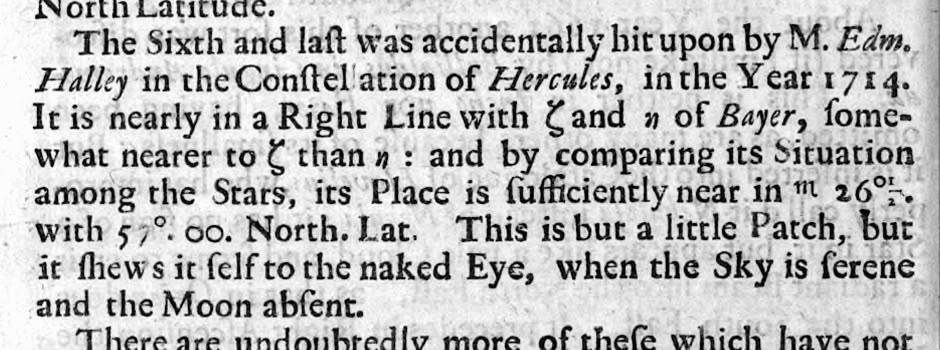
Edmond Halley’s description of his discovery of M13 (referring to himself in the third person), contained in a paper on nebulae published in the Philosophical Transactions of the Royal Society in 1716.