
This constellation first appeared on the Uranographia atlas of Johann Elert Bode in 1801, but it had been suggested to him in 1798 by the French astronomer Joseph Jérôme de Lalande (1732–1807) who wanted to honour the hot-air balloon invented in the 1780s by the Montgolfier brothers. The balloon floated in the sky south of the zodiacal constellation Capricornus, next to the tail of Piscis Austrinus, the southern fish, which was shortened to accommodate it. In his Histoire Abrégée de l’Astronomie, Lalande recalled that Nicolas Louis de Lacaille had placed instruments of science and arts among the stars of the southern hemisphere, and explained: ‘I thought the greatest discovery of the French deserved to occupy a place’.
Lalande put his suggestion to Bode at an international astronomical congress held in August 1798 at Gotha, Germany. Bode accepted Lalande’s idea, but in return took the opportunity to propose a constellation of his own to represent Gutenberg’s printing press; this became Officina Typographica. At the time of the Gotha conference Bode had reached Chart XV of his atlas. The hot air balloon appeared on Chart XVI, and the printing press on Chart XVIII. History shows that the printing press has been more influential than the hot-air balloon, but neither remain among the recognized constellations.
Its brightest star, which Bode labelled with a lower case ‘a’ (but looking like a Greek alpha) on his chart in Uranographia (below), was of only magnitude 4.7. This star was originally catalogued by Flamsteed as part of Piscis Austrinus. It has since been transferred to the adjacent Microscopium, where it is known as Epsilon Microscopii; Bode’s Epsilon Microscopii (right of chart below) is now left unlettered. In 2026 the IAU gave the name Aerostaticus to the present-day Epsilon Microscopii.
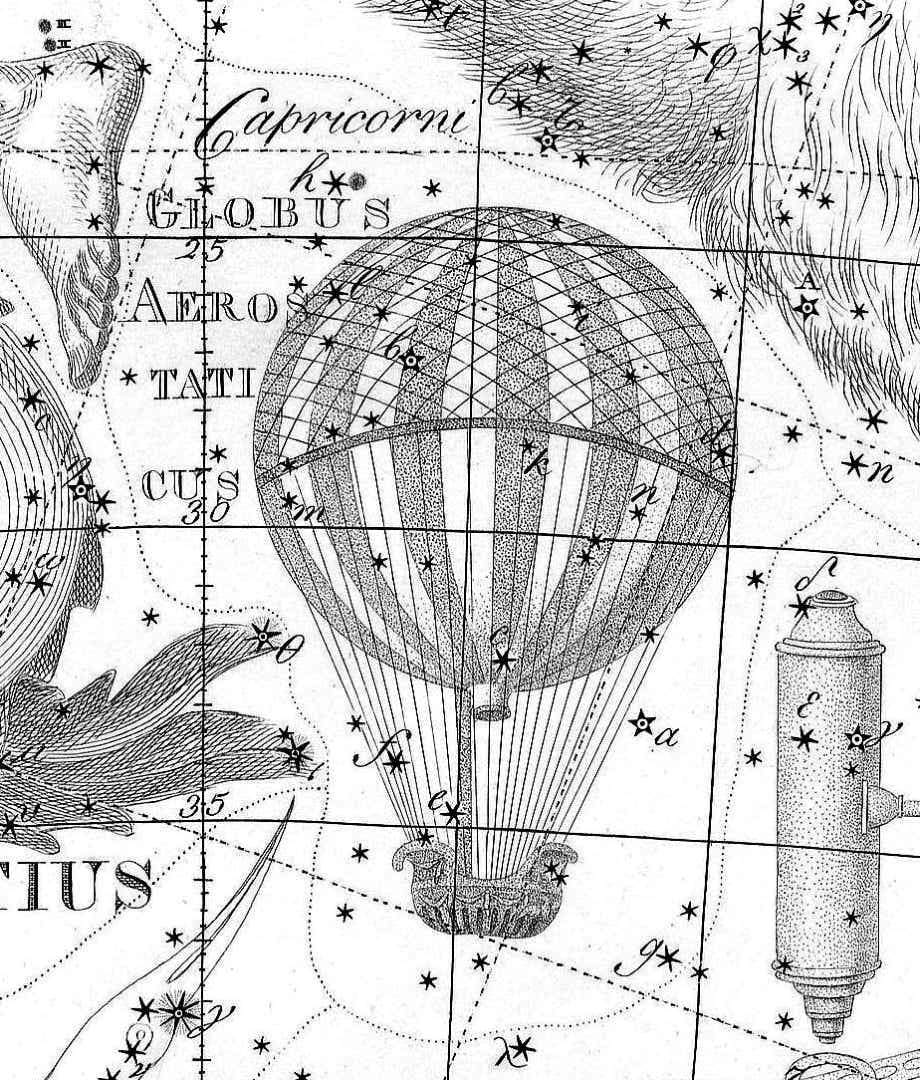
Globus Aerostaticus, rising into the sky with an empty basket, on Chart XVI of the Uranographia of Johann Bode (1801). To the left of the balloon is the tail of the southern fish, Piscis Austrinus, and to the right of it is Microscopium. The left foot of Aquarius is at upper left and Capricornus is at top right.
© Ian Ridpath. All rights reserved