

Invented in 1799 by the French astronomer Joseph Jérôme de Lalande (1732–1807), Felis consisted of a scattering of faint stars between Hydra to the north and Antlia to the south. Lalande did not himself depict the constellation on any globe or chart but suggested it to Johann Bode, who first showed it on on Chart XIX of his Uranographia atlas of 1801 (see illustration). Its brightest stars were of only 5th magnitude and now belong to Hydra.
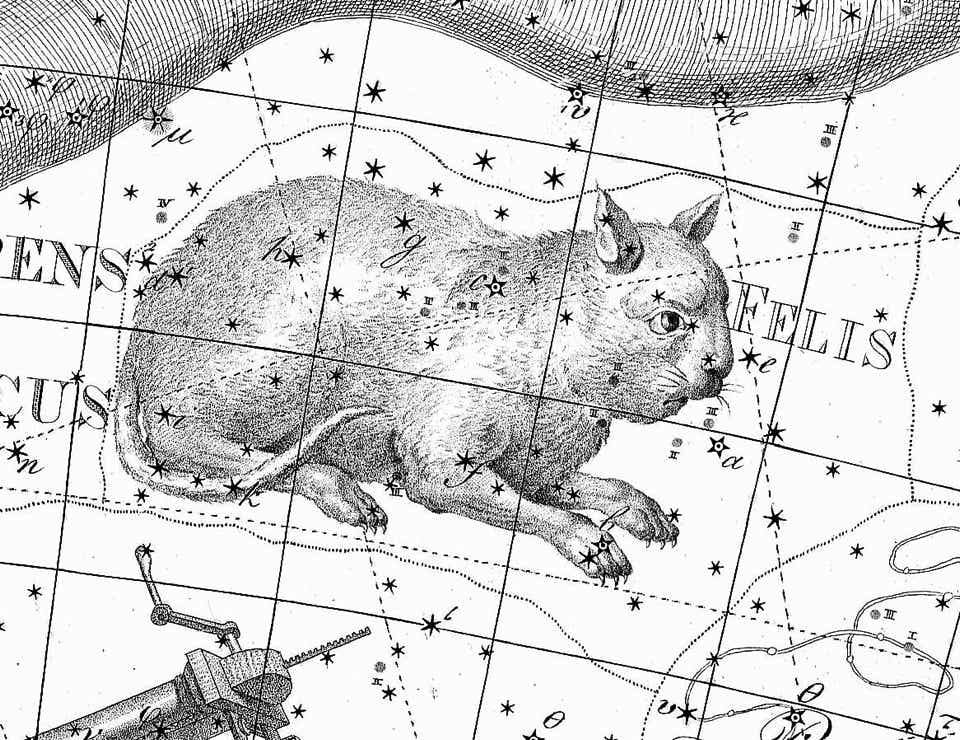
A grumpy-looking Felis on Chart XIX of the Uranographia of Johann Bode (1801).
The cat crouches under the snaking body of Hydra (top), with Antlia beneath it
and Pyxis at lower right. The star labelled with the letter c in the cat’s shoulder is now named Felis in memory of the constellation.
Lalande had supplied many star positions to Bode for his atlas and catalogue, including those in this area, and felt that this gave him the right to suggest some new constellations. As Lalande noted in his Histoire Abrégée de l’Astronomie: ‘There were already thirty-three animals in the sky; I added a thirty-fourth, the cat’. He said he was inspired by a recent poem on cats by Claude-Antoine Guyot-Desherbiers.
In his book Star Names, Their Lore and Meaning the American historian R. H. Allen quotes Lalande as saying: ‘I am very fond of cats. I will let this figure scratch on the chart. The starry sky has worried me quite enough in my life, so that now I can have my joke with it.’ Allen gave no reference, but his source was probably Ludwig Ideler’s Untersuchungen über den Ursprung und die Bedeutung der Sternnamen (Berlin, 1809), p. 367. (Thanks to Robert van Gent of Utrecht University, Netherlands, for pointing this out.)
The original quotation, in imperfect German, was from a letter by Lalande that appeared in Allgemeine Geographische Ephemeriden (A.G.E.), vol. 3 (1799), p. 623. A fuller and more accurate translation might be:
‘I have inserted between the Ship and the Cup a new constellation, a Cat… I greatly love these animals… I will have it engraved on the charts; the starry sky has tired me enough in my life [he was by then in his late sixties] that I can now have my fun with it.’
Other astronomers proved less susceptible to feline charms and the cat eventually vanished into the night. However, a faint trace of it can still be found. A 5th-magnitude star that lay in the cat’s body, labelled with a lower case letter c by Bode and later given the catalogue number HR 3923, was named Felis by the International Astronomical Union in 2018. So Lalande’s wish to commemorate the cat was finally officially granted.
© Ian Ridpath. All rights reserved
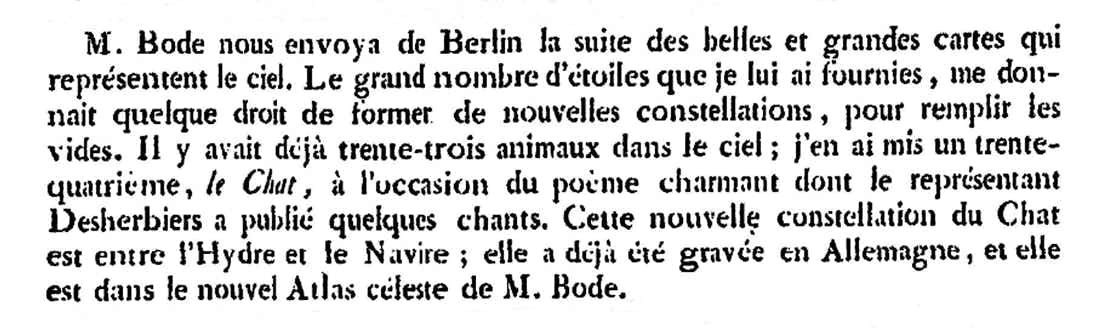
Lalande’s description of how he suggested adding Felis to Bode’s atlas, from his Histoire Abrégée de l’Astronomie of 1803.