

Genitive: Camelopardalis
Abbreviation: Cam
Size ranking: 18th
Origin: Petrus Plancius
One of the most unlikely animals to be found in the sky is a giraffe. The Greeks called giraffes ‘camel leopards’ because of their long necks and spots, which is where the name Camelopardalis comes from. However, the constellation Camelopardalis was not invented by the Greeks but by the Dutch theologian and astronomer Petrus Plancius in 1612. Plancius first showed it on a celestial globe in that year along with another odd constellation that is still recognized, Monoceros.
Plancius used the same name for the constellation as we do, but on some old maps the name is also written as Camelopardalus or Camelopardus – Hevelius and Bode both used the former variant, for example (Bode’s depiction is shown below). For a discussion of the correct spelling, see Harvard College Observatory Circular 146 (1908).
Camelopardalis lies in the far northern sky between the head of the Great Bear and Cassiopeia, an area that was left blank by the Greeks because it contains no stars brighter than fourth magnitude (the gap can be clearly seen on Dürer’s chart of 1515). Johannes Hevelius, though, was not put off by the constellation’s faintness; he catalogued 32 stars in Camelopardalis and devoted a whole plate to it in his atlas of 1690, thereby ensuring its general acceptance.
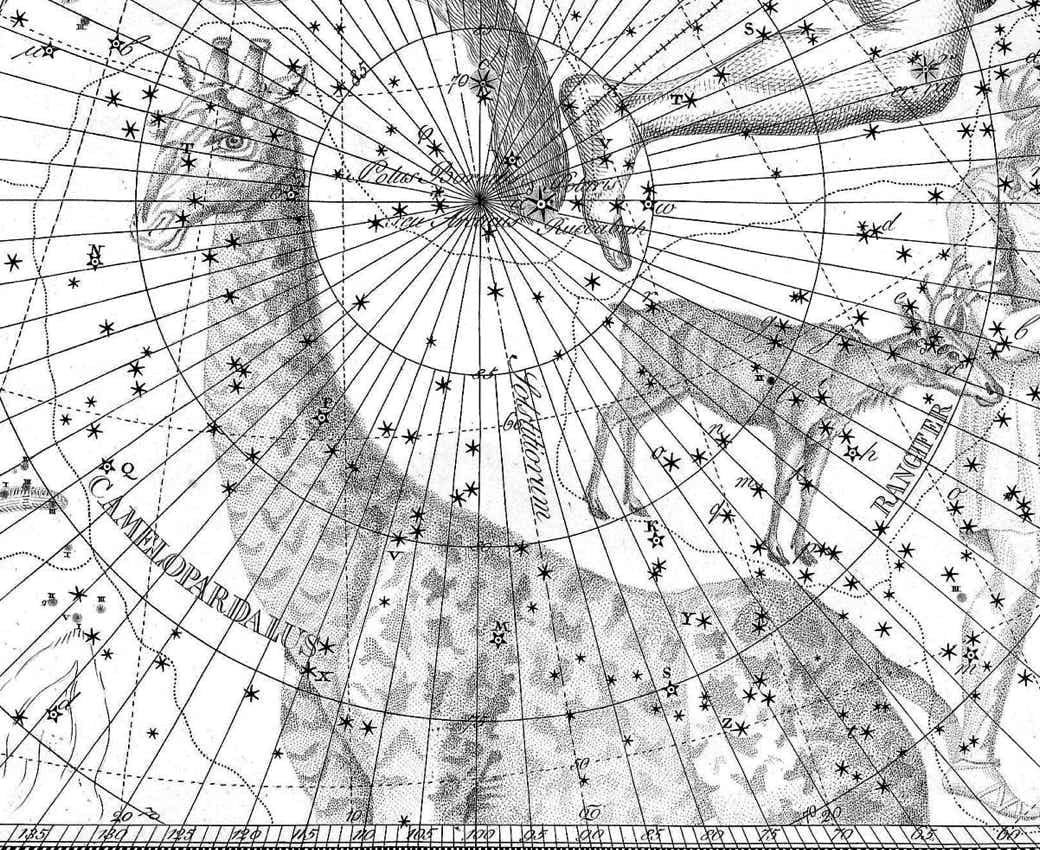
The top half of Camelopardalis, shown on Chart III of the Uranographia atlas of Johann Bode (1801). Above it is the now-obsolete constellation of Rangifer, the reindeer.
The exact significance of the constellation is unclear. The German astronomer Jacob Bartsch included Camelopardalis on his map of 1624, which was its first appearance in print as distinct from on a globe. (In his classic book Star Names, the American historian R. H. Allen gives the date of Bartsch’s depiction of Camelopardalis as 1614, but that is a misprint for 1624.) Bartsch interpreted it as the camel on which Rebecca rode into Canaan for her marriage to Isaac, as told in Chapter 24 of the book of Genesis. But Camelopardalis is a giraffe not a camel, so Bartsch’s explanation is unsatisfactory. Bartsch seems not to have known much about this constellation, for he wrongly attributed its invention to Isaac Habrecht of Strasbourg, who had shown it on his star globe of 1621.
Its three brightest stars were labelled Alpha, Beta, and Gamma by the English astronomer Francis Baily in his British Association Catalogue of 1845. By modern measurements Beta is magnitude 4.0 and Alpha is 4.3, so this is one of the constellations in which Alpha is not the brightest star.
Chinese associations
When the Chinese constellations became established around 1600 years ago the north celestial pole lay in northern Camelopardalis, an area where there are few naked-eye stars. The closest star of any note to the pole at that time was Struve 1694 (also catalogued as HR 4893), a mere 5th magnitude. To the Chinese, who were not unduly troubled by its faintness, Struve 1694 was grandly known as Tianshu, the Celestial Pivot, or Niuxing, the Pivot Star.
Struve 1694 was the most northerly member of an arc of five stars called Beiji, the North Pole Office, representing the Emperor and his immediate family; the other members of the chain were over the border in Ursa Minor. Four other faint stars around Struve 1694, identities uncertain, formed the constellation Sifu, representing four advisors to the Emperor.
Many star identities and positions in this area are confused, but some can be made out with a degree of certainty. In the southern part of the constellation, Beta Camelopardalis was part of a group of eight stars called Bagu, representing eight types of grain, which extended southwards to Xi and Delta Aurigae. Chuanshe, the guest houses, spread into western Camelopardalis from Cassiopeia.
Alpha and two other unnamed stars in Camelopardalis formed part of the western wall enclosing the Central Palace (or Purple Palace Enclosure), as the Chinese termed the north polar region of the sky. This wall started in Draco and passed through Ursa Major into Camelopardalis.
© Ian Ridpath. All rights reserved
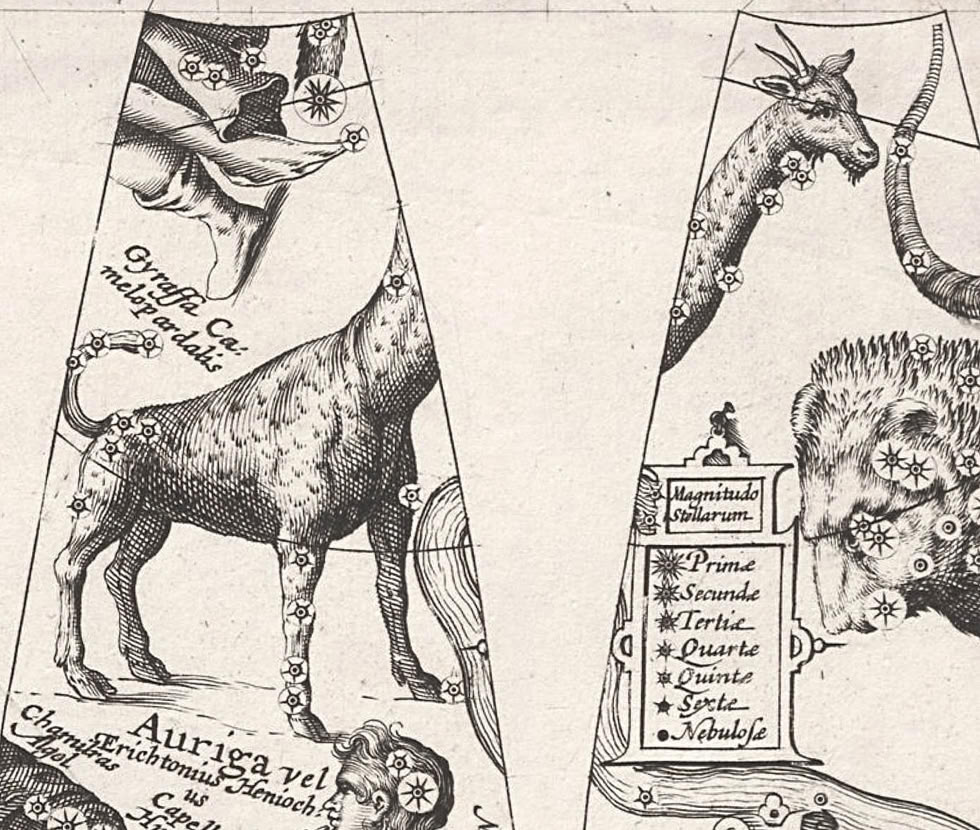
Camelopardalis stretches its neck across two gores of the 1612 celestial globe by Petrus Plancius and the Dutch engraver and cartographer Pieter van den Keere (Petrus Kaerius) (1571–c.1646). Being on a globe, the constellations are drawn in reverse from the way they appear in the sky.
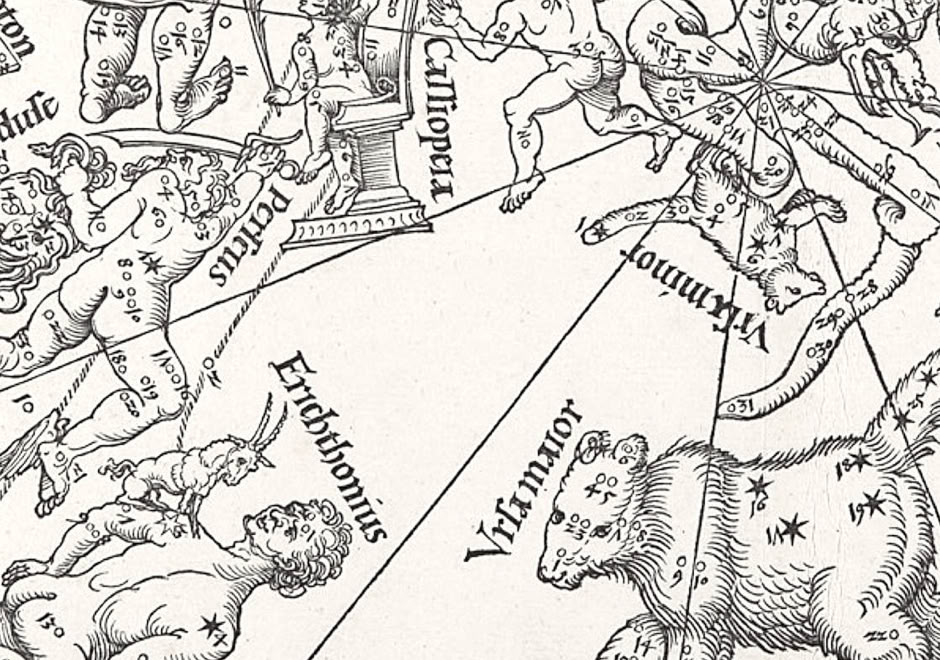
The starless gap between the northern Greek constellations into which Camelopardalis was placed, seen on Albrecht Dürer’s northern celestial hemisphere of 1515. The constellations on this chart are drawn as though on a celestial globe, and so appear reversed.
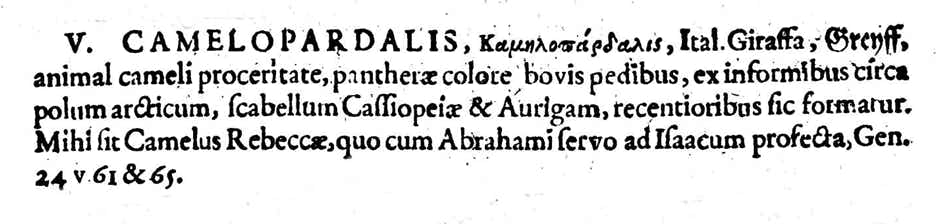
Jacob Bartsch’s entry on Camelopardalis from his book Usus Astronomicus Planisphaerii Stellati of 1624.