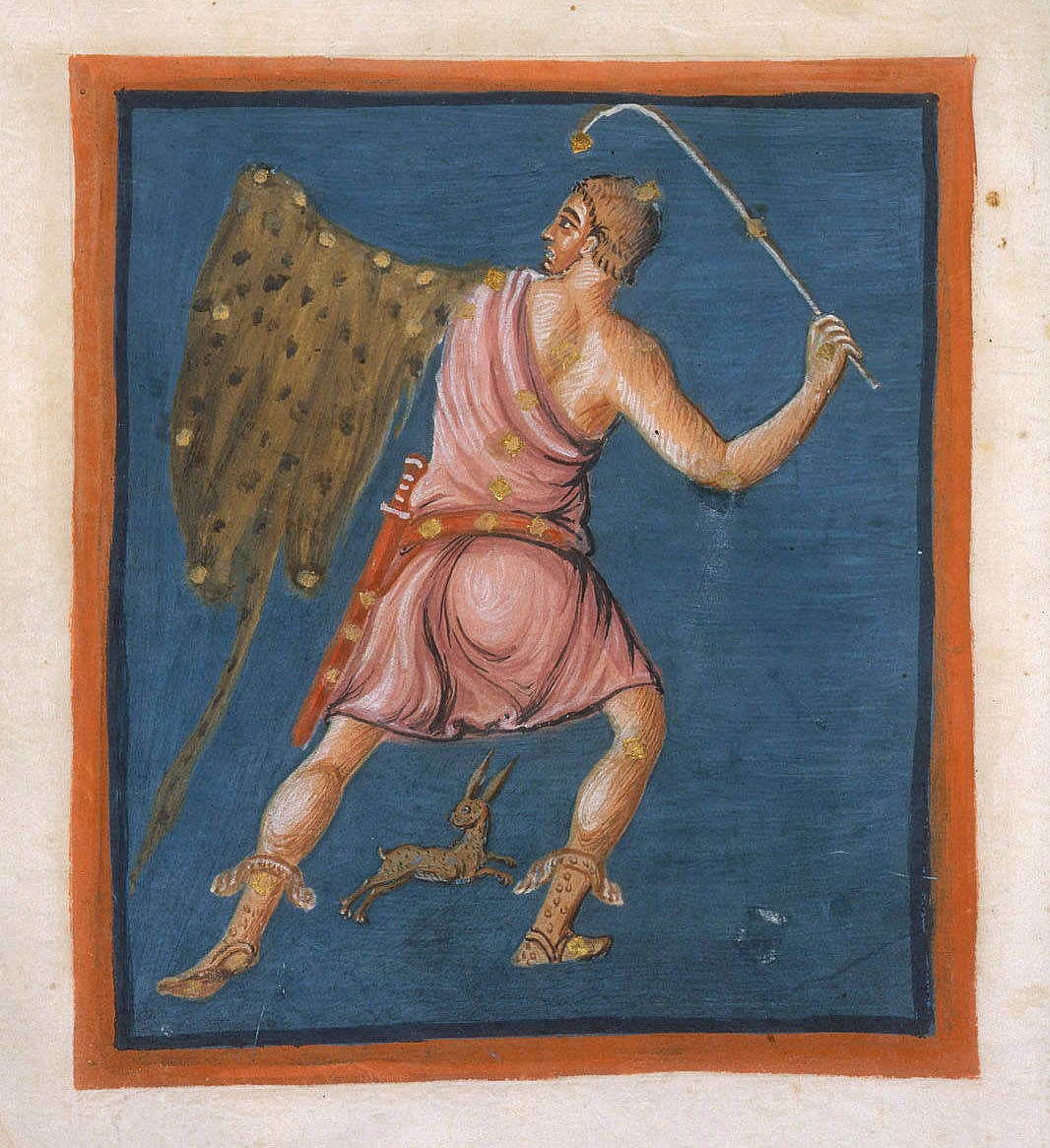
Orion with Lepus the hare at his feet, in an unusual visualization from the Leiden Aratea, c.816.
(Leiden University)
The first artistic depictions of the Greek constellations on paper are found in early medieval illuminated manuscript copies of the works of Aratus and Hyginus. Two famous examples are known as the Leiden Aratea and Harley 647, both dating from the 9th century.
At that time, Ptolemy’s Almagest with its catalogue of a thousand stars was no longer known in Europe, and would not be rediscovered until the 12th century from Arabic sources. All that the illustrators had to go on when drawing the constellations were the generalized descriptions given by Aratus, Eratosthenes, and Hyginus, and the results bear little relation to the constellation figures as described by Ptolemy. Hence the artists’ impressions in these editions of Aratus and Hyginus are only a sidelight in the history of constellation illustration, albeit an attractive one.
Leiden Aratea
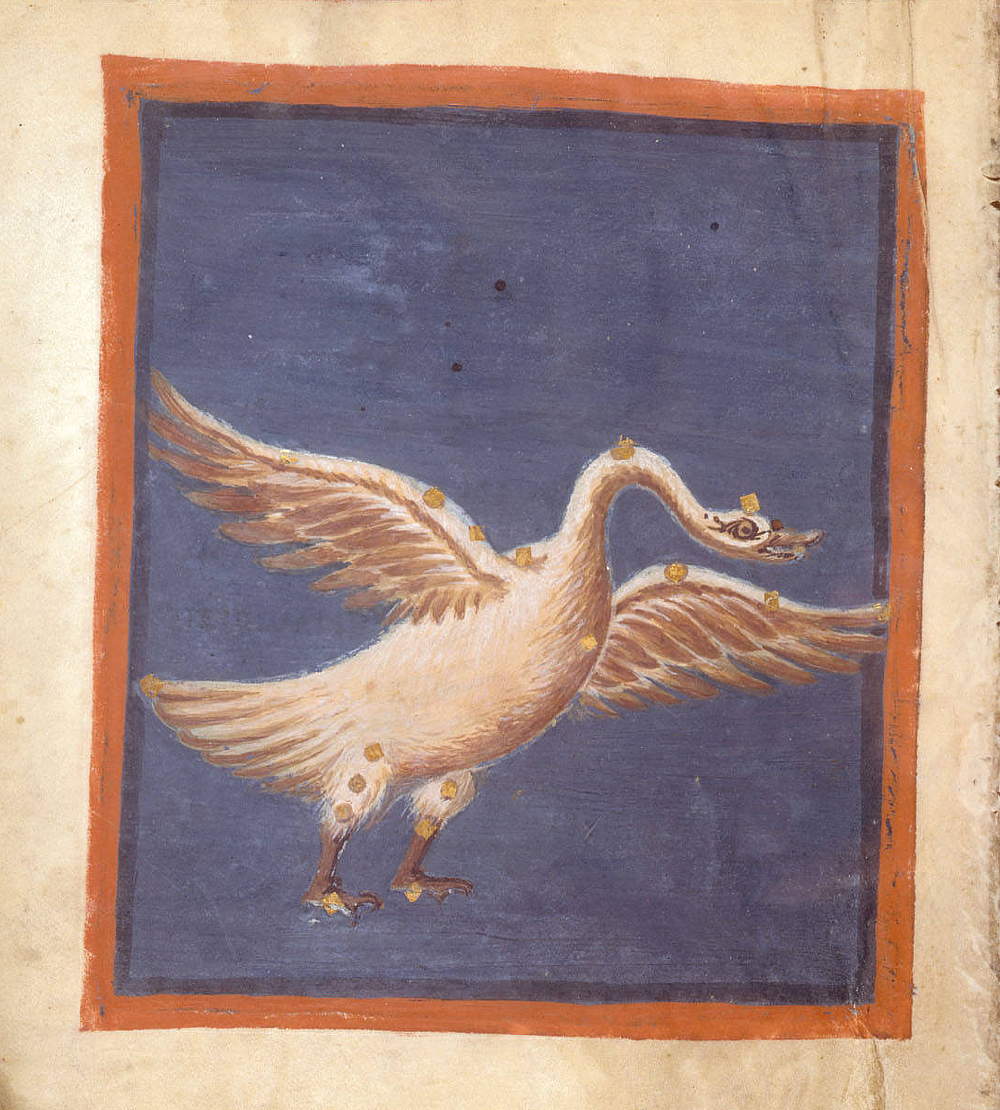
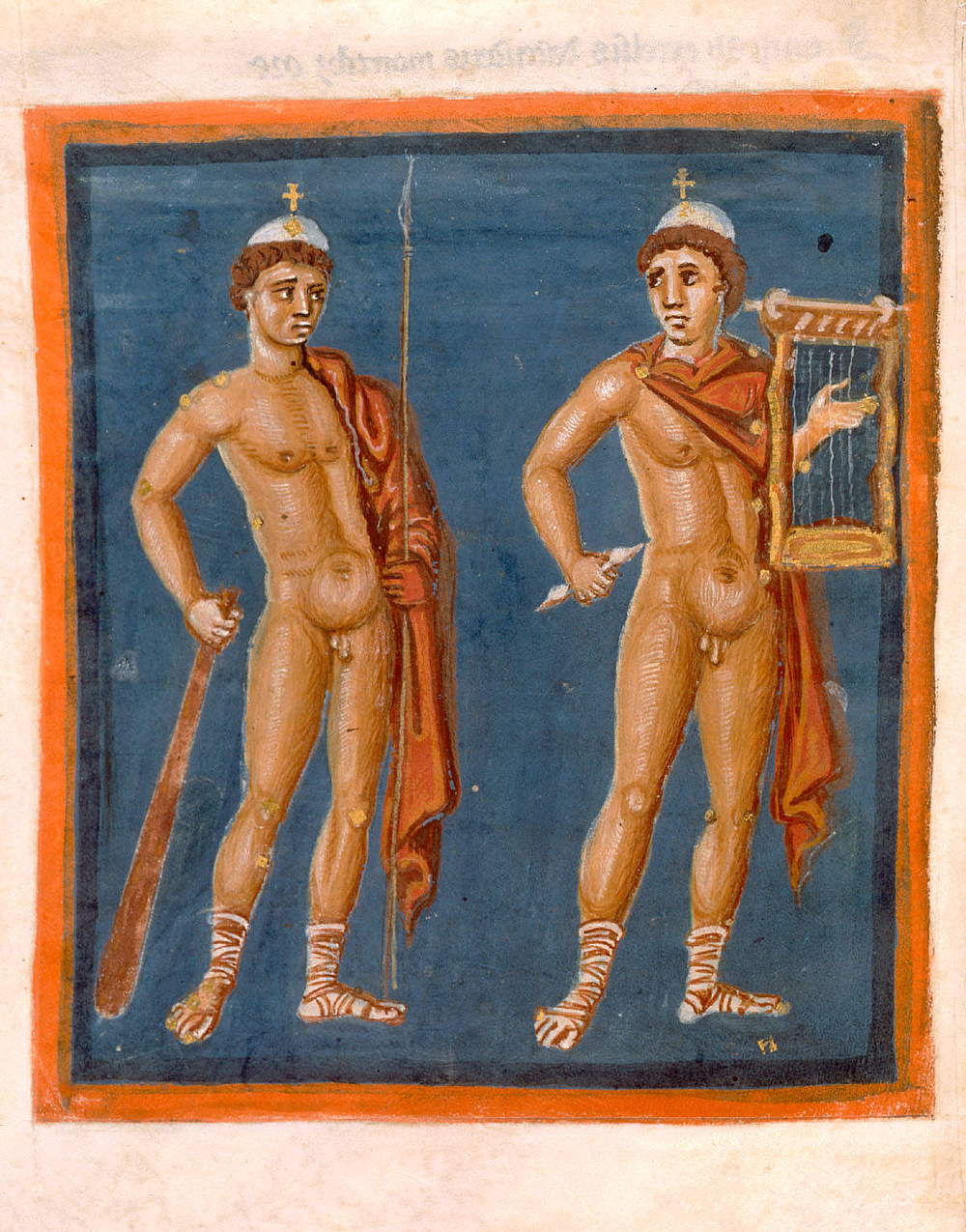
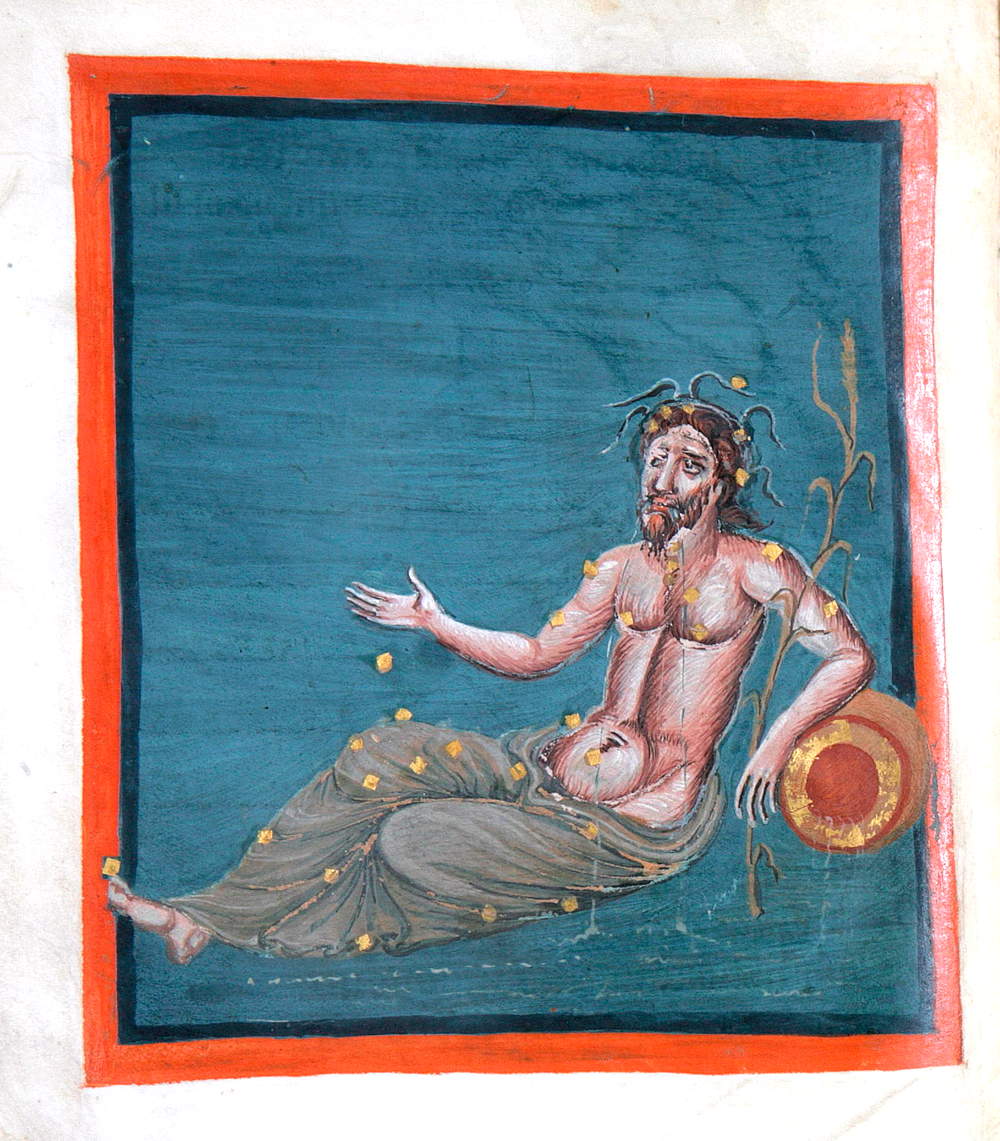
Dated to AD 816, the Leiden Aratea (manuscript VLQ 79) is a copy of Germanicus Caesar’s Latin translation of the Phaenomena of Aratus. It was bought by the University of Leiden in 1690, hence its name. The manuscript is illuminated with full-colour paintings of the constellation figures, but since this is a poem and not a star catalogue the artist has interpreted the figures quite freely, with little concern for the framework of the underlying stars. Cygnus, for example, is unlike the cruciform figure we know today. The bronzed, scantily clad twins of Gemini appear almost comically camp to the modern eye. Eridanus was portrayed not as a river but as a river god. The Leiden Aratea’s version of Orion is shown at the top of this page; in this, the great hunter is seen from behind and reversed left to right, as on a celestial globe.
Cicero’s translation of Aratus
Manuscript Harley 647 in the British Library, London, also dates from the 9th century. It is based on a different Latin translation of the Phaenomena, this one by the Roman philosopher and statesman Marcus Tullius Cicero (106–43 BC). One attractive aspect of Harley 647 is that the constellation figures are filled with text from Hyginus’s Poeticon Astronomicon, as in its visualization of Cygnus. Again, though, the free-form placing of the stars shows that the illustrations in Harley 647 are not intended to be an accurate depiction of the real sky.

These early western manuscripts differed markedly in approach from the Arabic revision of the Almagest called the Book of the Fixed Stars by the Persian astronomer al-Ṣūfī, which first appeared in the 10th century. Al-Ṣūfī’s book (actually a manuscript) was intended as a true scientific representation of the sky. Its constellation images were quite loyal to the Ptolemaic descriptions, with accurately positioned star symbols graded in size according to brightness. The Almagest itself lacked illustrations, so al-Ṣūfī’s Book of the Fixed Stars was the first attempt to depict the constellations as Ptolemy had intended, albeit in an Arabic style.
First printed illustrations
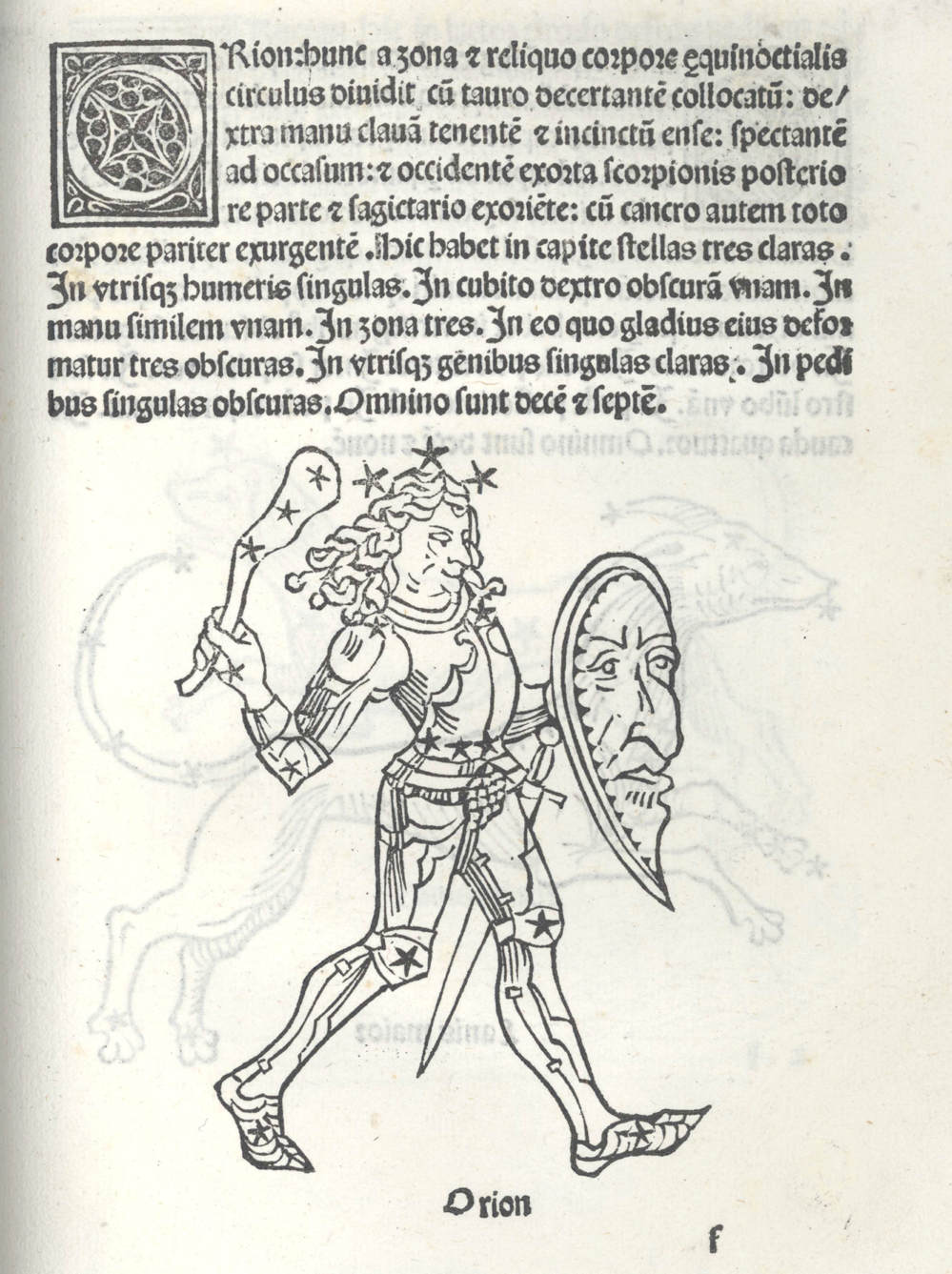
The first printed illustrations of the Greek constellations (as distinct from the earlier hand-drawn ones) appeared in an edition of Hyginus’s Poeticon Astronomicon published by the German printer Erhard Ratdolt in Venice in 1482. Ratdolt commissioned an unknown artist to produce a series of woodcuts to accompany Hyginus’s text. As with the earlier illuminated manuscripts, these artist’s impressions are quite fanciful. Some resemble the existing depictions from manuscripts, whereas others are quite different in character. Orion, for example, is shown as a knight in medieval armour.
A famous printed edition of Aratus’s Phaenomena called Syntagma Arateorum, published in 1600 by the Dutchman Hugo Grotius (Hugo de Groot, 1583–1645), contained engravings based on the illustrations in the Leiden Aratea, which at that time he owned.
None of these illustrations, either in the manuscripts or the printed books, has any coordinate lines and no attempt was made to plot the stars accurately, not even after Ptolemy’s star catalogue had been reintroduced to the west, so they cannot be considered as true star charts. Their intent is decorative rather than astronomical.
© Ian Ridpath. All rights reserved