Petrus Apianus’s planisphere of 1533
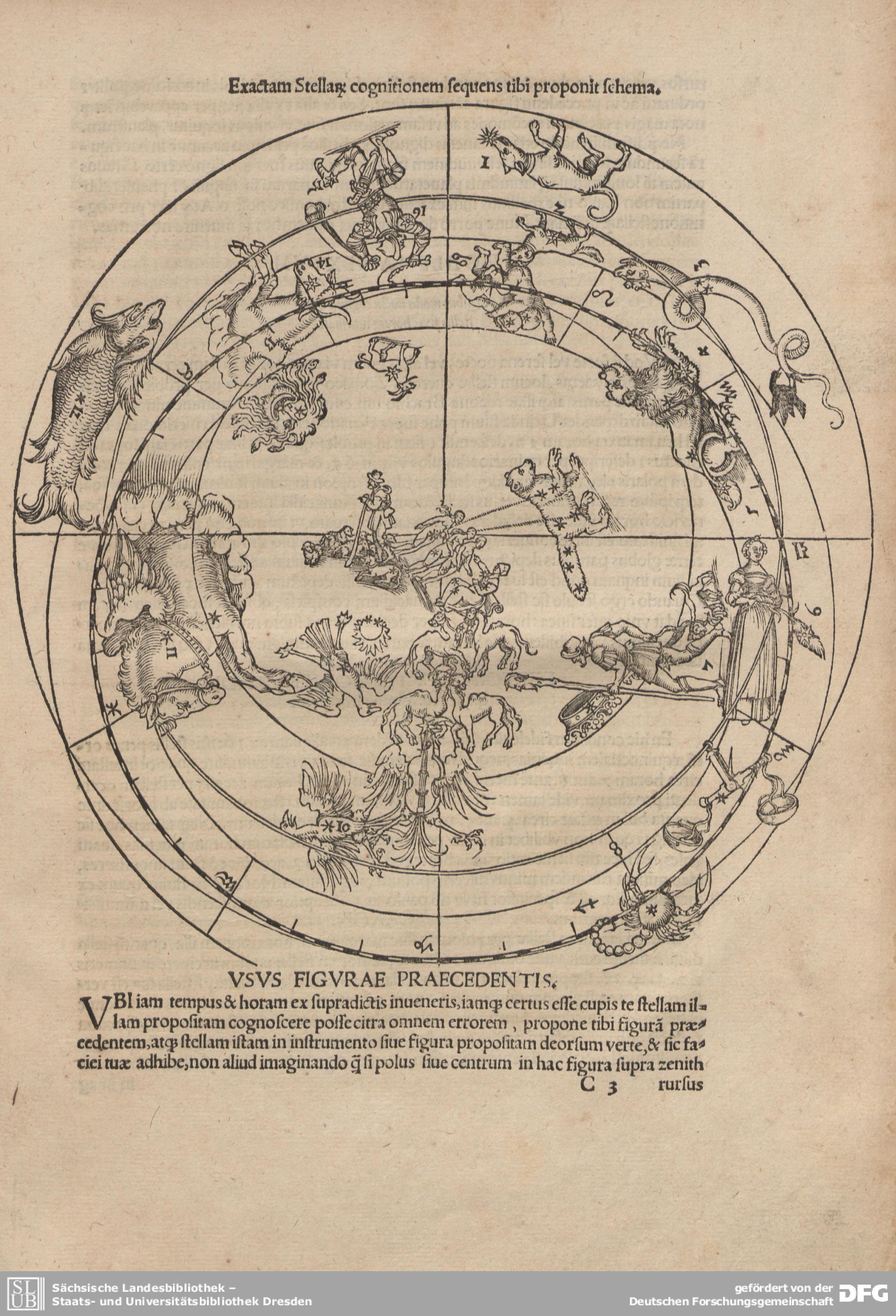
The chart had first appeared as a single sheet under the name Imagines syderum coelestium in 1536, but that version did not have the hand-colouring found in the 1540 book from which the above illustration comes. Although the constellation images were the same on both versions, the typography changed for the 1540 edition, and four more star names were added.
This chart of the northern celestial hemisphere was produced by the German astronomer Petrus Apianus (1495–1552) (also known as Peter Apian). It appeared in two of his books, Horoscopion Apiani Generale (written in Latin) and Instrument Buch (in German), both printed on his own press at Ingolstadt in 1533. The horoscopion of the first book’s title was a form of quadrant he had invented for calculating time and measuring distances and heights. The Instrument Buch, published later the same year, described the use of a wider range of instruments for surveying and navigation. The illustration above comes from the Horoscopion; the version of the chart in the Instrument Buch did not have the Latin text at the bottom.
Only a selection of constellations is shown on the chart because it was intended primarily for finding 16 reference stars around the ecliptic, numbered as follows: 1, Sirius; 2, Procyon; 3, Alphard; 4, Regulus; 5, Denebola; 6, Spica; 7, Arcturus; 8, Antares; 9, Vega; 10, Altair; 11, Markab; 12, Baten Kaitos; 13, Pleiades; 14, Aldebaran; 15, Rigel; 16, Betelgeuse. A few additional bright stars were included on the chart but not identified, such as Deneb in Cygnus, Algol in Medusa’s head, Capella in Auriga, Alphecca in Corona Borealis, and of course the seven stars of the Plough. But what makes this chart particularly remarkable is that in the north polar region it includes a selection of Arabic constellations, garnered from the Book of the Fixed Stars by the tenth-century Persian astronomer Ἁbd al-Raḥmān al-Ṣūfī. It is the only known European depiction of Arabic constellations.
Apianus’s Arabic constellations
For example, Apianus knew from al-Ṣūfī's book that the Arabs called the seven stars of the little bear Banāt Na’sh al-Ṣughrā, the Daughters of the Smaller Bier, or coffin. He incorporated this idea by depicting a line of three girls, each marked by a star in the tail of the little bear, but for some reason replaced the bier with a seated woman, presumably their mother, pointing at them. Next to this family of mourners, a shepherd (Gamma Cephei) and his dog (Rho Cephei) keep watch over six sheep in the area of Cepheus. Our name Errai for the star Gamma Cephei comes from the Arabic al-rā’ī meaning ‘the shepherd’.
In the area of the head of Draco, between Ursa Minor and Lyra, stands a group of four mother camels protecting their young, from another Bedouin folk tale. The four mothers are represented by the stars Beta, Gamma, Nu, and Xi Draconis. On the right, Apianus depicted Boötes holding two dogs on a leash, a precursor to Hevelius’s introduction of Canes Venatici a century and a half later. As the constellation historian Paul Kunitzsch has shown, these dogs came about from a mistranslation of a word in al-Ṣūfī’s book and are not an Arabic invention at all. There is, though, no known explanation for the tiara-shaped figure above the wing of Cygnus.
These Arabic constellations did not feature on Apianus’s later charts of 1536 and 1540, nor indeed any others of the time. Why he chose to include them on this map remains a mystery.
Reference: Paul Kunitzsch, ‘Peter Apian and Azophi: Arabic constellations in Renaissance astronomy’, Journal for the History of Astronomy, 18 (1987), 117–124.
© Ian Ridpath. All rights reserved
◄ Back to Star Tales – Boötes with two dogs depicted by Petrus Apianus