Ernst Julius Öpik
Ernst Öpik (1893–1985) was an Estonian astronomer who moved to Armagh Observatory, Northern Ireland, in 1948 and remained there for the rest of his life. His speciality was the minor bodies of the Solar System – asteroids, comets, and meteors – which at the time were an unfashionable area of study. In 1932 he proposed that comets originate in a cloud orbiting at the edge of the Solar System; this is now known as the Oort Cloud, after the Dutch astronomer Jan Oort who revived the idea. His grandson Lembit Opik is a British politician who has helped draw attention to the dangers posed to the Earth by collisions with asteroids.
1986 Mauritania
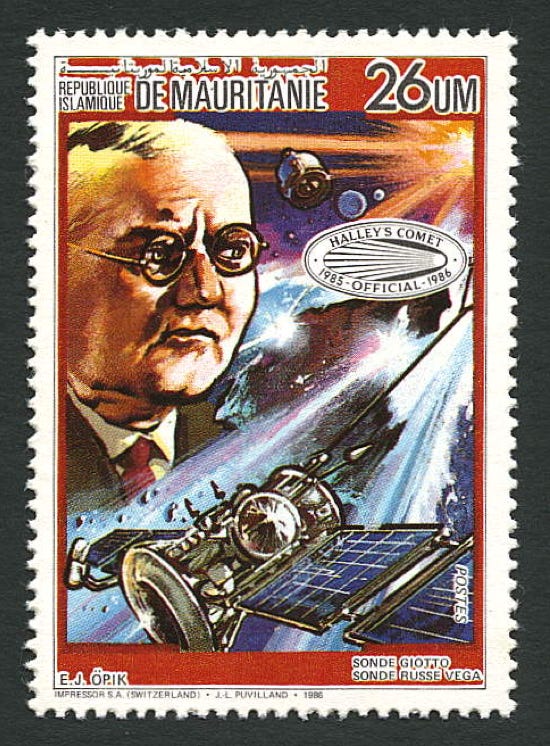
Öpik appeared on one of the four members of a Halley’s Comet set issued by the African republic of Mauritania in 1986. In the foreground is one of the twin Russian Vega probes heading for the nucleus of the comet, with the European Giotto probe in the distance towards the top.
Stanley Gibbons no. 866
1995 Mali
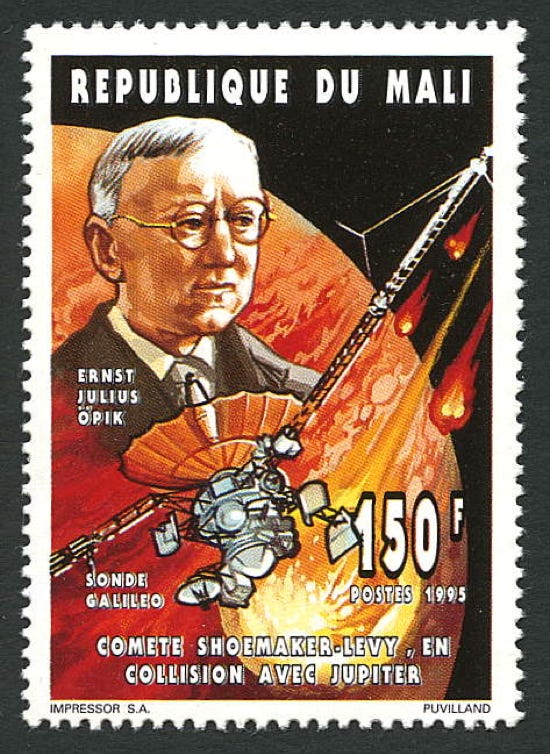
In 1995 the African republic of Mali issued a series of stamps commemorating various anniversaries and events. The lowest value member of the set recalled the impact of Comet Shoemaker–Levy 9 with Jupiter the previous year. Also shown is NASA’s Galileo probe which arrived at Jupiter at the end of 1995, with Öpik above.
Stanley Gibbons no. 1359