Not-quite astro stamps from pre 1957
These didn’t make it on to my list of oldest astro stamps for the reasons stated
ARGENTINA
SG 827 from 1951, commemorating the 10th anniversary of the state airline, and SG 856 from 1954, commemorating the 50th anniversary of the Argentine Post Office in South Orkney, each have a recognizable Southern Cross in the background, but it is incidental to the composition of the stamp.

SG 827

SG 856
BOLIVIA
SG 511 and 521 from 1951 (not illustrated) depict the so-called Gate of the Sun, but its astronomical connection is doubtful.
CANADA
SG 447 from 1953 (below) has what appears to be an aurora behind the head of a polar bear, but it’s not a substantial part of the design.

SG 447
CHILE
SG 252, 253 from 1934 and SG 296, 297 from 1941 (below) all show an aircraft and the Southern Cross. The 1941 issues might just count but the 1934 design is too stylized. These scans come from the Antonius Ra World collection.
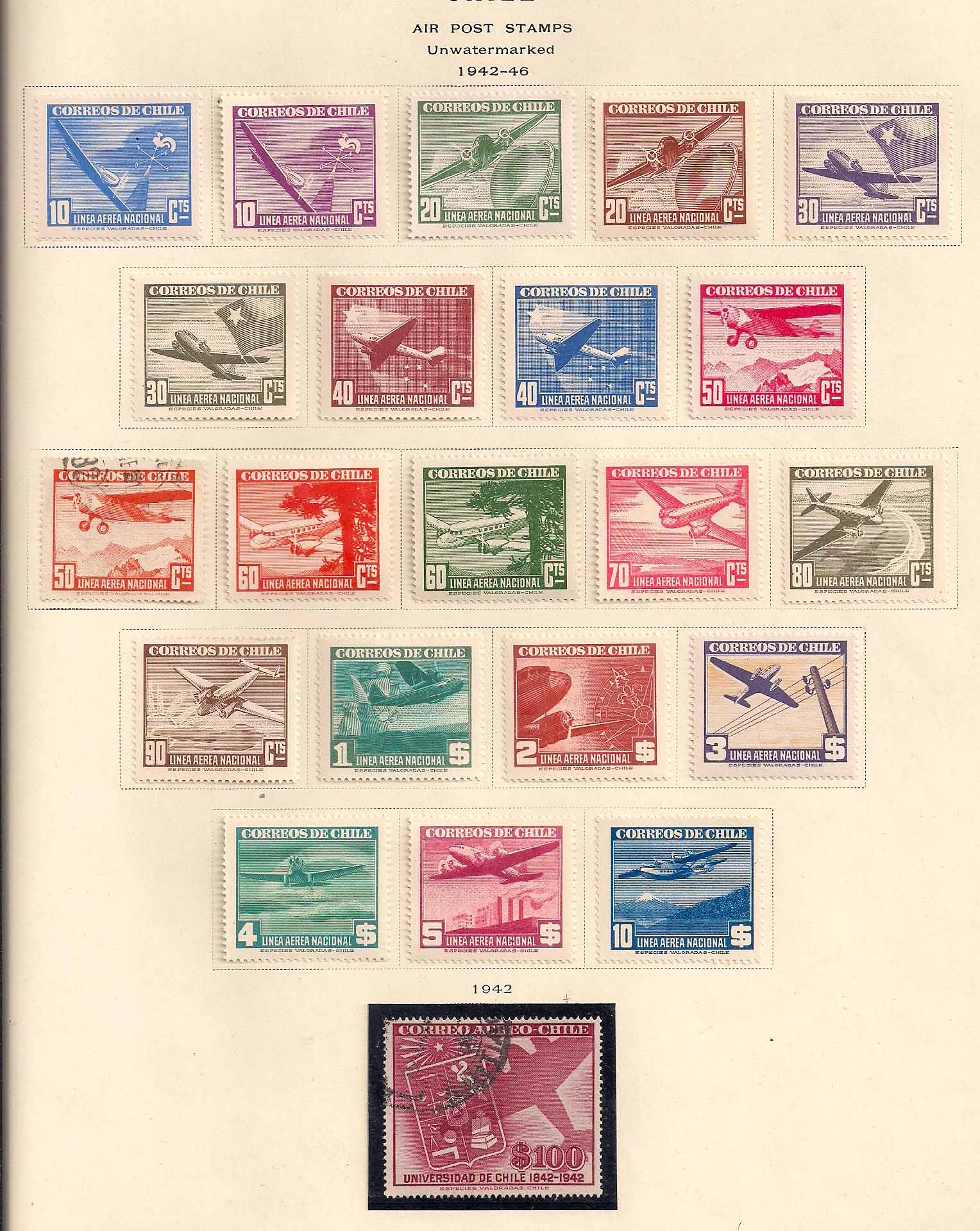
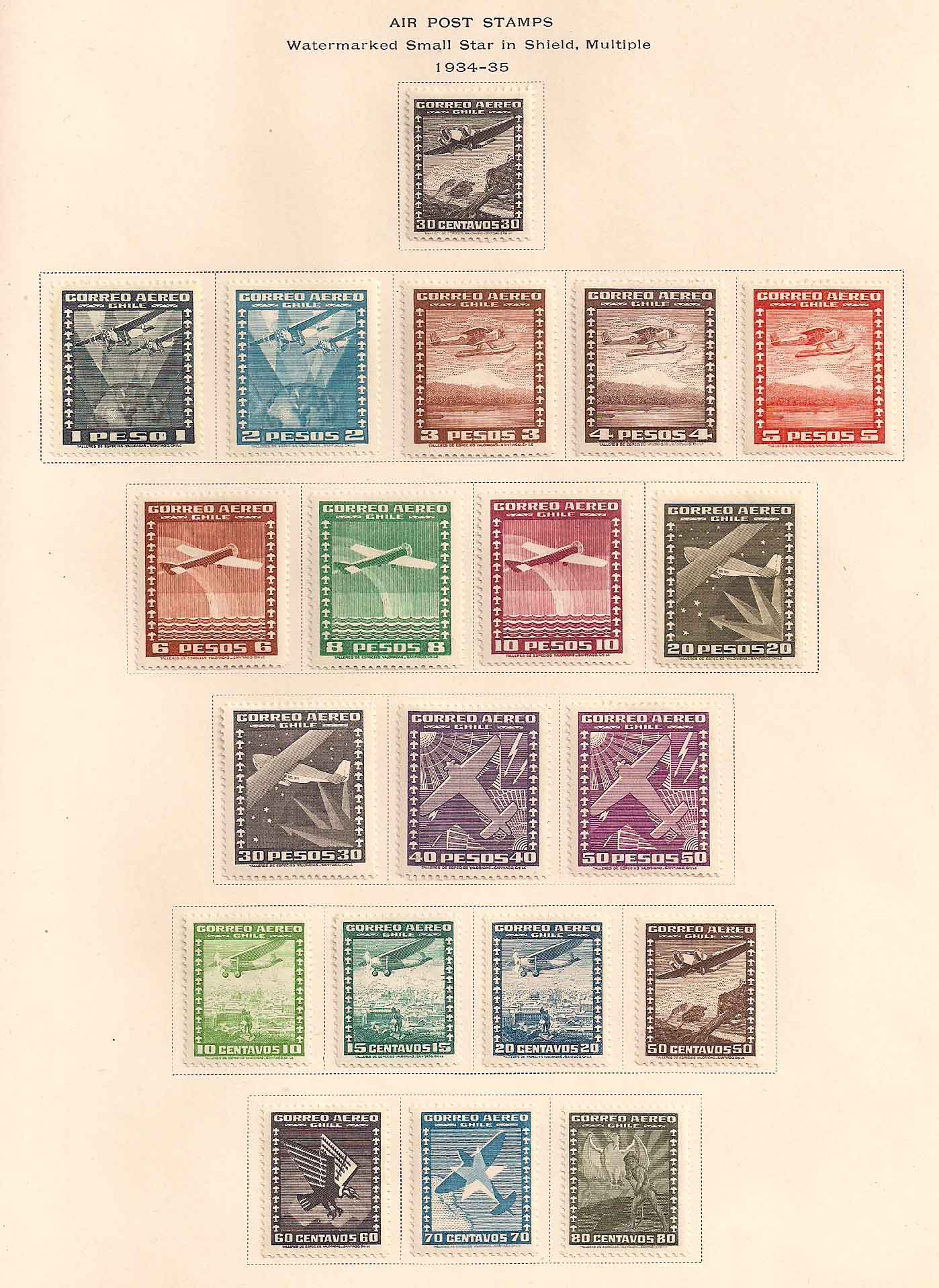
SG 252, 253

SG 296, 297
Another stylized Southern Cross appears on Chile SG 381–3 from 1948 (below), part of a natural history series featuring a range of botanical and zoological designs. The rest of the star pattern appears to be imaginary.
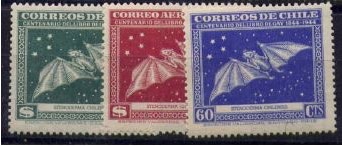
SG 381–3
MEXICO
SG 438 from 1923 (not illustrated) shows what is called the Pyramid of the Sun, while SG 554 (1934) shows the Pyramids of the Sun and Moon, and SG 619 (1938) shows the Chichen Itza ruins, but all these have more to do with religion and ritual than astronomy. The same goes for the Pyramids of Egypt.
RUSSIA
SG 687 from 1935 shows an aurora in the background of an expedition being evacuated from a polar camp, but again it’s not central to the theme of the stamp. This scan comes from stamprussia.com.
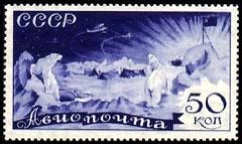
SG 687
A COUPLE OF RED HERRINGS
Judging by the brief catalogue descriptions alone, the following two stamps might appear to deserve categorization as astro stamps – but they are not.
Danzig SG 245 (1936) shows an area of the port now known as Gdansk with a tower that is described in the Gibbons catalogue as an ‘observatory’. This waterside building, which is now an archaeological museum, was a lookout post for monitoring shipping, like a coastguard station, not observing the sky.
Guatemala SG 218 (1926) is described in the Gibbons catalogue as ‘National Observatory’. In fact it is the National Observatory la Aurora, a meteorological (and nowadays also geophysical) observatory, not an astronomical one.
Why no Euler, Hamilton, or Poincaré?
Although these three made contributions to astronomy, they were not primarily astronomers (not even Hamilton, despite being accorded a chair as a professor of astronomy). While they all made it onto stamps, we can conclude that they did so for non-astronomical reasons.