Isaac Newton stamps continued
1987 Russia
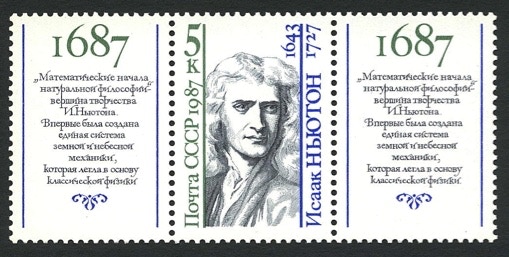
Russia commemorated the 350th anniversary of the Principia with this stamp, part of a set of three honouring famous scientists. The drawing of Newton is based on Godfrey Kneller’s 1689 portrait. Attached to the stamp are two identical labels, the wording on which says: ‘Mathematical Principles of Natural Philosophy, the greatest work of I. Newton. For the first time a unified system of terrestrial and celestial mechanics was constructed, which became a basis of classical physics.’
Stanley Gibbons no. 5802
1993 Germany
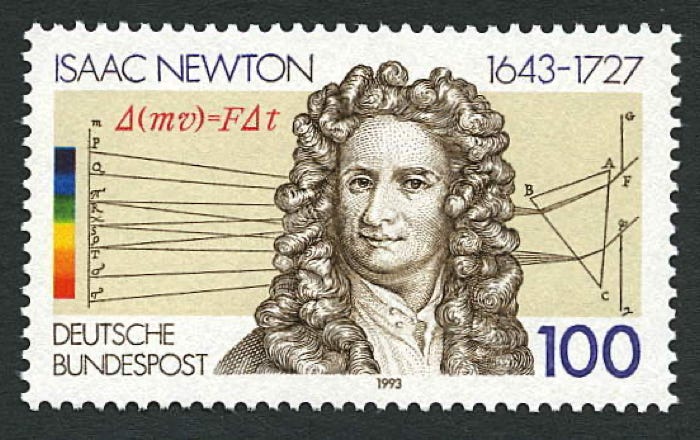
This German stamp commemorates Newton’s 350th birthday. Behind a sketch of Newton is shown the famous experiment in which he passed rays of light through a prism to form a spectrum. The equation is the mathematical expression of Newton’s second law of motion concerning acceleration produced by a force.
Stanley Gibbons no. 2495
1993 North Korea
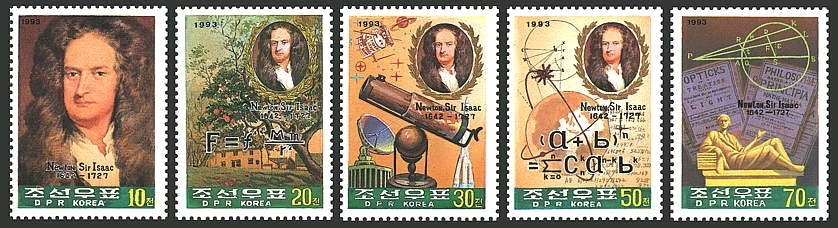
A beautiful set, let down slightly by indifferent colour printing, issued in 1993 to mark the 350th anniversary of Newton’s birth the preceding year. From left, the stamps show: 10ch, the familiar 1702 portrait of Newton by Sir Godfrey Kneller, from the National Portrait Gallery in London; 20ch, the famous apple tree in the garden of his cottage at Woolsthorpe, Lincolnshire, overlain with the formula of the law of gravitation; 30ch, Newton’s reflecting telescope with a rocket (Russian), stylized satellite and tracking dish; 50ch, formula of the binomial theorem over a diagram of satellites orbiting the globe; 70ch, pages from Opticks and the Principia behind Newton’s monument in Westminster Abbey, London. This monument shows a reclining figure of Newton resting his right arm on a pile of books representing his great works. The stamps were also issued in two souvenir sheets of three stamps, the 10ch value being repeated on each.
Stanley Gibbons nos. N3334–8
2000 Burundi
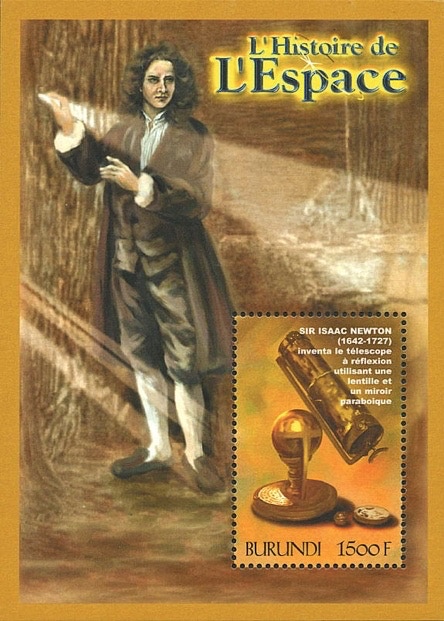
Newton is here shown performing his famous experiment of dividing white light into a spectrum by passing it through a prism, which convinced him that the optical defect of chromatic aberration could not be overcome and led him to design and build the first reflecting telescope. Newton’s reflector is shown on the stamp itself which is inset into this souvenir sheet from the central African country of Burundi. The sheet is not listed by Stanley Gibbons and thus has no SG number.