Caroline Herschel
Caroline Lucretia Herschel (1750–1848) was the sister of the German-born astronomer William Herschel, and the first woman astronomer to gain recognition in her own right. For ten years she worked as her brother’s assistant in England, helping to grind mirrors, record his observations and prepare them for publication. In 1782 she began her own observations, discovering a total of eight comets and several nebulae.
Redonda, 1986
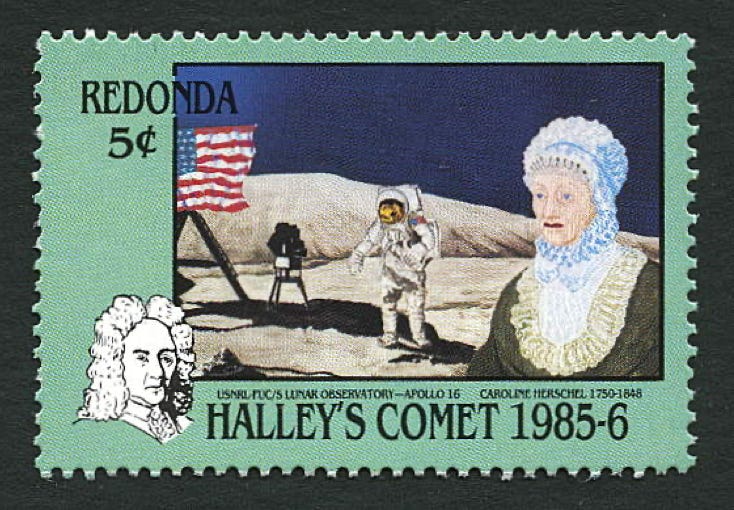
Caroline Herschel appears on this stamp from Redonda, issued in 1986 as part of its Halley’s Comet set. Somewhat absurdly, she shares the stamp with an Apollo 16 astronaut using an ultraviolet camera on the Moon for celestial photography. The image of Caroline is based on a portrait of her painted by Martin Tielemans in 1829, when she was 79.
Redonda itself is something of an oddity, being a small, uninhabited island 40 km southwest of Antigua in the Caribbean. Stamps were issued from 1979 to 1991 in anticipation of commercial and tourist development which never materialized. The stamps were valid in Antigua but are not recognized by Stanley Gibbons and hence have no catalogue number.
Guyana, 1991
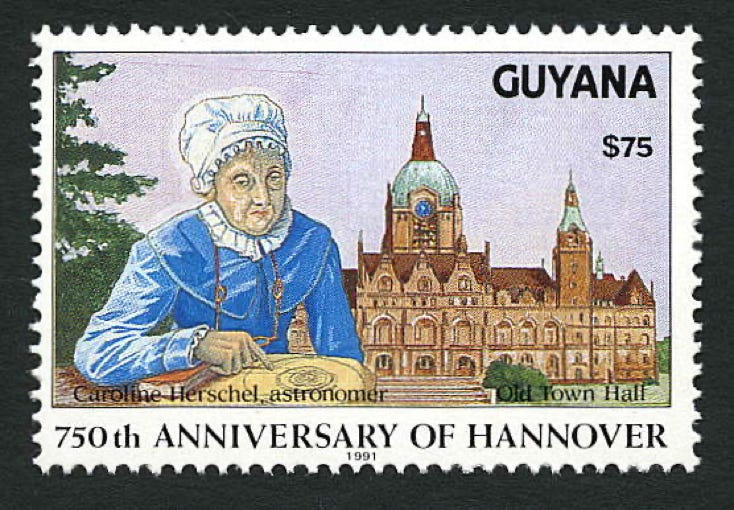
In 1991 Guyana depicted Caroline Herschel in a set of 18 devoted to anniversaries. The anniversary in this case was the 750th anniversary of her home town of Hannover, the Town Hall of which is shown in the background. (Although the stamp says it is the Old Town Hall, it is clearly the New Town Hall.)
The drawing shows Caroline pointing at the orbit of one of the comets she discovered on a map of the Solar System, and is copied from a portrait made in Hannover in 1847, the year before she died.
Caroline Herschel’s stamp is the only one in the set with a scientific theme.
Stanley Gibbons no. 3215