John Harrison
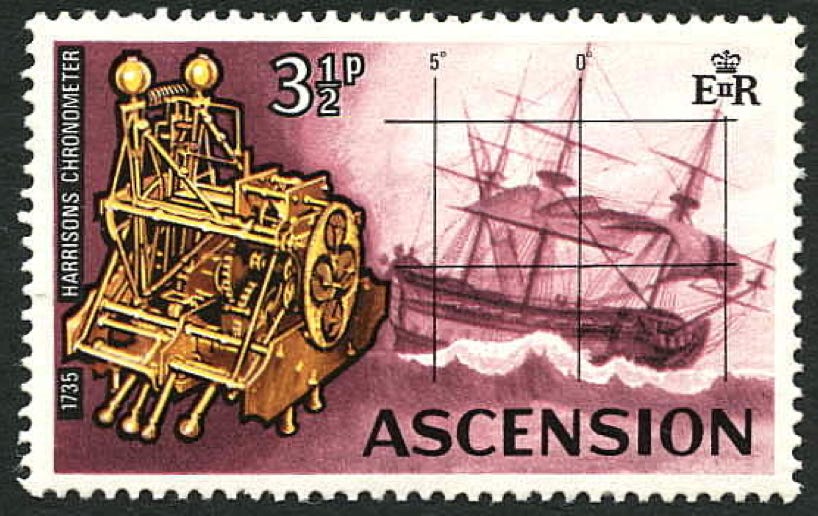
Ascension, 1971
John Harrison (1693–1776) was an English instrument-maker who invented the marine chronometer for finding longitude at sea. Seeking to win a £20,000 prize offered by the British government, Harrison developed a series of chronometers between 1735 and 1761. The stamp above, one of a classic set from Ascension Island on the history of astronomy and space travel, shows the first Harrison chronometer, completed in 1735. The ship depicted is named as the frigate HMS Deptford, on which the fourth and most successful chronometer, called H4, was tested on a voyage to the West Indies and back in 1761–62 with Harrison’s son William on board.
Harrison’s achievements are recognized on several British stamps, such as the Marine Timekeepers set from 1993.
Stanley Gibbons no. 140