Edmond Halley
Edmond Halley (1656–1742) was an English astronomer best known for his prediction, published in 1705, of the return of the comet that is now named after him. He had previously produced the first telescopic catalogue of the southern stars while in his early twenties, and collaborated with Isaac Newton on the publication of the Principiain the 1680s. In 1718 Halley discovered the proper motion of several bright stars by comparing their modern positions with those in ancient catalogues. Hence much of his greatest work had already been done when he was appointed Britain’s second Astronomer Royal in 1720, a post which he filled until his death in 1742. He also made fundamental contributions to geophysics.
The return of Halley’s Comet in 1985–86 produced a flood of stamps depicting Halley, but prior to that he had featured on only one issue, from St Helena, shown below.
St Helena, 1977
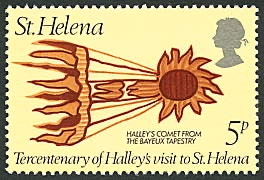
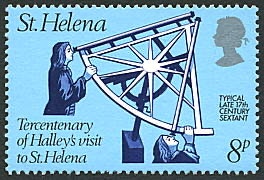
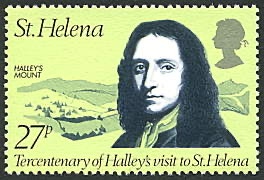
While still a student at Oxford University, Halley began to observe with the newly appointed Astronomer Royal, John Flamsteed, as a result of which he formed the ambition to map the southern stars below the horizon from England. Without bothering to take his degree, Halley sailed in November 1676 for the British-owned island of St Helena in the South Atlantic ocean. There he produced a catalogue of 341 stars which he published on his return to England in 1678, along with a chart of the southern heavens.
On the 300th anniversary of his trip to St Helena, the island issued the three stamps above. The 5p value shows Halley’s comet as it appeared on the Bayeux Tapestry. The 8p stamp shows what is described as a ‘typical late 17th-century sextant’, equipped with telescopic sights, of the kind which Halley and his assistant used to measure the angular distances between pairs of stars. The 27p stamp shows Halley in front of Halley’s Mount, a peak on one of the island’s central ridges where he set up his observatory.
Stanley Gibbons nos. 335–337
St Helena, 1986
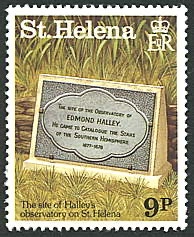
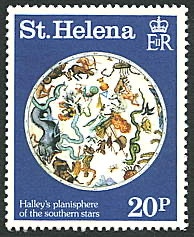
St Helena returned to the theme of Halley’s visit for their Halley’s Comet set in 1986. The 9p stamp depicts the plaque where Halley had his observatory – the wording on the plaque says ‘The site of the observatory of Edmond Halley. He came to catalogue the stars of the southern hemisphere 1677–1678’. The 20p stamp shows Halley’s chart of the southern stars, including the now-defunct constellation Robur Carolinum, Charles’s Oak, which he invented to honour King Charles II. Two other members of the set, not shown here, depicted Halley himself and the ship Unityon which he sailed to the island at the end of 1676.
Stanley Gibbons nos. 482, 484 (nos. 483 and 485 not shown)