Sir Arthur Eddington
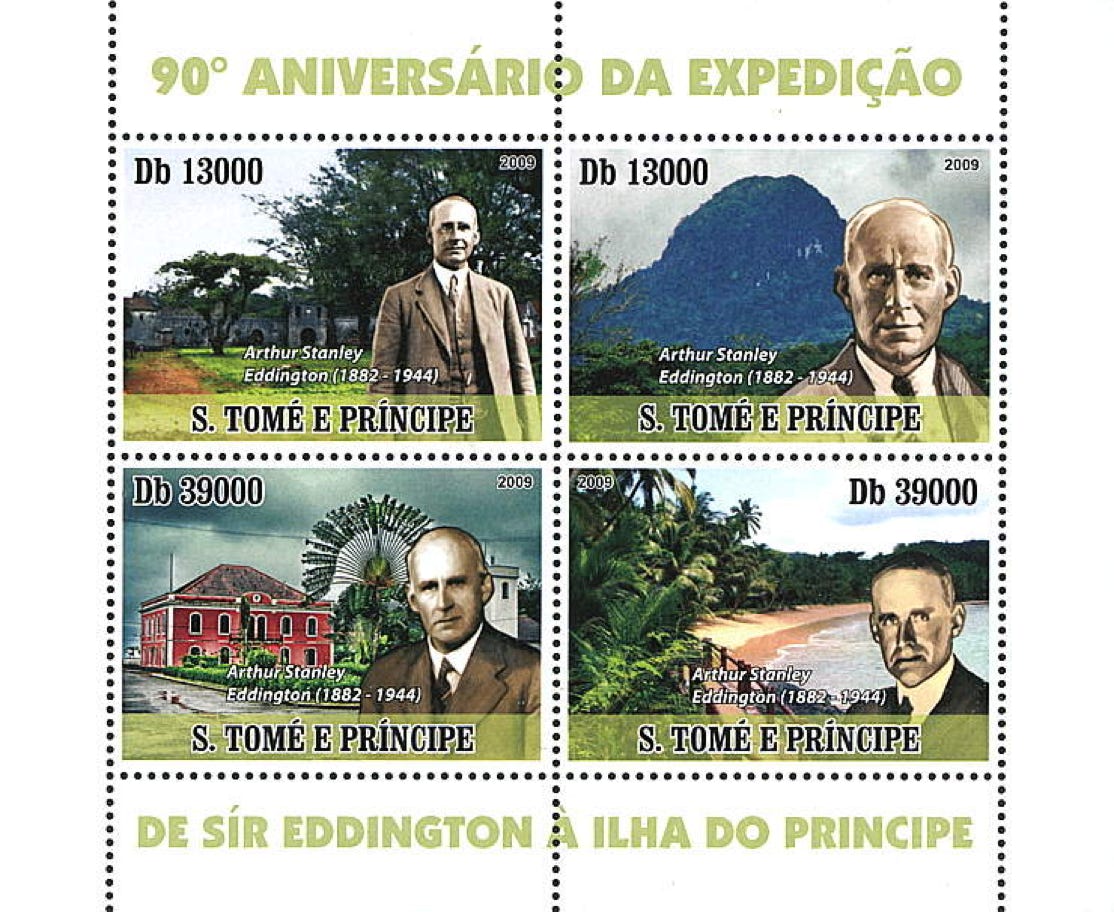
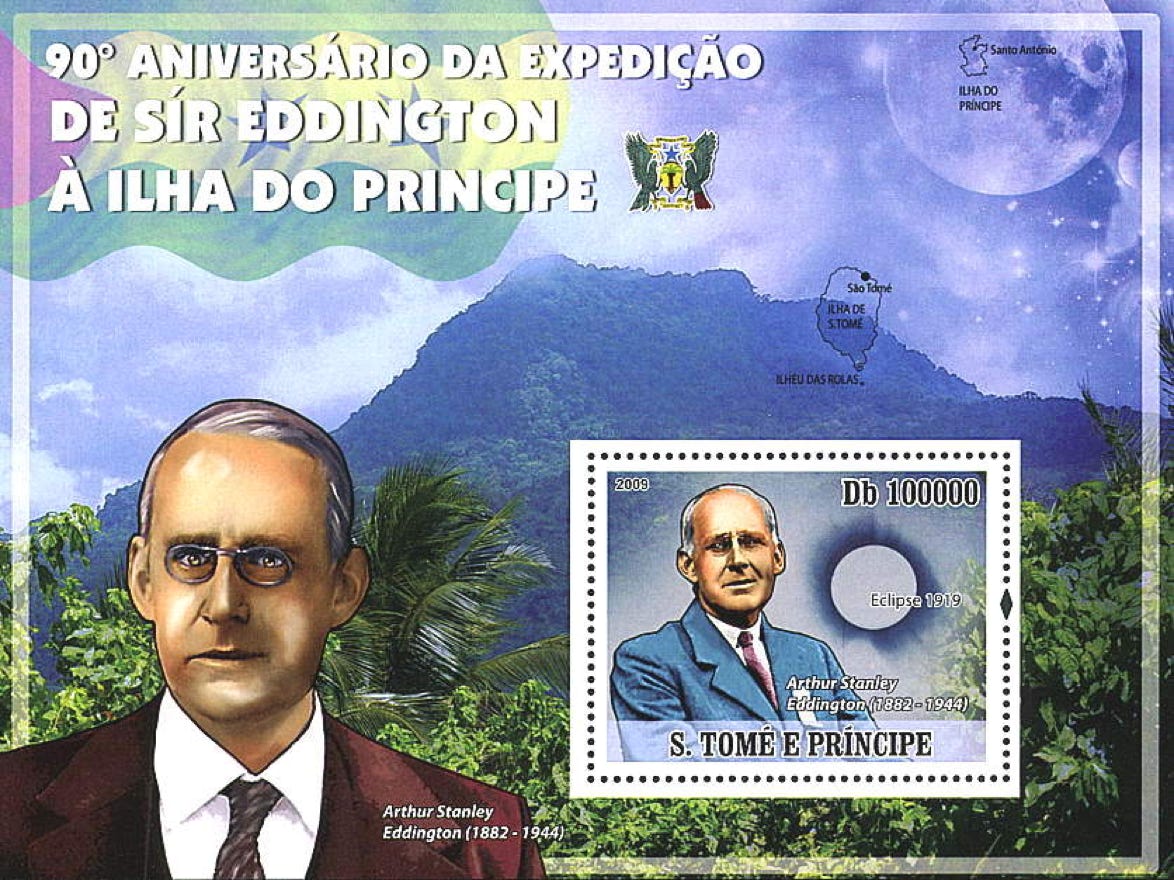
St Thomas and Prince, 2009
Arthur Stanley Eddington (1882–1944) was an English astrophysicist best known for his work on the internal structure of stars, which set the stage for our modern understanding of stellar evolution. In addition, he was an early champion of Einstein’s general theory of relativity. To test the theory’s prediction that light is bent by a gravitational field, Eddington led an expedition to photograph a total eclipse of the Sun on 1919 May 29. As it happened, the Sun was in front of the Hyades star cluster during the eclipse and the idea was to see if the stars in the cluster had changed their positions slightly as their light skimmed past the Sun on its way to Earth.
Eddington observed from the island of Príncipe, then still owned by Portugal, off the west coast of Africa. Although the observations were hampered by clouds, the results were good enough to show that the light from the stars had undergone a deflection similar to that predicted by Einstein.
The 90th anniversary of this eclipse fell conveniently during the International Year of Astronomy (IYA), and was the subject of a special commemorative event. The anniversary celebrations included the issue of a set of stamps by the twin islands of São Tomé and Príncipe (St Thomas and Prince in English, which is the name used in the Gibbons catalogue). There were two sheets in the set, as shown above: a sheet of four, showing photographs of Eddington against views of the island; and a separate souvenir sheet containing Eddington with the eclipsed Sun based on this image. Although the image comes from Eddington’s report published in the Philosophical Transactions of the Royal Society, it was not one of those he took in Príncipe; it was in fact taken from Sobral in Brazil by a separate expedition mounted by Greenwich Observatory to view the same eclipse. Eddington used results from both expeditions to draw his conclusions.

Stanley Gibbons nos. ??