Captain Cook and the transit of Venus
In 1768 Captain James Cook (1728–79) was sent by the Royal Society and the Admiralty in a ship called the Endeavourto observe the 1769 transit of Venus from the Pacific island of Tahiti. The intention was to refine the estimate of the distance of the Sun. Cook and the astronomer Charles Green observed the transit from the island’s northernmost point, still known as Point Venus. From Tahiti, Cook went on to circumnavigate New Zealand and landed in eastern Australia at what is now known as Botany Bay.
For more about Cook, Green, and the transit see James Cook’s 1769 transit of Venus expedition to Tahiti by Wayne Orchiston.
Captain Cook bicentenary (New Zealand, 1969)
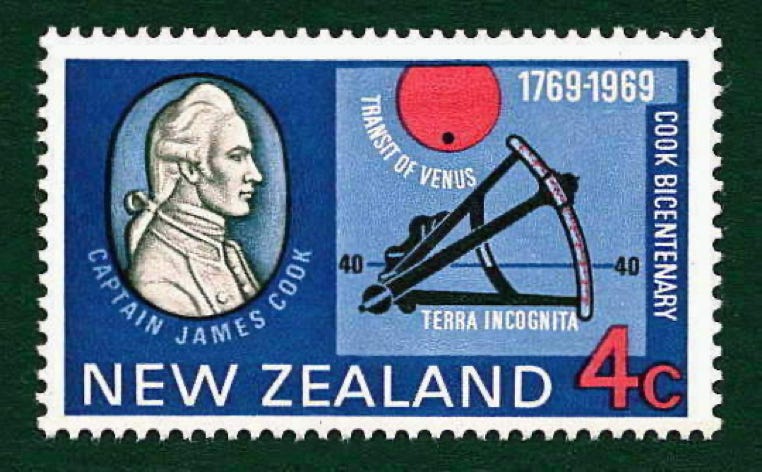
New Zealand issued a set of four stamps to commemorate the bicentenary of Captain James Cook’s first voyage to the South Pacific. The lowest-value member of the set, pictured above, depicts Cook himself, the 1769 transit of Venus across the Sun, and an octant (a navigational instrument, forerunner of the sextant) superimposed on the latitude line of 40 degrees. An undiscovered continent, Terra Incognita, was thought by some to lie south of this, but Cook proved that such a continent did not exist. The other stamps in the set show the naturalist Joseph Banks and HMS Endeavour (6c); the botanist Dr Daniel Solander and the plant Rhabdothamnus solandri (18c); and Cook’s 1769 chart of New Zealand (28c).
Stanley Gibbons no. 906
Captain Cook bicentenary (Norfolk Island, 1969)
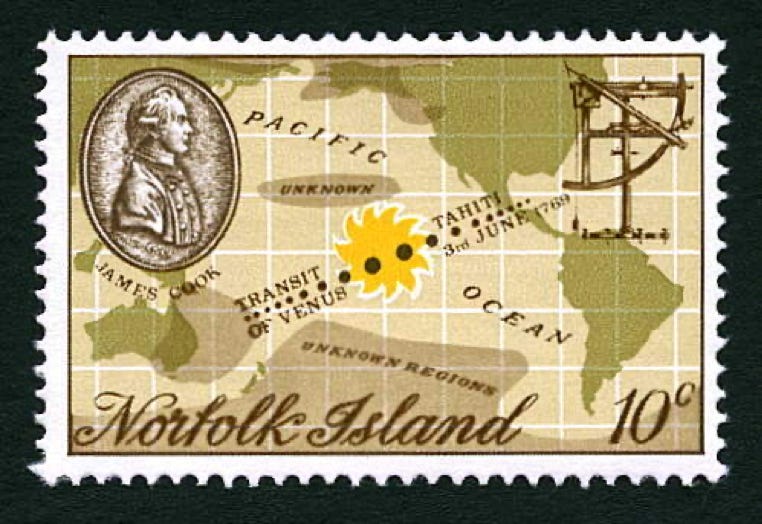
Norfolk Island commemorated the bicentenary of Cook’s observation of the transit of Venus from Tahiti with this stamp, which depicts the track of Venus across the Sun superimposed on the Pacific Ocean. The lettering along the line of the transit says ‘Transit of Venus Tahiti 3rd June 1769’. The instrument shown at top right is a quadrant made by John Bird, used by the expedition for finding latitude and checking time.
Norfolk Island itself was not discovered by Cook until 1774 during his second expedition to the South Pacific and is now a dependency of Australia.
Stanley Gibbons no. 99
Captain Cook bicentenary (Tuvalu, 1979)
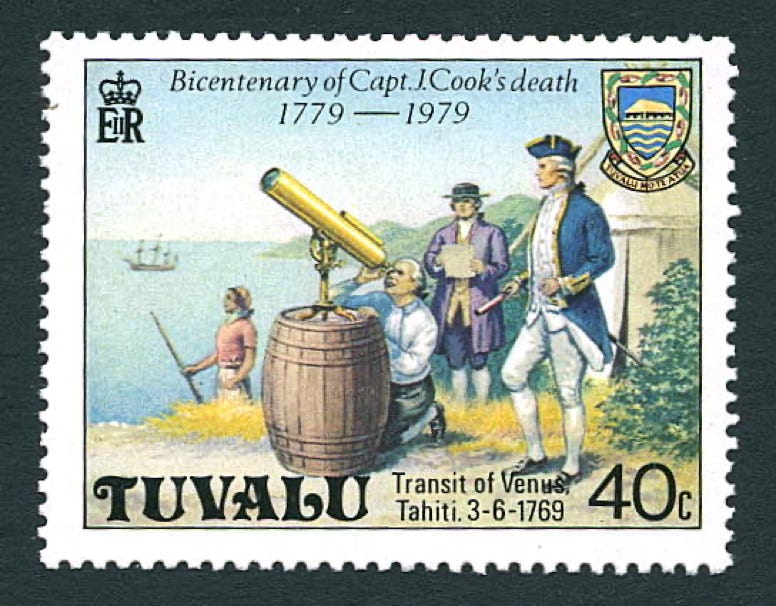
A modern-day artist’s impression of the observation of the 1769 transit of Venus from Tahiti by Cook and the astronomer Charles Green on a stamp from the Pacific islands of Tuvalu issued in 1979, the bicentenary of Cook’s death. Green is presumably intended to be the kneeling figure looking through the telescope, which was a 4-inch Gregorian-style reflector made by James Short, magnifying 140 times. It is screwed to the top of a ship’s keg filled with wet sand, providing a simple but stable mounting. In reality, Cook and Green observed simultaneously through identical telescopes while Daniel Solander, the naturalist, here shown taking notes, used a third telescope of higher magnification.
During the day of the transit the temperature rose to 119° F, so it is unlikely that Cook and Solander were so formally dressed as depicted here. The stamp also errs in showing the observing site as elevated, when it was actually within a temporary fort on a flat sandspit.
The observers are thought to have used dark eyepiece filters to dim the Sun’s light. The telescope mirrors of the day were of metal rather than silvered glass as now, and so were less reflective, but this is most assuredly not the recommended way to observe the Sun. This stamp should come with a health warning!
In 2018 Great Britain’s Royal Mail issued a stamp set to commemorate the 250th anniversary of Cook’s voyage. One of the set reproduced Cook and Green’s drawings of the transit.
Stanley Gibbons no. 125