Sir George Airy
Sir George Biddell Airy (1801–92) was the seventh British Astronomer Royal and the leading government scientist of his day. Appointed in 1835, he served for 46 years. His transit telescope installed in 1851 at the Royal Observatory, Greenwich, defines the world’s 0° line of longitude, and is shown on the GB set from 1984 commemorating the centenary of the Greenwich meridian.
Tonga, 1984
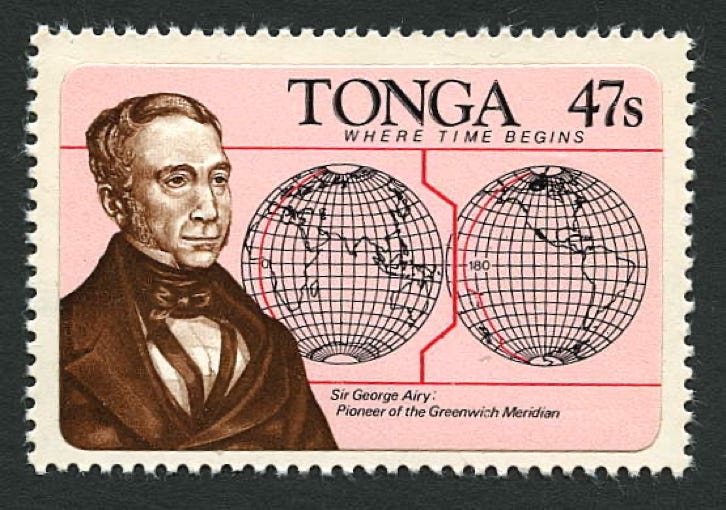
On the 100th anniversary of the adoption of the Greenwich meridian as longitude zero for the Earth, the Pacific islands of Tonga issued this stamp. Behind Airy are two halves of the globe, one marked with the Greenwich meridian and the other with the International Date Line which lies on the diametrically opposite side of the globe from Greenwich. The International Date Line detours eastwards to bring the islands of Tonga into the western hemisphere, hence the slogan ‘Where Time Begins’ on the stamp.
Stanley Gibbons no. 888
Nicaragua, 1994

Nicaragua’s Airy stamp shows the great man next to a diagram of the so-called Airy disk, an optical effect that occurs in telescopes and microscopes and which he investigated mathematically, deriving the equations that describe it. The Airy disk is the rounded image of a point source of light, such as a star, as seen through an optical instrument. This is surrounded by fainter rings, called diffraction rings, as illustrated on the stamp. The larger the aperture of the telescope the smaller the Airy disk and hence the better the resolution of the instrument.
This stamp was part of a sheet of 12 commemorating great astronomers from Copernicus to Gerard Kuiper.
Stanley Gibbons no. 3353