John Couch Adams
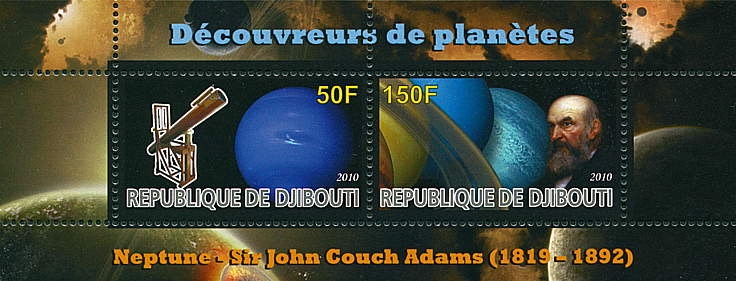
Djibouti, 2010
‘Formed a design, in the beginning of this week, of investigating, as soon as possible after taking my degree, the irregularities of the motion of Uranus...in order to find whether they may be attributed to the action of an undiscovered planet beyond it.’ So wrote John Couch Adams (1819–92) in July 1841 while still a Cambridge undergraduate.
Adams did indeed undertake such a task and in 1845 delivered a possible position for the new planet to the Astronomer Royal, Sir George Airy. But Airy took no action, regarding the search for unknown planets as outside the remit of the Royal Observatory at Greenwich.
Meanwhile, in France, Urbain Le Verrier had independently begun a similar investigation and arrived at a similar conclusion. Le Verrier called on the help of astronomers at Berlin Observatory to search the predicted area for the new planet, which they found on the night of 1846 September 23. It was subsequently named Neptune.
Adams eventually received joint credit for the prediction of Neptune as well as Le Verrier, even though the British contribution did not lead directly to its discovery.
The picture of Adams on the 150F stamp above comes from a portrait painted c.1888 by Sir Hubert von Herkomer and now in the National Portrait Gallery. Although the sheet refers to him as ‘Sir’ John Couch Adams, he actually turned down a proffered knighthood. The 50F stamp shows a Voyager 2 image of Neptune next to the telescope with which William Herschel discovered Uranus – wrong telescope, wrong planet!
This sheet was part of a series of three commemorating planetary discoverers issued by the French-speaking African country of Djibouti. (Given Djibouti’s French connections it is surprising they chose to honour Adams rather than Le Verrier.) The other sheets depicted William Herschel, discoverer of Uranus, and Clyde Tombaugh, discoverer of Pluto.
Stanley Gibbons no. [to come]