2007 The Sky at Night set
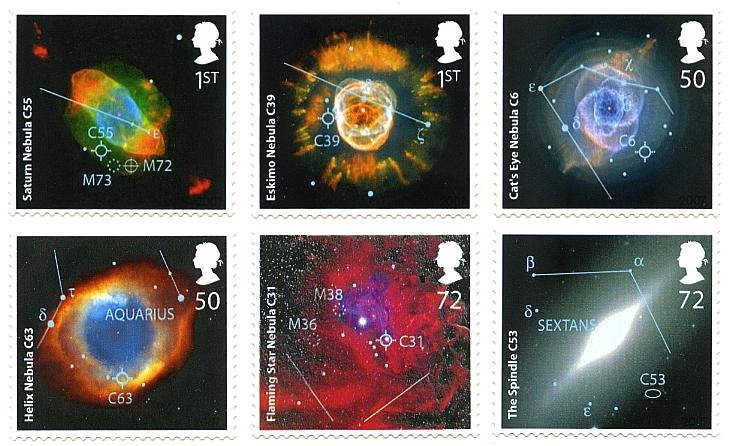
The 50th anniversary of Patrick Moore’s BBC TV programme The Sky at Night was commemorated by a set of six colourful and attractive stamps released in 2007 February. Designed by Dick Davis, their face values and subjects are as follows:
• 1st class, Saturn Nebula (NGC 7009), a planetary nebula in Aquarius, photographed with the Hubble Space Telescope.
• 1st class, Eskimo Nebula (NGC 2392), a planetary nebula in Gemini, photographed by the Hubble Space Telescope.
• 50p, Cat’s Eye Nebula (NGC 6543), a planetary nebula in Draco, photographed by the Hubble Space Telescope.
• 50p, Helix Nebula (NGC 7293), a planetary nebula in Aquarius, in a composite image from Hubble and ground-based telescopes.
• 72p, Flaming Star Nebula, an emission nebula in Auriga lit up by the hot blue star AE Aurigae, taken by the American amateur Robert Gendler.
• 72p, Spindle Galaxy (NGC 3115), a lenticular galaxy in Sextans, taken by the American professional John Kormendy.
Superimposed on each image is an outline of the home constellation with the location of the object marked. All objects are identified with a number beginning with the letter C, which is their reference in Patrick’s own-brand Caldwell Catalogue (his full surname being Caldwell-Moore). Other deep-sky objects on the stamps bear their more usual M numbers from Charles Messier’s historic catalogue.
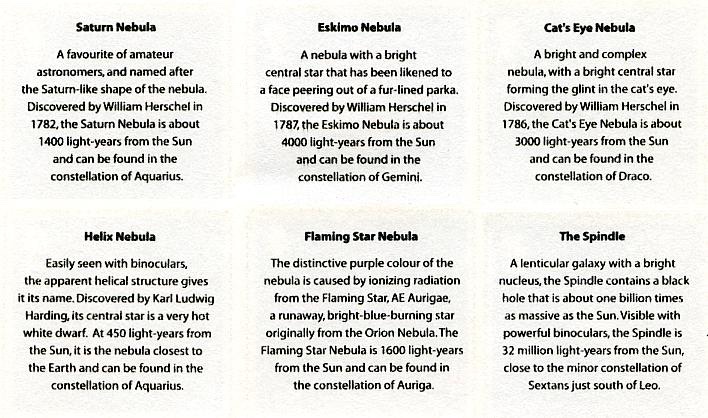
The stamps were self-adhesive, and text on the backing paper described the object shown (see above). The was the first time that the Royal Mail had printed on the back of self-adhesive stamps.
As with the 2002 Astronomy sheet, the tribute could be considered flawed by the fact that none of the images is from British telescopes or British astronomers. Given all that The Sky at Night has done to support British astronomy over the past half century, this was a dismaying choice and a missed opportunity to showcase British achievements.
Stanley Gibbons no. MS 2315
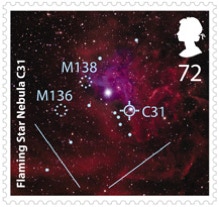
PS: Royal Mail narrowly avoided an embarrassing error on the 72p Flaming Star Nebula stamp. In the original designs released for publicity purposes in 2006 November, M36 and M38 were incorrectly labelled M136 and M138 (see below). I am sure I was not the only one to contact Royal Mail to point this out. A hasty redesign saved the day. Royal Mail have never admitted whether they had started printing before the error was caught.