Iran 1956 – Nasir al-Din al-Tusi
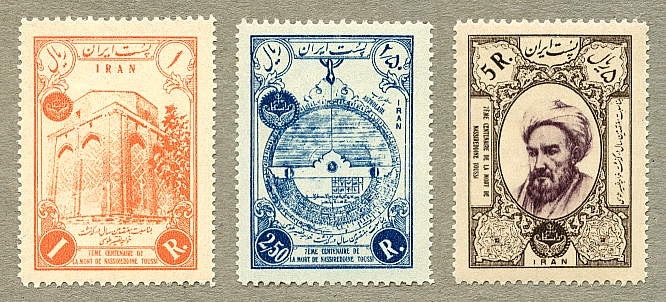
Nasir al-Din al-Tusi (1201–74), also known simply as Nasireddin, was a Persian scientist who set up an observatory at Maragha (the modern Maragheh) in 1259 where he compiled a star catalogue and tracked planetary motions with large quadrants. The resulting tables, published in 1272, remained in use until the time of Copernicus. As well as astronomy, al-Tusi made major contributions to many other areas of science including mathematics and biology.
This set of three stamps was issued as an early commemoration of the 700th anniversary of his death. They depict al-Tusi’s tomb at Maragheh; an astrolabe, an Arabic star-sighting device about which he wrote a treatise; and a supposed representation of the man himself. Unfortunately the stamps were poorly printed.
SG number
Face value
Colour
1086
1 r
Orange
1087
2.50 r
Blue
1088
5 r
Lilac and sepia