Germany 1955 – C. F. Gauss
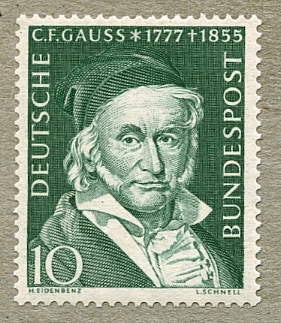
Carl Friedrich Gauss (1777–1855) was a German mathematician and astronomer who made significant contributions to celestial mechanics (the study of orbital motion and gravitational interactions). He devised the method of least squares for fitting a smooth curve to observations of uneven quality and used it to predict where the newly discovered asteroid Ceres would be found after it had vanished behind the Sun. He also introduced the Gaussian gravitational constant, from which the astronomical unit can be precisely derived. His work on gravitational perturbations was used by J.C. Adams and U.J.J. Leverrier when predicting the existence of the planet Neptune.
He also investigated terrestrial magnetism, as a result of which a unit of magnetic flux was named the gauss. This unit is now obsolete but the term ‘degaussing’ lives on. This stamp was issued on the centenary of his death.
Colour
SG number
Face value
1130
10 pf
Green