China 1955 – Zhang Heng, Zu Chongzhi, Zhang Sui
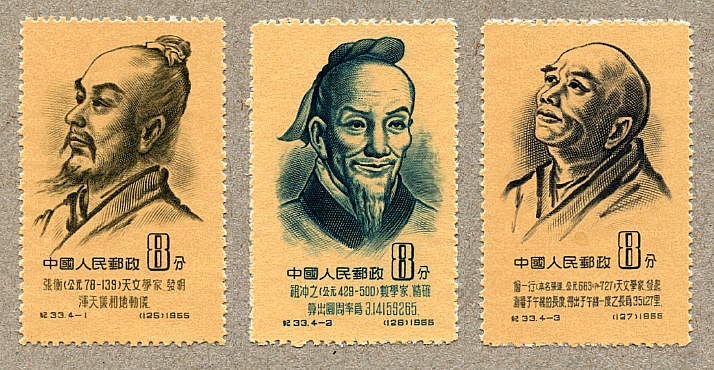
Zhang Heng (AD 78–139), also spelled Chang Heng, was court astrologer to the Emperor of China, although he had originally made his name as a poet and writer. In his role as court astrologer he adjusted the calendar to bring it into line with the seasons as determined by his observations. His greatest invention was a seismograph for recording earthquakes (which, incidentally, is illustrated on a Chinese stamp from 1953). Another great invention was an improved form of armillary sphere turned by water power, a precursor of water-powered clocks. Zhang also studied mathematics but his reputation in this was not as good as in astronomy.
Zu Chongzhi (429–500), also spelled Tsu Ch’ung-Chih, made many improvements to astronomy and mathematics. He calculated the value of precession, although his result was nearly twice the true amount. He was more accurate with his measurement of the lunar month and the length of the year which allowed him to predict the occurrence of eclipses. In mathematics, he calculated the true value of pi to several decimal places and introduced the now-familiar fraction of 22/7 as a good approximation. He also devised the Daming calendar, which took into account the effect of precession, but it was not adopted until after his death.
Zhang Sui (683–727), also known as Yi Xing or I-Hsing, developed Zhang Heng’s work to create a water-powered celestial sphere with an escapement that struck the quarter hours and hours as the sphere turned once every day. Two additional wheels outside the sphere carried small globes representing the Moon and Sun. By comparing his observations of star positions with those of earlier astronomers, he is credited with discovering the phenomenon of proper motion. He also drew up a new and more accurate version of the calendar – in the Chinese calendar, as in the Jewish calendar, months are based on the cycle of lunar phases and how these fit into the solar year is governed by certain rules which were modified by a succession of calendar reformers.
The above three feature in a set of four commemorating scientists of ancient China. The set is rounded out by Li Shizhen (Li Shih-Chen) (1518–93), a physician and pharmacologist.
SG number
Face value
Colour
1660
8 f
Sepia on buff
1661
8 f
Blue on buff
1662
8 f
Black on buff