USSR 1954 – Pulkovo Observatory reopening
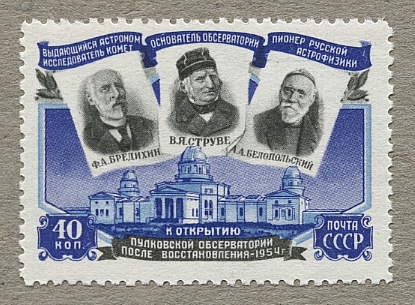
Pulkovo Observatory is some 19 km south of St Petersburg, Russia, and takes its name from the chain of hills called the Pulkovskiye Heights on which it lies. Opened in 1839, the observatory soon gained an international reputation for its work on positional astronomy and double stars. Originally its largest telescope was a 38-cm (15-inch) refractor, at that time the largest refractor in the world, but in 1885 this was superseded by a 76-cm (30-inch). Neither of these are in operation today, although the lenses remain. Destroyed during World War II, Pulkovo Observatory was rebuilt and reopened in 1954, when this stamp was issued.
The stamp depicts three of the observatory’s first five directors. At the centre is the first director, Friedrich Georg Wilhelm von Struve (known in Russian as Vasily Yakovlevich Struve) (1793–1864), who served from 1839 to 1861; at left is Fyodor Aleksandrovich Bredikhin (1831–1904) the third director, 1890–95; and at right is Aristarkh Apollonovich Belopolsky (1854–1934), fifth director, 1916–19. Bredikhin appears again on a USSR stamp issued in 1956.
SG number
Face value
Colour
1856
40 k
Black, blue, and violet