Austria 1953 – Johannes Kepler
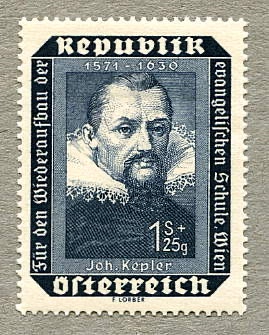
Johannes Kepler (1571–1630) was a German mathematician and astronomer whose three laws of planetary motion, based on the observations of Tycho Brahe and published in 1609 and 1619, established our modern view of the Solar System. Kepler’s laws stated that the planets orbit the Sun on elliptical paths, moving faster when closer to the Sun and slower when farther away, and that there is a simple mathematical relationship between their distances and orbital periods. He also observed and described the supernova of 1604 in Ophiuchus, now commonly known as Kepler’s Star, and wrote a book about optics and the theory of the telescope.
This stamp was issued as part of a set devoted to the Vienna Evangelical School Rebuilding Fund. Kepler was throughout his life a devout Christian and he taught for two periods in Austria, first in Graz and later in Linz.
(Note: Although the Gibbons catalogue describes the colour of this stamp as ‘blue’, it looks more like a dark slate.)
SG number
Face value
Colour
1247
1 s + 25 g
Blue