Russia 1951 – Konstantin Tsiolkovsky
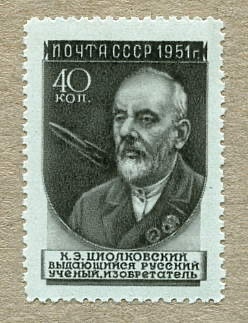
Konstantin Eduardovich Tsiolkovsky (1857–1935) was a Russian pioneer of spaceflight whose speculations about interplanetary travel started even before the first aircraft had flown. The Russians term him the Father of Astronautics. By profession he was a mathematics teacher. In 1903 he published an article titled Exploration of Space by Means of Reactive Devices which contained the first theoretical proof that space travel by rocket was possible; his basic equation is now known as the Tsiolkovsky equation. The article included a design for a rocket that would work on liquid hydrogen and liquid oxygen, the fuels used by many modern rockets. Tsiolkovsky realized that multi-stage rockets (which he termed ‘rocket trains’) would be needed to escape from Earth. He published this idea in 1929 in his book Rocket Space Trains. Shortly before his death he wrote of a rocket with boosters arranged side by side, similar to the staging technique actually adopted by Russian space boosters.
This stamp is part of a set of 16 commemorating various Soviet scientists.
SG number
Face value
Colour
1715
40 k
Grey on blue