France 1949 – François Arago
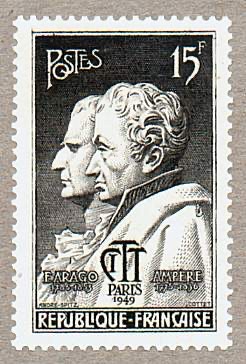
Dominique François Jean Arago (1786–1853) was a French physicist, astronomer and statesman. Among his major achievements was to establish the wave nature of light, in conjunction with Augustin Fresnel. Arago also studied the polarization of light and is credited with discovering the Sun’s chromosphere at the total eclipse of 1842.
Arago was director of the Paris Observatory from 1843–53 where he encouraged U.J.J. LeVerrier to study irregularities in the motion of the planet Uranus, which led to the prediction and subsequent discovery of Neptune. Arago also worked on electromagnetism, which is presumably why he is shown alongside André Ampère on this stamp, part of a set of four marking the 1949 International Telephone and Telegraph Congress in Paris.
Although the Gibbons catalogue describes its colour as Violet, this stamp is printed in black. Was the catalogue compiler perhaps working under strange lighting conditions?
SG number
Face value
Colour
1073
15 f
Violet (?)