Japan 1949 – Mizusawa Latitude Observatory
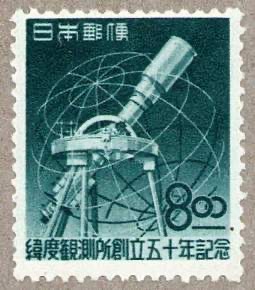
The International Latitude Observatory at Mizusawa in northern Japan was founded in 1899 as one of six stations of the International Latitude Service (ILS, the forerunner of the modern International Earth Rotation Service), with Hisashi Kimura as its first director. The other ILS observing stations were: Tschardjui (Russia), Carloforte (Italy), Gaithersburg (USA), Cincinnati (USA), and Ukiah (USA), all chosen to be close to the same latitude, 39° 08’ north. By measuring precise star positions, these observatories tracked slight changes in latitude caused by motion of the Earth’s axis of rotation (polar motion).
Mizusawa, Carloforte, Gaithersburg, and Ukiah were initially equipped with a 108-mm (4.25-inch) Visual Zenith Telescope made in Germany. However, the telescope shown on this stamp commemorating Mizusawa’s 50th anniversary is the 178-mm (7-inch) Floating Zenith Telescope, a photographic instrument introduced at Mizusawa in 1939, made in Japan but with Zeiss optics.
Mizusawa Latitude Observatory served as the Central Bureau of the ILS from 1922 to 1934 and again from 1962 to 1987 (when the ILS became the International Polar Motion Service). It is now known as Mizusawa Astrogeodynamics Observatory.
SG number
Face value
Colour
555
8 y
Green