Korea (South) 1948 – Kyongju Observatory
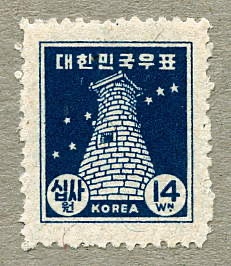
The 7th-century celestial observation tower at Kyongju (now Gyeongju), first shown on a Korean stamp in 1946, turned up again on one of the first stamps to be issued after South Korea became an independent republic in 1948. The star background looks as though it is intended to represent Ursa Minor, the little bear. The stone tower is regarded by Koreans as one of their great cultural treasures, and in fact the whole area of Gyeongju, which is dotted with architectural remains of all kinds, was declared a World Heritage Site by UNESCO in 2000. There was also a light blue version of this stamp, SG number 109b. A surcharged version was issued in 1951, overprinted with the value ‘300 w’; it is SG 149 (SG 149b for the light-blue version).
Kyongju Observatory makes its third and final appearance in our list of oldest astro stamps on a South Korean issue from 1956.
SG number
Face value
Colour
109
14 w
Blue