USA 1948 – Palomar Observatory
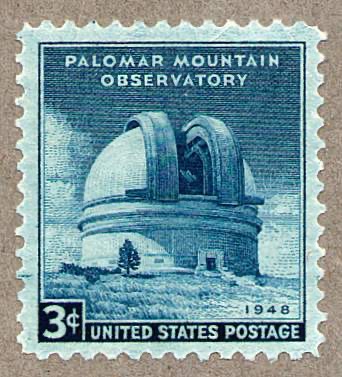
In 1928 the American astronomer George Ellery Hale (1868–1938) was awarded a grant of $6 million by the Rockefeller Foundation to build the largest telescope in the world, with a mirror 200 inches (5 m) in diameter. A site was chosen at an altitude of 1706 m (5600 feet) on Palomar Mountain, 80 km (50 miles) northeast of San Diego, California. Work began on the telescope in 1934 but was interrupted by World War II, and not until late 1947 was the mirror installed. Even then, nearly two years of final polishing and adjustment was needed.
At a dedication ceremony in June 1948, before it was fully operational, the 200-inch telescope was named in memory of George Ellery Hale, who had died ten years earlier. In August that year this commemorative stamp was issued depicting the telescope’s magnificent dome, 41 m (135 ft) tall and 42 m (137 ft) in diameter. Edwin Hubble took the first photographic exposure with the Hale telescope in January 1949 and in October that year it was finally put into full-time use, 21 years after the award of the initial grant. The Palomar giant was not superseded in size until 1975. It remains in productive operation.
This was, incidentally, the first astronomically themed stamp issued by the United States. Produced in vast numbers, it is still easily and cheaply available and has long been a stalwart of many a beginner’s collection.
SG number
Face value
Colour
963
3 c
Blue