Jaipur 1947 – Jaipur Observatory
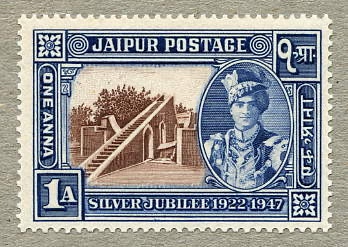
Jaipur was a former Princely state in northern India that released its own stamps until 1949. Subsequently it became part of the much larger state of Rajasthan, and its capital, also called Jaipur, is now the capital of all Rajasthan. One of Jaipur city’s greatest tourist attractions is the Jantar Mantar observatory, a set of stone instruments for timekeeping and measuring the positions of celestial bodies, built by Maharaja Jai Singh II around 1730.
The most imposing of these instruments is the Samrat Jantar, said to be the largest sundial in the world, built to tell local time to within seconds. The Samrat Jantar consists of a triangular wall, aligned north–south and rising to a summit some 27 m high, with its slope parallel to the Earth’s axis. The wall casts its shadow onto a curved surface from which the time can be read off.
Surprisingly, this imposing instrument is not the one shown on the Jaipur stamp; rather, the stamp shows a smaller sundial about a fifth the size at the same site.
Jai Singh built four other observatories, at Delhi, Mathura, Ujjain and Varanasi, but the one at Jaipur was the greatest of all. The Jaipur observatory was restored in 1901 and declared a national monument in 1948.
The stamp commemorates the Silver Jubilee in 1947 of the accession to the throne of Maharaja Man Singh II, who is the person depicted.
SG number
Face value
Colour
74
1 a
Brown and blue