Korea (South) 1946 – Kyongju Observatory
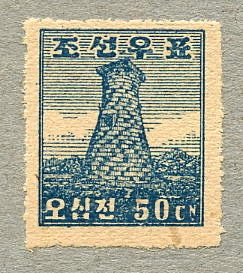
At Kyongju (now more usually transliterated as Gyeongju), in southeastern South Korea, lies the oldest astronomical observatory in the Far East: a 9.4-m-high stone tower known in Korean as Cheomseongdae – literally meaning ‘Tower for star observation’ – built during the reign of Queen Seondeok in AD 632–647. From its flat top observers kept watch on the heavens each night, charting the movements of celestial bodies and recording events such as eclipses and the appearance of comets or so-called ‘guest stars’ (novae and supernovae). The observers are thought to have climbed an external ladder to enter the tower at the window-like opening partway up and then ascended another ladder inside the tower to reach the top.
Regarded as a national treasure in Korea, Kyongju Observatory reappears twice more on this list, on Korean stamps from 1948 and 1956. The 1946 stamp shown here was issued while South Korea was under US Military government and was the lowest-value member of a series of five depicting subjects of nationalistic significance. The paper has browned with age.
SG number
Face value
Colour
83
50 ch
Blue