Denmark 1946 – Tycho Brahe
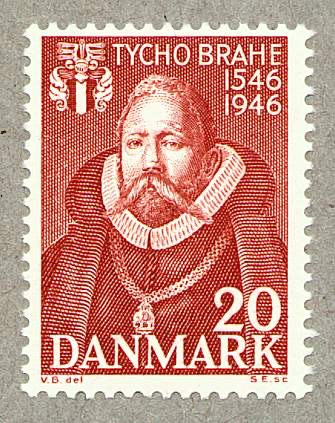
Tycho Brahe (1546–1601), a Danish astronomer, was the greatest observer of the pre-telescopic era. In 1576 he built a castle-cum-observatory called Uraniborg on the island of Hven (now called Ven) between Denmark and Sweden, followed some years later by an underground observatory nearby called Stjerneborg. He equipped these with the largest and most accurate sighting instruments of the day. His observations showed that the comet of 1577 followed an orbit that passed between the planets, changing both the prevailing opinion of the nature of comets and smashing the concept of ‘heavenly spheres’ that had originated with the Greeks. Tycho’s long-term observations of the movements of the planets at Ven were later used by Johannes Kepler to derive his laws of planetary motion, showing for the first time that planets orbit the Sun on elliptical paths.
This stamp was issued by his native country to commemorate the 400th anniversary of his birth. As a young man, Tycho had lost part of his nose in a duel and replaced it with a metal insert; this feature can just be made out in the portrait on the stamp.
SG number
Face value
Colour
349
20 øre
Red