Mexico 1942 – Tonantzintla Observatory
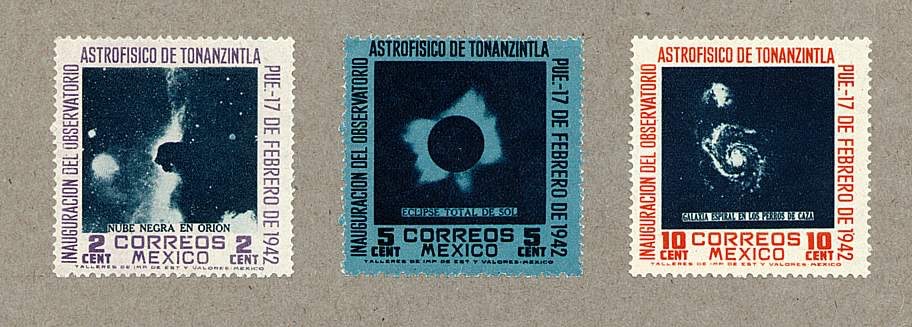
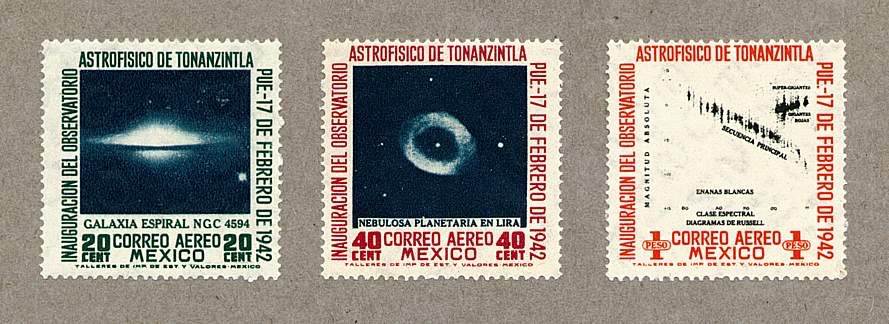
Without doubt this is the greatest of all the pre-1957 astro issues and a classic set for any astro collector. These stamps are often offered for sale in two separate lots: non-airmail (the first three values) and airmail (the three highest values). All six were issued in 1942 February to mark the inauguration of the Mexican National Astrophysical Observatory at Tonantzintla, near the city of Puebla, about 100 km southeast of Mexico City. The observatory was established with the help of Harvard College Observatory and its director Harlow Shapley (see here for a brief history). Probably the best-known astronomer who worked at Tonantzintla was Guillermo Haro (1913–88), co-discoverer of the nebulous outflows from young stars known as Herbig–Haro objects.
These are also notable as the first stamps to feature real astronomical photographs, rather than engravings. The subjects depicted are as follows: the Horsehead Nebula in Orion (2 cent); total solar eclipse (5 cent); the Whirlpool Galaxy, M51, in Canes Venatici (10 cent); the Sombrero Galaxy, M104, in Virgo (20 cent); the Ring Nebula, M57, in Lyra (40 cent); and the Hertzsprung-Russell diagram (1 peso).
Many people will not have realized that these images are not the work of Mexican astronomers but come from the Harvard Observatory plate collection. However, over the following half century Tonantzintla built up its own collection of astronomical plates taken with a Schmidt telescope built by Harvard, until increasing light pollution from Puebla led to the cessation of serious observing in 1995. A 1-m reflector was added to the observatory in 1961, which is still in use, but a need for improved instruments and a better site led to the establishment of a new observatory in 1970 at San Pedro Mártir in the Baja California peninsula.
SG number
Face value
Colour
676
2 c
Blue and violet
677
5 c
Blue
678
10 c
Blue and orange
679
20 c
Blue and green
680
40 c
Blue and red
681
1 p
Black and orange