Slovakia 1939 – Milan Štefánik
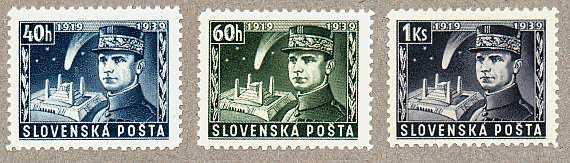
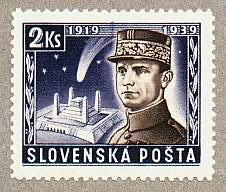
Milan Rastislav Štefánik (1880–1919) is probably best known as one of the founders of Czechoslovakia, but in his early career he was an astronomer. He worked at Meudon Observatory near Paris from 1905 to 1907, during which time he led an expedition to make solar observations from the top of Mont Blanc. In 1910 he observed Halley’s Comet from Tahiti and the following year went to Australia to observe a solar eclipse. In 1912 he took French nationality and during World War I helped organize the Czechoslovak forces which fought with Britain and France. His diplomatic efforts after the war are credited with establishing an independent Czechoslovakia.
In 1919 Štefánik was killed in a plane crash outside the Slovak capital Bratislava. His mausoleum, built on the site, is shown on this set of stamps produced in 1939 to commemorate the 20th anniversary of his death. He wears the uniform of a French army general, while the stars and comet convey his lifelong interest in astronomy and, presumably, are meant to remind us of his observations of Halley’s Comet. It is, incidentally, the first stamp to depict a comet.
There were four stamps in the set: 40 haliers (blue); 60 h (dark green); 1 koruna (dark blue); and 2 korunas (dark blue/brown). All four stamps are reproduced here to the same scale – the 2 Ks stamp really was larger than the rest of the set. This example is a rarity in that it contains an additional star between Štefánik’s cap and the edge of the stamp. Only one stamp on each sheet of 2 Ks stamps contained this feature, always at position 93 of 100 (so it is part of the original engraving and not a printing fault).
The stamps were valid for just one day: 1939 May 4, the 20th anniversary of his death. At that time Slovakia was under German domination, and presumably the Germans had no wish to glorify a man who had led opposition to them in World War I. The stamps have no Stanley Gibbons catalogue number, although there is a gap in Gibbons’ Slovakia numbering system between 35a and 40 which would accommodate them. Were the numbers once assigned and then withdrawn?
Czechoslovakia issued stamps depicting Štefánik in 1935, but they had no astronomical content and so are not included here.