Estonia 1932 – Tartu Observatory
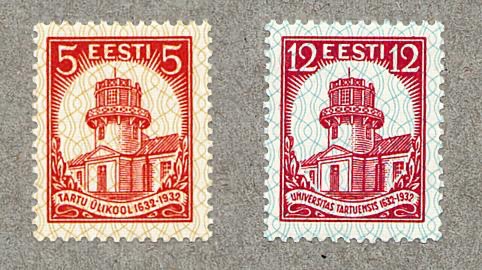
The Gibbons catalogue notes that these stamps have what it terms a ‘network background’, which in practice means a pattern of wavy lines in a different colour from the stamp. On the 5s stamp the background pattern is in yellow, on the 12s stamp it is in blue.
Tartu Observatory, originally known by its German name of Dorpat, was founded in 1811 as part of Dorpat University when Estonia was under Russian control. Its name changed to Tartu in 1917. The observatory’s most famous director was F.G.W. Struve (1793–1864) who served from 1818 to 1839, building it into one of the world’s leading observatories of the time. (Struve went on to found Pulkovo Observatory in Russia; he is featured on a 1954 stamp from the USSR.) In 1964 the observatory moved to a new location at Töravere about 21 km from Tartu but the old observatory building still remains, now a museum and science centre. The round turret shown on these stamps houses a 20-cm (8-inch) Zeiss refractor opened in 1911.
These two stamps were part of a set of four commemorating the 300th anniversary of Tartu University; the two other values in the set depict the main university building.
SG number
Face value
Colour
95
5 s
Deep orange
97
12 s
Red