The (sometimes) vexed history of the
Sporting Life marathon trophy
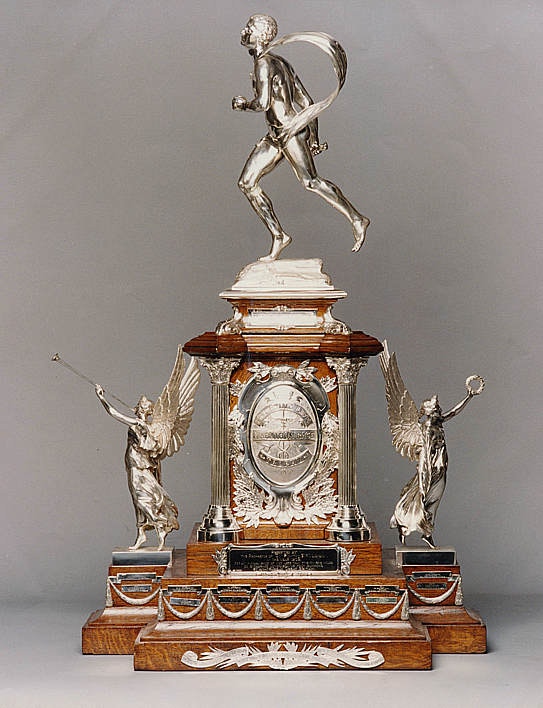
The Sporting Life marathon trophy, created in 1909 for the Polytechnic Marathon from Windsor to London. In 1992 it featured in an exhibition of sporting trophies at the Victoria and Albert Museum, along with better-known trophies from Wimbledon tennis, the Open golf championship, and horse racing.
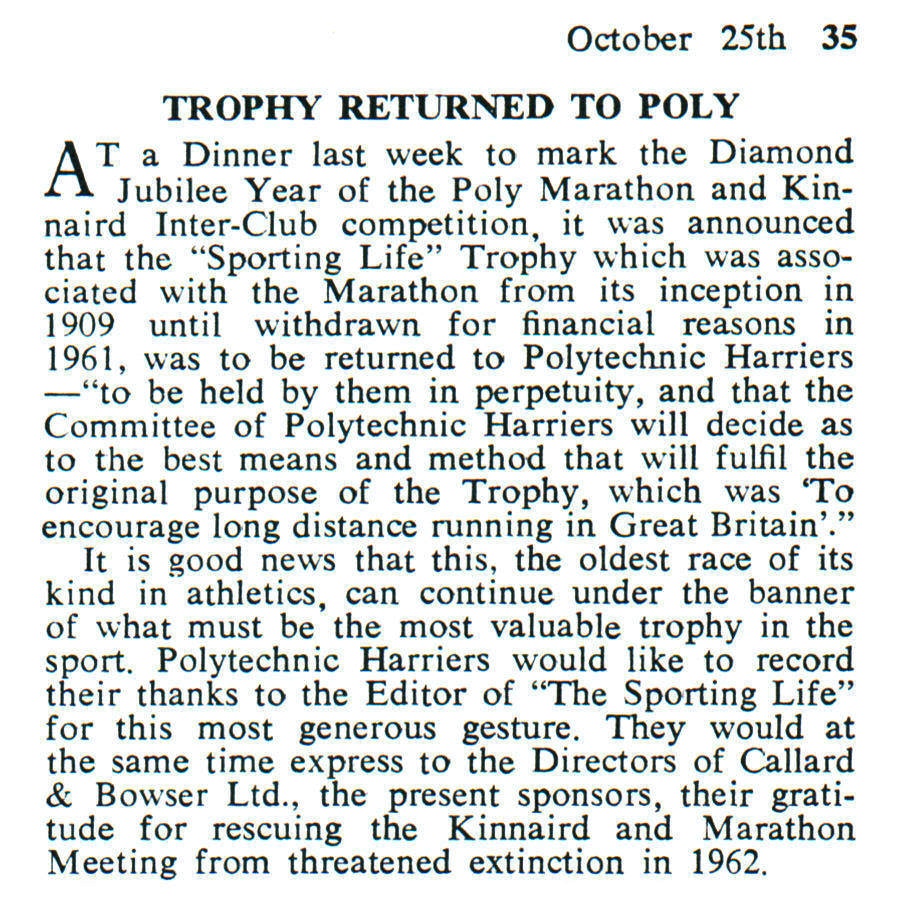
Above: How Athletics Weekly reported the gift of the Sporting Life Trophy to Polytechnic Harriers in their issue of 25 October 1969.
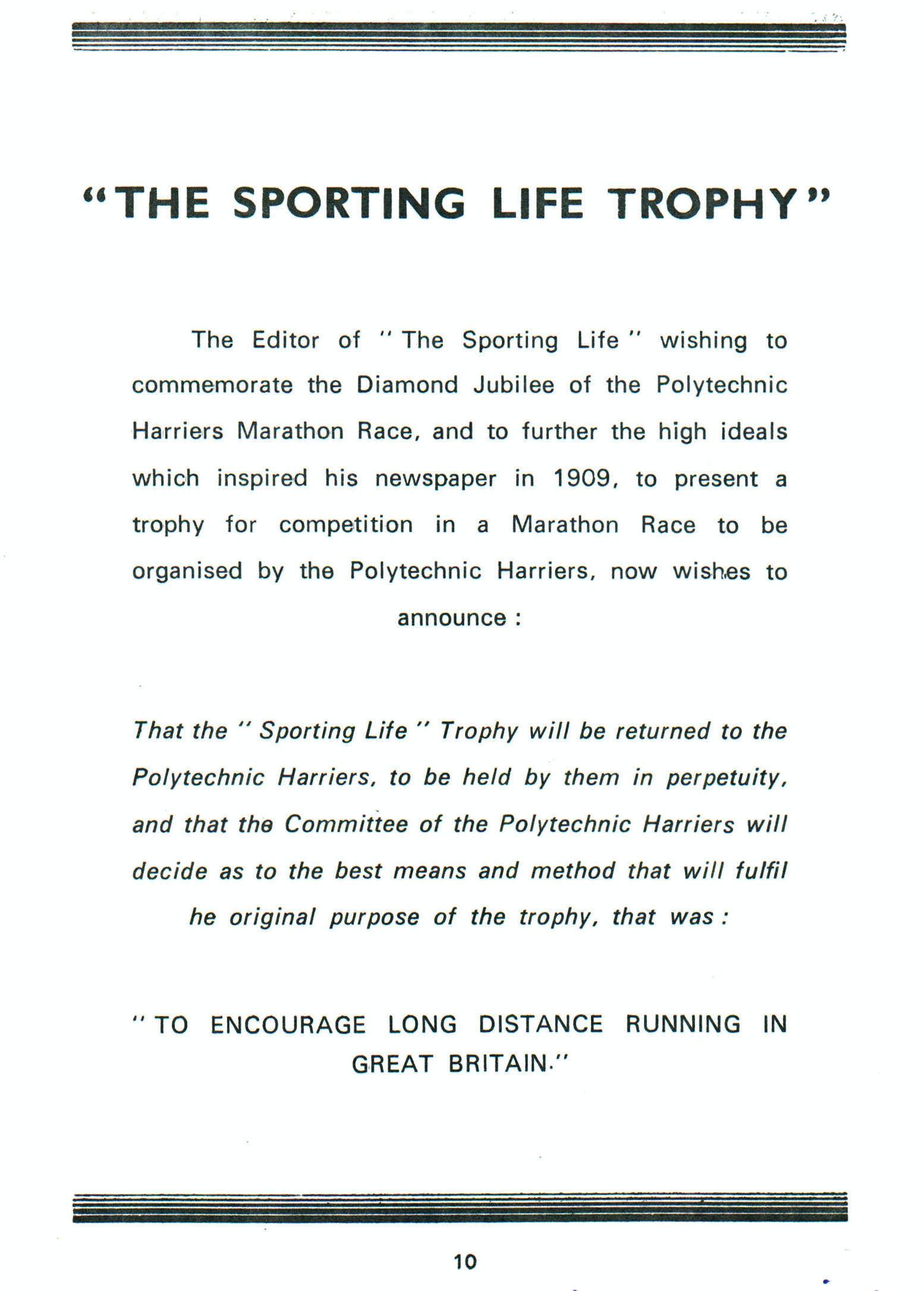
Above: How The Sporting Life announced their gift to the Polytechnic Harriers – a full-page announcement in a booklet by Arthur Winter called From the Legend to the Living, a history of the Polytechnic Marathon published on the occasion of the race’s Diamond Jubilee in 1969.
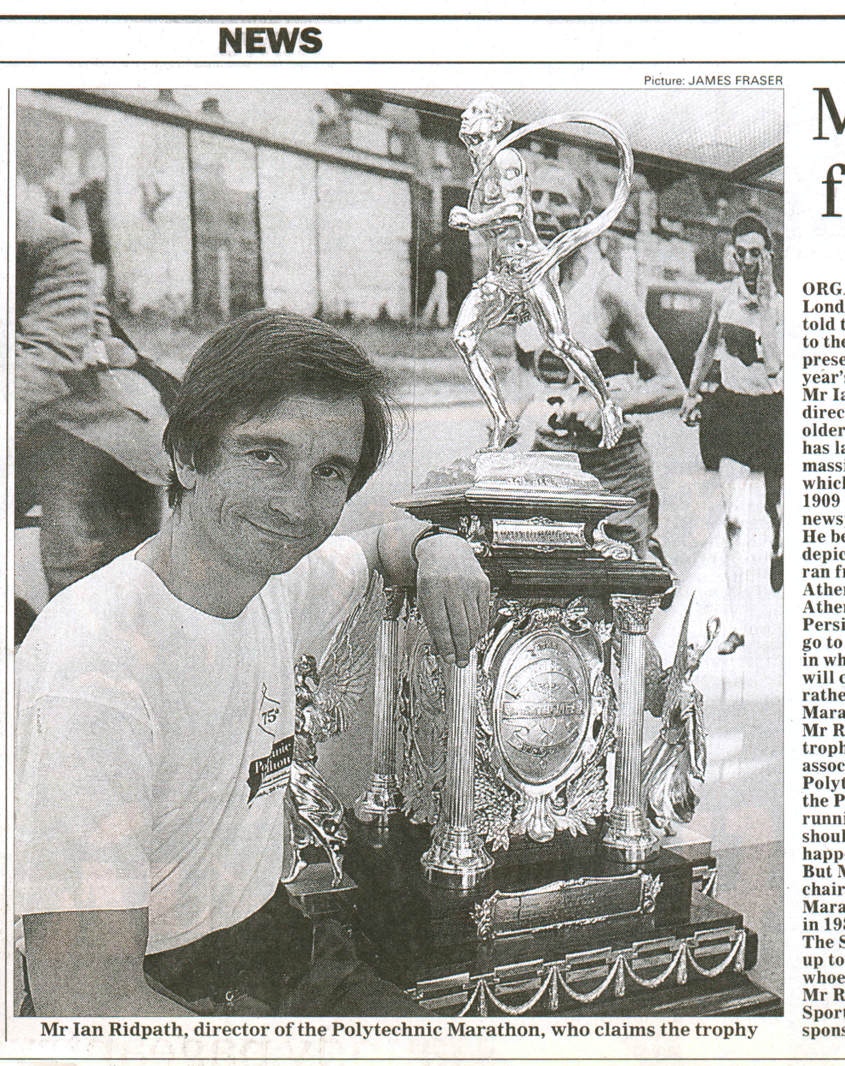
One hand on the trophy – me with the Polytechnic Marathon trophy at the Museum of London in March 1994, where it formed the centrepiece of an exhibition on the history of London’s marathons from the 1908 Olympic event to the present. Unfortunately, the Mirror Group’s hand proved stronger. (Cutting from
The Daily Telegraph, 1 April 1994.)
To go with their new world-beating marathon, The Sporting Life commissioned a world-beating trophy. Made by the Goldsmiths and Silversmiths Company of Regent Street at a cost of £500 (equivalent to at least £50,000 today), it stands 4 feet 9 inches high and requires several people to lift it.
The March 1909 issue of The Polytechnic Magazine described the trophy thus:
‘It is classical in design, the principal feature consisting of a solid silver model representing Phidippides [sic], the Greek athlete, in the attitude of running. The statuette stands upon a square oak pedestal, having at the angles solid silver Corinthian columns. Each of the sides bears a richly decorated silver panel surrounded by laurel, one panel portraying a classical scene illustrative of the subject of the trophy; another contains a medallion portrait of the ruler of Greece at the period represented, and a third a medallion portrait of King Edward VII. All the decorations in these panels are executed in relief, while the front panel bears the title of the trophy in a ribbon, also in relief, and behind this appears a caduceus of Mercury.
‘Upon each two of the four sides of the base are projections supporting finely modelled silver figures of Victory and Fame respectively, and the plinth carries a number of silver scrolls, for engraving the names of winners, divided by festoons of laurel. The presentation inscription is engraved on a silver plate, and the trophy is fitted in a specially constructed oak case.’
This awesome trophy was presented to the winners of the Polytechnic Marathon from 1909 until 1961, when The Sporting Life withdrew their sponsorship of the race, having ceased athletics reporting. It was never officially awarded after that, but remained as a symbol and heirloom of the event.
Donation to Polytechnic Harriers
In 1969, to commemorate the Diamond Jubilee of the Polytechnic Marathon, The Sporting Life donated the trophy to the Polytechnic Harriers ‘in perpetuity’, to use their own words, and instructed that the club should decide ‘the best means and method that will fulfil the original purpose of the trophy’ (see the full announcement at left). The handover took place at the Polytechnic Harriers’ dinner celebrating the Diamond Jubilee year of the race held at the Polytechnic on October 18, 1969.
The Sporting Life was represented by its deputy editor at the time, Graham Taylor, standing in for the paper’s executive editor, A. Hayward, who was indisposed. ‘I can assure you there were no strings attached and the trophy became the sole property of Polytechnic Harriers,’ Taylor recalled for me in April 1994. Unfortunately, there was no legal documentation to confirm the change of ownership, and this was to cause problems over 20 years later.
Polytechnic Harriers put their new acquisition on display at their Regent Street headquarters until security became a concern, after which it was stored in the Victoria and Albert Museum. In the 1980s, when the London Road Runners Club were organizing the Poly Marathon under licence, the trophy was loaned to them for display at the finish of the race. It ended up stored in someone’s basement.
There matters might have remained but for a reader’s letter which appeared in the Daily Mirror of 7 December 1990, asking what had happened to the famous old trophy. The paper replied that ‘it must have been destroyed in the war’. This was a surprising reply, given that Mirror Group newspapers had by then taken over The Sporting Life; clearly, the newspaper group did not at that stage realize that the trophy still existed, let alone that it had been presented to the race winners until 1961.
David Barrington, Secretary of Kingston AC and Polytechnic Harriers (the club formed by the merger of Polytechnic Harriers with Kingston AC in 1985), wrote to the Mirror Group to let them know the trophy lived on. And it is at this point that the question of ownership becomes one for the lawyers.
Mirror Group takes it back
The Mirror Group took back the trophy, renovated it and assumed responsibility for its safe keeping. They loaned out the trophy for display at the finish of the Polytechnic Marathon when the race was revived in 1992, and again in 1993, the first year in which I was race director. We had plans to put it on display again the following year, when we received a surprise.
In March 1994 the London Marathon announced, without reference to Kingston AC and Polytechnic Harriers or to me as Polytechnic Marathon race director, that the Sporting Life Trophy would henceforth be presented jointly to the men’s and women’s London Marathon champions. ‘The trophy...owned by Mirror Group newspapers...is on permanent loan to the event,’ said the London Marathon press release.
Despite protests, neither Mirror Group nor The Sporting Life would acknowledge Polytechnic Harriers’ claim to the trophy. In 2003 this historic, and by now controversial, piece of silverware was renamed the Chris Brasher Sporting Life Trophy.
Ian Ridpath
Race Director, Polytechnic Marathon, 1993–95