 |
 |
||
|
|
|||
|
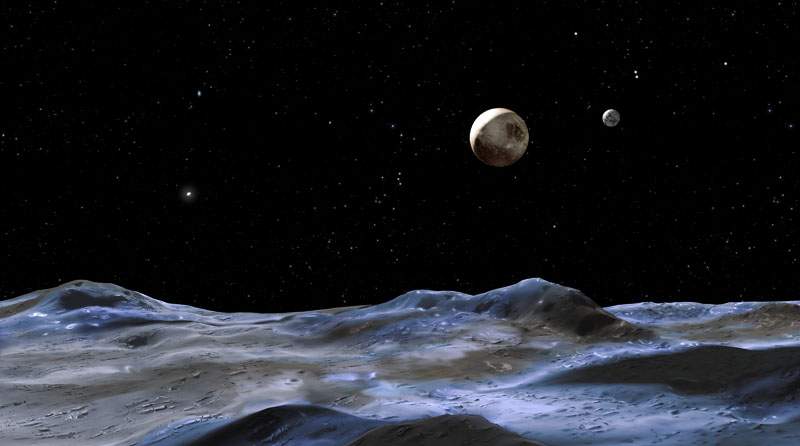
Pluto (centre right) and its largest moon Charon (right) as they might be seen
from the surface of one of the two smaller moons recently discovered. Artwork:
NASA, ESA and G. Bacon (STScI).
|
|
||
|
|
|||
|
Is Pluto a planet? Astronomers once thought it was, but now they don’t. Indeed it never really was, but it has taken them three quarters of a century
to admit it. As Abraham Lincoln once supposedly asked, “If you call a tail a leg, how many legs does a dog have?” Lincoln’s answer: “Four. Calling a tail a leg doesn’t make it a leg.” In planetary terms, Pluto was that tail, and calling it a planet didn’t make it one. By demoting Pluto, astronomers have pinned the tail back on the
dog.
Had Pluto been discovered today, it would not have been classified as a planet.
Pluto’s now-rescinded status as the ninth planet is a historical accident. When Clyde
Tombaugh discovered it in 1930 astronomers had expected that it would be much
bigger than it really is.
Every new measurement of its diameter came up with an ever-smaller value, until
by the 1970s it became clear that Pluto was smaller even than our own Moon – embarrassingly small for a supposed planet. Around the same time, an icy object
called Chiron was discovered in the outer Solar System, shuttling between the
orbits of Saturn and Uranus. Although only one-tenth the diameter of Pluto,
there was much about Chiron’s eccentric orbit and icy composition that was reminiscent of Pluto.
The situation became worse in the 1990s when astronomers began to discover a
whole swarm of icy objects at Pluto’s distance and beyond. This swarm is known as the Kuiper Belt and astronomers
began to speak of Pluto as simply the largest Kuiper Belt object (KBO) or
Trans-Neptunian Object (TNO).
Matters came to a head in 2005 when a newly discovered TNO, now known as Eris, turned out to be larger than Pluto. If Pluto was a planet,
then shouldn’t Eris be one also? And were there even larger objects lurking beyond, yet to be
discovered? It was time to decide what was meant by a planet.
Strange though it may seem that astronomers did not have a comprehensive
definition of a planet, none had previously been needed. Everyone knew that a
planet was an object that orbited a star and didn’t emit light of its own. Simple. The upper limit between a planet and star was
reasonably easy to define, but the lower limit proved more difficult. When does
a planet become just a lump of rock or ice?
At the 26th assembly of the International Astronomical Union (IAU) in Prague in
2006 August, astronomers were presented with a proposal to define a planet as
anything large enough to be pulled into a round shape by its own gravity. That
included Pluto, but it would also have allowed into the planetary club various
other objects not previously considered as planets such as the asteroid Ceres
and any number of TNOs yet to be discovered.
The proposal was overwhelmingly rejected, to general relief. Instead, the
assembled astronomers decided that a planet is a body that is (a) in orbit
around the Sun, (b) has sufficient mass for its self-gravity to overcome rigid
body forces so that it assumes a hydrostatic equilibrium (nearly round) shape,
and (c) has cleared the neighbourhood around its orbit.
This definition retains the originally proposed criterion of roundness, which
sets a physical boundary, but the added criterion of “clearing the neighbourhood” excludes objects in populated areas such as the asteroid belt and the Kuiper
Belt. Large asteroids and TNOs become dwarf planets under this new definition,
while smaller bodies become – well, Small Solar System Bodies. For a while there seemed to be no place in
this scheme for the long-established term “minor planet” but eventually the term was retained, to the relief of the IAU’s own Minor Planet Centre.
A vote at an IAU Assembly is not Papal doctrine. It gives a lead, but will
succeed only if other astronomers follow. My expectation is that many
astronomers will continue to regard Pluto as a large TNO and eschew the “dwarf planet” designation.
Either way, it won’t be possible to throw away three quarters of a century of history just like
that. We are used to thinking of Pluto as a planet, and most books still tell
us that it is a planet. For now, Pluto should be afforded dual status as both a
planet and a TNO, in much the same way that humans can have dual nationality.
Eventually, we will cease to talk of it as a planet, except to note the
historical curiosity that it was once considered as such. This dual personality
is already manifested by Ceres, which manages to be an asteroid as well as a
dwarf planet.
Does it matter? When all is said and done, the whole debate comes down to
swapping name-tags. Whatever you call it, Pluto remains a fascinating object at
the edge of the Solar System which we still know little about. Currently a NASA
space probe called New Horizons, launched in 2006 January, is on its way to Pluto. When it was dispatched from
Earth its mission was to investigate the only planet not to have been reached
by space probe – but when it arrives in 2015 it will be investigating not the ninth planet but a
large TNO.
Ian Ridpath
Read my article Pluto: Planet or Impostor? published in the December 1978 issue of Astronomy magazine (5 MB PDF file).
|
|
||
|
|
|
|
|