Exploring the Moon
A history of lunar discovery from the first
space probes to recent times
Landers and orbiters – 2
At the same time as the Surveyor landers were providing an astronaut’s-eye view of the surface, a series of Lunar Orbiter photo-reconnaissance probes was scanning the Moon from orbit. Each Lunar Orbiter carried two cameras, one for close-ups and the other for wide-angle views. The photographs were recorded on film that was processed aboard the spacecraft and the pictures were transmitted to Earth in strips, which accounts for their banded appearance. Tracking the Lunar Orbiters revealed the existence of mascons (short for mass concentrations), areas of denser rock and hence increased gravitational pull, under the lunar maria.
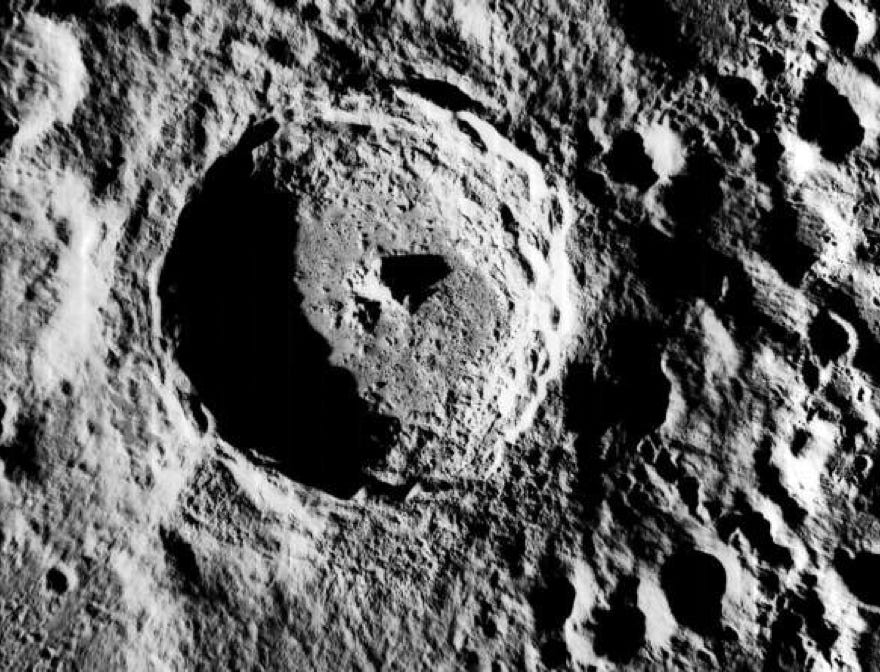
The first three Lunar Orbiters concentrated on possible Apollo landing sites, but Lunar Orbiter 4 was placed into a near-polar orbit from which it mapped almost the entire Moon, front and back, in unprecedented detail. Lunar Orbiter 5, the last of the series, filled in missing areas on the far side and scrutinized sites of special interest, such as the bright ray craters Tycho and Aristarchus. The Lunar Orbiter images remain our best overall survey of the Moon to date, and can be seen in the Lunar Orbiter Photographic Atlas of the Moon.
During this time the Soviet Union was also launching orbiters – Luna 10, Luna 11, Luna 12, and Luna 14 – and followed up the Luna 9 landing with Luna 13, but these achievements paled beside the American successes. More significant were the flights of Zond 5 and Zond 6 in 1968, which looped behind the Moon and returned to Earth carrying biological samples; Zond 5 even carried a dummy cosmonaut. These probes, actually modified versions of the Soyuz manned spacecraft, were clear evidence that the Soviet Union was preparing for manned lunar missions
Landers and orbiters 2
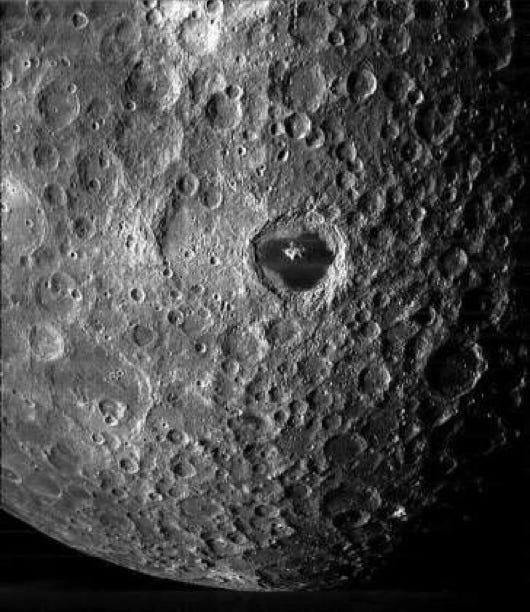
The dark-floored crater Tsiolkovsky on the Moon’s far side from Lunar Orbiter 4
The crater Tycho from Lunar Orbiter 5