Exploring the Moon
A history of lunar discovery from the first
space probes to recent times
Russia’s secret manned Moon programme
As the Apollo programme neared its climax in the late 1960s, the Soviet Union was desperately trying to beat the United States to the Moon. President Kennedy’s daring goal of putting a man on the Moon before the end of the decade had caught the Russians by surprise. In response, they secretly began to prepare a series of manned Moon shots that, they hoped, would culminate in a manned landing before Apollo.
The secret Russian Moon plan came in two parts. First, two cosmonauts would be sent on a circumlunar trip in a stripped-down Soyuz spaceship, launched by an existing rocket known as the Proton. Following that would come the lunar landing mission in which a more advanced version of the Soyuz would carry two men to the Moon, along with a lunar lander. Once in orbit around the Moon, one cosmonaut would enter the lander and descend on his own to the surface. According to reports, this cosmonaut would have been Alexei Leonov, who in 1965 had been the first man to walk in space. After a day on the Moon he would take off again and rejoin the orbiting Soyuz, which would then return to Earth. For the lunar landing mission, a powerful new rocket would be needed. Called the N-1, it was similar in size to the American Saturn V.
To rehearse the first part of the plan, the simple loop around the Moon and back, a number of flights were launched using a craft called Zond, which was an unmanned version of the proposed circumlunar Soyuz. However, the programme was beset with technical difficulties and the first fully successful flight in the series, Zond 7, was not until 1969 August. By then, Apollo 11 had completed the first manned lunar landing and there was no point in the Russians going ahead with a manned circumlunar flight.
The Russians slipped even further behind on their development of the mighty N-1 rocket. Four N-1 prototypes were test-launched between 1969 and 1972, but they all blew up and the programme was scrapped.
Had Apollo faltered, a Russian might well have been first to orbit the Moon. But, in retrospect, it is doubtful whether the manned landing programme could have gone ahead successfully given the unreliability of the N-1.
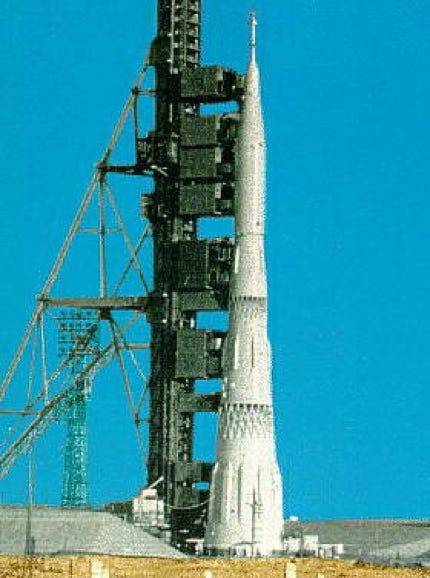
Russia’s N1 Moon rocket on the launch pad
Russia’s secret manned Moon programme
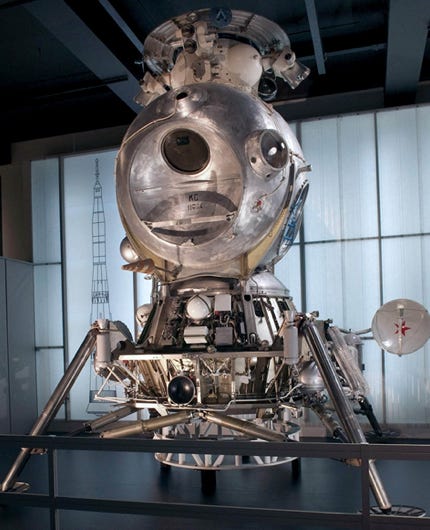
Russian lunar module