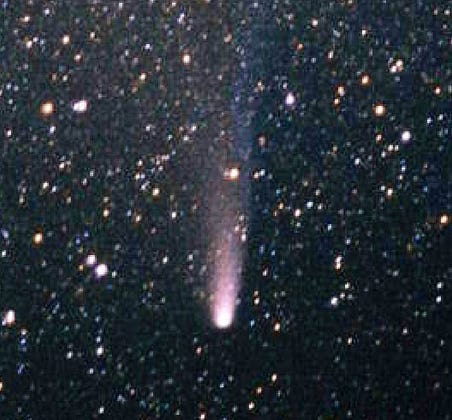
A BRIEF HISTORY OF HALLEY’S COMET
Revised extracts from A Comet Called Halley by Ian Ridpath
(Cambridge University Press, 1985)
The comet cloud
The comet cloud
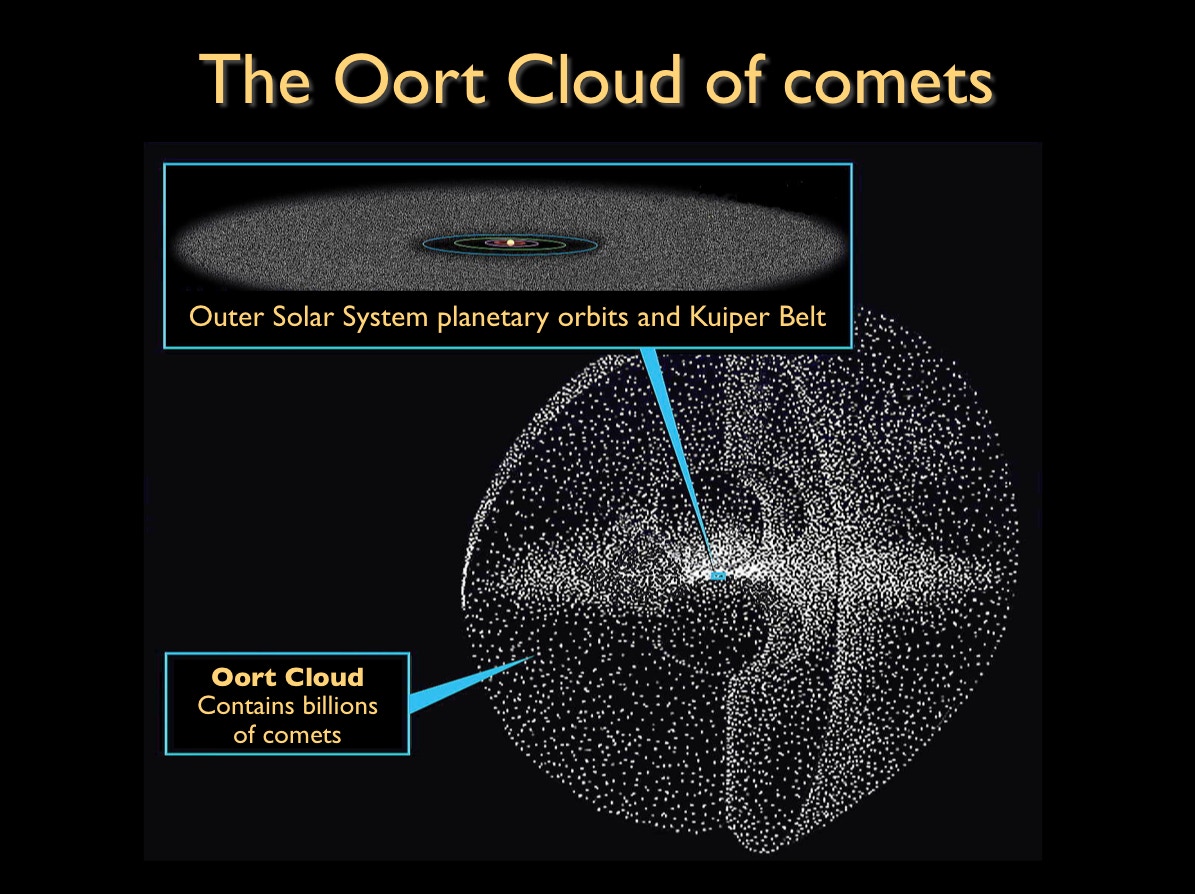
Beyond the planets, in the darkness far from the Sun, orbits a swarm of blocks of ice and dust – inactive comets. No one has actually seen this swarm, for at that distance the blocks are too faint to detect with any telescope. Rather, the swarm’s existence has been deduced from the fact that virgin comets, making their first approach to the Sun, arrive on highly elongated orbits that must originate partway to the nearest star.
According to the most widely accepted theory, comets are debris remaining from the formation of the Solar System some 4,600 million years ago. The comets tag along unseen in cold storage at the perimeter of the Solar System until diverted onto new routes by the gravity of passing stars. Some comets are elbowed out of the Solar System entirely, but others head sunwards.
Astronomers estimate that the cometary cold store, known as the Oort Cloud after the Dutch astronomer Jan Oort who proposed its existence in 1950, lies about 50,000 times farther from the Sun than does the Earth, a distance that light takes nearly a year to cross. Even that far away, the Oort Cloud is still held by the Sun’s gravity, albeit loosely. In recent years, astronomers have come to recognize that there is an inner extension of the Oort Cloud, called the Kuiper Belt, which is concentrated in the plane of the Solar System. Pluto, formerly classified as the ninth planet until demoted in 2006, is simply a large and close-in member of that belt, orbiting where the outer planets meet the realm of the comets.
Every few hundred thousand years a star passes close enough to disturb the comets of the Oort Cloud onto new orbits. To account for the regular supply of comets heading inwards to the Sun, there must be around a million million of them in the cloud. Yet the mass of all these comets is, in total, only a few per cent of the mass of the Earth. Although comets advertise themselves impressively, in truth they are disappointingly insubstantial.
No one knows when the comet that was to bear the name Halley made its first approach to the Sun, although one estimate suggests it was over 100,000 years ago. Left to its own devices, the comet would have swung around the Sun and headed back out into the Oort Cloud, not to be seen again for millennia. But, during the comet’s passage through the inner Solar System, its path was tweaked by the gravitational pull of the giant planet Jupiter which reined it into a tighter loop that has brought it back to the Sun regularly ever since. Halley’s Comet is the only really bright example among the comets that return regularly to the Sun. ☄
Counting comets
While Halley’s Comet is the best-known comet, and has been seen with the naked eye more often in history than any other, there are plenty more of these celestial wanderers to entertain astronomers. Each year over 200 come into view, mostly new discoveries but also some known comets returning. All but a few are faint, though, requiring large telescopes or satellites in space to be seen. Only occasionally does a comet become bright enough to be easily visible to the naked eye, such as Hale-Bopp in 1997, McNaught in 2007 – and of course Halley on its various returns.
One particularly daredevil family of comets is the Sungrazers, so named because they virtually scrape the Sun at their closest approach. One such was Comet Ikeya-Seki, which in 1965 passed a mere 500,000 kilometres from the Sun’s incandescent surface. This distance, only slightly more than the separation between the Earth and the Moon, is a hair’s breadth in astronomical terms. Numerous Sungrazers have been found in recent years by observatories in space designed to watch the environs of the Sun, notably a craft called SOHO.
Sungrazing comets have orbits that bear a distinct resemblance to each other, and are thought to be the fragments of a much larger super-comet that split after a succession of close approaches to the Sun. Some Sungrazers fail to emerge from their run of the gauntlet: they crash into the Sun, or are evaporated by the intense heat. For some examples, see here and here.