A BRIEF HISTORY OF HALLEY’S COMET
Revised extracts from A Comet Called Halley by Ian Ridpath
(Cambridge University Press, 1985)
Returns of Halley’s Comet
Returns of Halley’s Comet
BC
240
First confirmed sighting.
164
Seen by the Babylonians.
87
Seen by the Babylonians and Chinese.
12
Watched by Chinese for two months. ‘Hung like a sword over Rome before the death of Agrippa’ according to the historian Dion Cassius.
AD
66
‘A comet of the kind called Xiphias, because their tails appear to represent the blade of a sword’ was seen above Jerusalem before its fall, according to the Jewish historian Flavius Josephus.
141
Described by the Chinese as bluish-white in colour.
218
Described by the Roman historian Dion Cassius as ‘a very fearful star’. Heralded the murder of Emperor Macrinus of Rome by his own troops.
295
Seen in China, but not spectacular.
374
Comet passed 13.5 million kilometres from Earth.
451
Appeared before the defeat of Attila the Hun at the Battle of Chalons.
530
Noted in China and Europe, but not spectacular.
607
Comet passed 13.5 million kilometres from Earth.
684
First known Japanese records of the comet. Seen in Europe and depicted 800 years later in the Nuremberg Chronicle.
760
Seen in China, at the same time as another comet.
837
Closest-ever approach to the Earth (5 million km). Tail stretched halfway across the sky. Appeared as bright as Venus.
912
Seen briefly in China and Japan.
989
Seen in China, Japan, and (possibly) Korea.
1066
Appeared before the Battle of Hastings. Shown on the Bayeux Tapestry. The comet passed 16.5 million km from the Earth and was described in Europe as looking like a dragon, with multiple tails. Seen for over two months in China.
1145
Depicted on the Eadwine Psalter, with the remark that such ‘hairy stars’ appeared rarely, ‘and then as a portent’.
1222
Described by Japanese astronomers as being ‘as large as the half Moon . . . Its colour was white but its rays were red’.
1301
Seen by Giotto di Bondone and included in his painting The Adoration of the Magi. Chinese astronomers compared its brilliance to that of the first-magnitude star Procyon.
1378
Passed within 10 degrees of the north celestial pole, more northerly than at any time during the past 2,000 years. This is the last appearance of the comet for which Oriental records are better than Western ones.
1456
Observed in Italy by Paolo Toscanelli, who said its head was ‘as large as the eye of an ox’, with a tail ‘fan-shaped like that of a peacock’. Arabs said the tail resembled a Turkish scimitar. Turkish forces attacked Belgrade.
1531
Seen by Peter Apian, who noted that its tail always pointed away from the Sun. This sighting was included in Halley’s table.
1607
Seen by Johannes Kepler. This sighting was included in Halley’s table.
1682
Seen by Edmond Halley at Islington.
1759
Return predicted by Halley. First seen by Johann Palitzsch on 1758 December 25.
1835
First seen at the Vatican Observatory in August. Studied by John Herschel at the Cape of Good Hope.
1910
Photographed for the first time. Earth passed through the comet’s tail on May 20.
1986
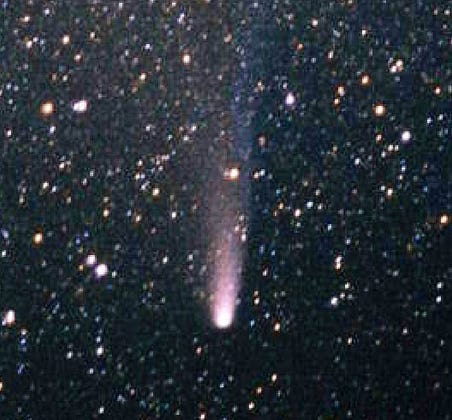
Reached perihelion on February 9, closest to Earth (63 million km) on April 11. Nucleus photographed by the European space probe Giotto and the Russian probes Vega 1 and 2.
2023
Reached aphelion on December 9 at 01.00 UT.
2061
Next return.