A BRIEF HISTORY OF HALLEY’S COMET
Revised extracts from A Comet Called Halley by Ian Ridpath
(Cambridge University Press, 1985)
Halley’s Comet in history
Halley’s Comet in history
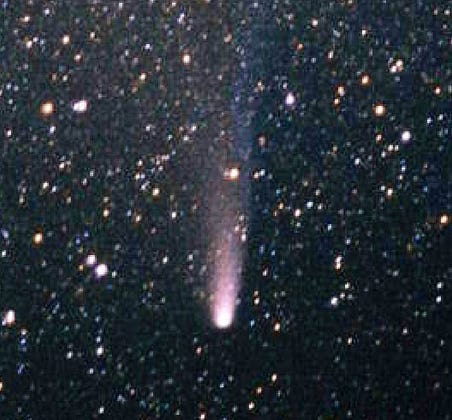
Since its first predicted return in 1759, Halley’s Comet has come back to us three times, in 1835, 1910, and most recently in 1985–86. Historical records, unknown to Edmond Halley, show that the Comet’s previous appearances stretch back far into the past, long before comets were recognized to be periodic. Including its most recent visit, Halley’s Comet has been sighted on 30 occasions, the earliest by the Chinese in 240 BC, and there may be still older records that remain undiscovered.
To chase the orbit of a comet back through time is not such an easy task as it might sound, for the gravitational effects of the planets are perpetually tugging on the comet and modifying its orbit. If the comet’s orbit is slightly expanded by the pull of the planets, it will take longer to return; if the orbit shrinks, the comet will come back sooner.
Prior to its appearance in 1456, the best observations of Halley’s Comet come from China. For over 2,000 years, the Chinese government ran an astronomical bureau whose officials kept a scrupulous watch on the sky, noting anything unusual and interpreting its portents for the Emperors. Their records are an encyclopaedic source of information about ancient events in the sky.
A close approach
Of the present-day astronomers who have tried backtracking Halley’s Comet, the most successful have been Donald Yeomans, who used NASA’s computers at the Jet Propulsion Laboratory in California, and Tao Kiang, a Chinese astronomer based at Dunsink Observatory in Ireland. In their research, published in 1981, Yeomans and Kiang calculated that the Comet made an exceptionally close approach to the Earth in AD 837, a mere 5 million kilometres away. There are extensive descriptions of this spectacular ‘broom star’ from China: ‘On the night of April 9 its length was more than 50 degrees. It branched into two tails . . . On the night of April 11 the length of the broom was 60 degrees. The tail was without branches and it pointed north. The Emperor summoned the Astronomer Royal and asked him the reason for these star changes.’ One hopes that the Astronomer Royal had a good answer handy, for tradition has it that two Chinese astronomers who were caught napping by an unexpected eclipse were beheaded.
Yeomans and Kiang found that the earliest reliable record of Halley’s Comet was in 240 BC, when a Chinese source briefly noted: ‘During this year a broom star was seen at the north direction and then at the west direction.’ Then comes the inevitable genuflection to superstition: ‘During the summer the Empress Dowager died.’
Surprisingly, the Chinese did not record the Comet’s subsequent appearance in 164 BC, and only vaguely mentioned it in 87 BC. This was vexing for Yeomans and Kiang, who needed to check their calculations for those years. But confirmation came from a different direction: the Babylonians, inhabitants of the Middle East, who assiduously compiled diaries of astronomical information.
Their annals for 164 BC and 87 BC contain unmistakable references to a comet that can only be Halley’s putting in its regular appearances according to the schedule established by Yeomans and Kiang. It is a remarkable fact that observations made with the naked eye 2,000 years ago, and impressed into clay tablets in cuneiform script, are still of value in this day of high-speed computers and space probes. Perhaps even older records of the Comet, still unnoticed, lie etched on the Babylonian clay tablets stored in the British Museum.
1066 and all that
More recently, we know that it was Halley’s Comet in 1066 that tolled the knell for King Harold at the Battle of Hastings. Its depiction on the Bayeux Tapestry, being pointed out to King Harold by his worried aides, is perhaps the most famous image of a comet in history. An earlier appearance of Halley’s Comet, in AD 684, is illustrated in the Nuremberg Chronicle, but this book was not published until 1493, and the simple woodcut is merely an artist’s impression made 800 years after the fact. According to the Chronicle’s accompanying text, the Comet’s appearance was followed by three months of rain and storms, culminating in plague.

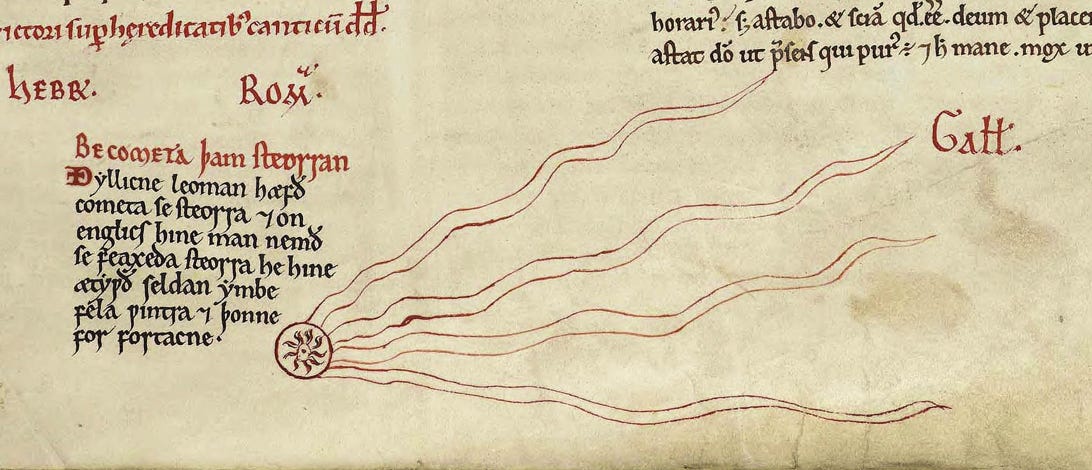
Eadwine, a Canterbury monk, sketched the Comet at its 1145 apparition on the bottom of an illuminated manuscript of Psalms he was transcribing and hence immortalized himself in a way he did not expect. Among those who marvelled at the Comet on its appearance in 1301 was the Italian artist Giotto di Bondone who depicted it as the Star of Bethlehem, darting golden fires in the background of his fresco of The Adoration of the Magi. In 1985, the European Space Agency’s probe to Halley’s Comet was given Giotto’s name. ☄
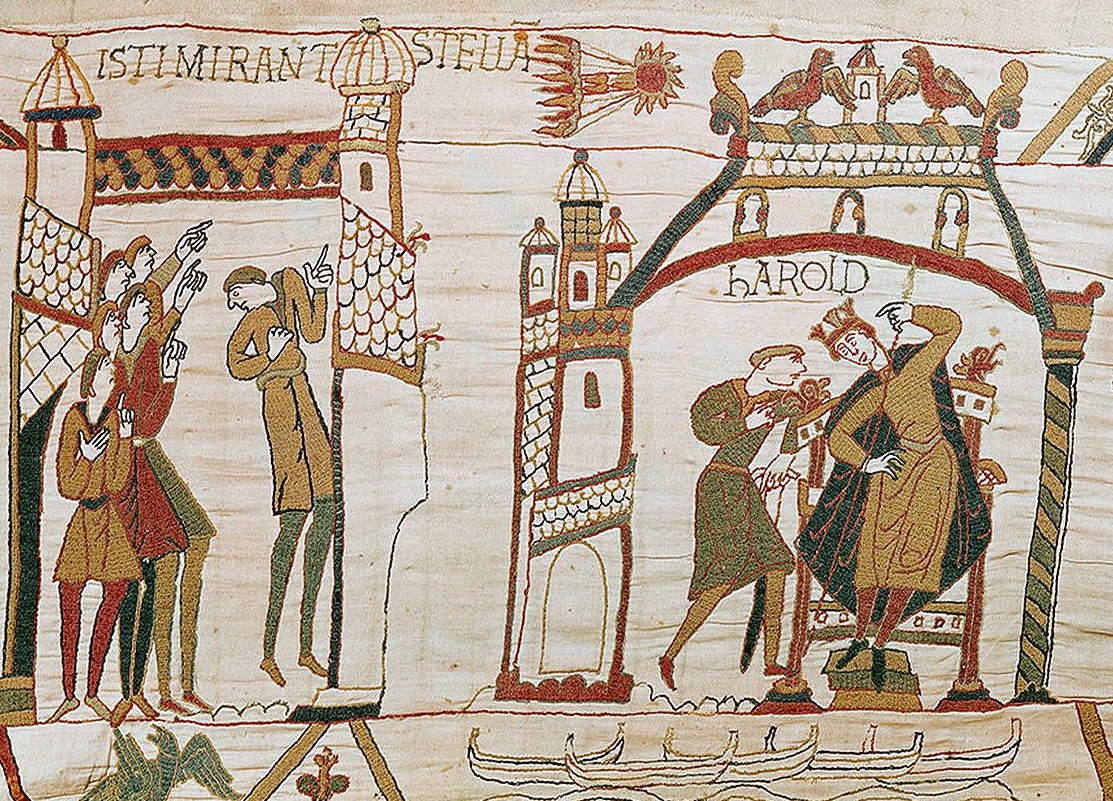
Halley’s Comet seen on the Bayeux Tapestry. ‘Isti mirant stella’ reads the heading – ‘they marvel at the star’ – while, at right, King Harold shifts uneasily on his throne.
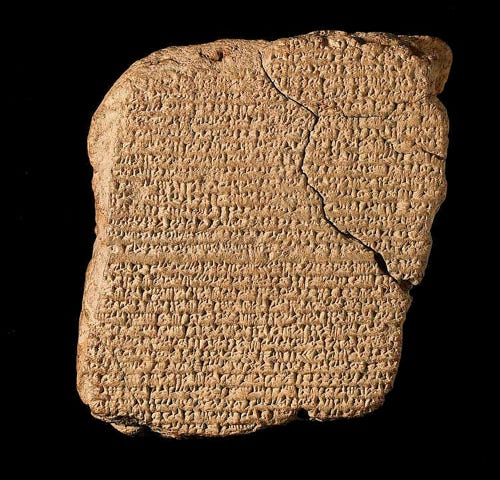
Recorded on clay
This Babylonian clay tablet in cuneiform script contains astronomical observations including the appearance of Halley’s Comet in 164 BC.
(Trustees of the British Museum.)
Sketch of what is thought to be Halley’s Comet at its appearance in 1145 on the Eadwine Psalter, an illuminated manuscript of the Psalms. (Trinity College, Cambridge.)