A BRIEF HISTORY OF HALLEY’S COMET
Revised extracts from A Comet Called Halley by Ian Ridpath
(Cambridge University Press, 1985)
The Comet returns
The Comet returns
Halley was aware that his prediction of the Comet’s return could be in error by many months, for he had only roughly estimated the effect of Jupiter on the Comet’s path and had not taken the effect of Saturn into account at all. Two French astronomers, Alexis Clairaut and Joseph Lalande, spent several arduous months refining the prediction. They found that the actions of Jupiter and Saturn would delay the Comet’s arrival at perihelion (closest to the Sun) until April 1759.
So great was the anticipation that scarcely a night can have passed in 1758 without some astronomer in Europe looking out for the Comet. As the months wore on with no sighting, doubts began to surface. At last, on Christmas night 1758, a German amateur astronomer, Johann Palitzsch, observing with a home-made telescope, saw the smudgy image of the Comet. It reached perihelion on 1759 March 13, a month earlier than the revised date calculated by Clairaut and Lalande. (Had they known of the existence of the planets Uranus and Neptune, not yet discovered, their prediction would have been even more accurate.)
Now there could be no doubt. Comets were periodic and they were members of the Solar System, subject to the same laws that guided the planets in their paths. And Edmond Halley, guided by the hand of Isaac Newton, was the man who had proved it. Halley’s Comet is his permanent memorial, looping around the Sun once in a human lifespan. ☄
The orbit of Halley’s Comet
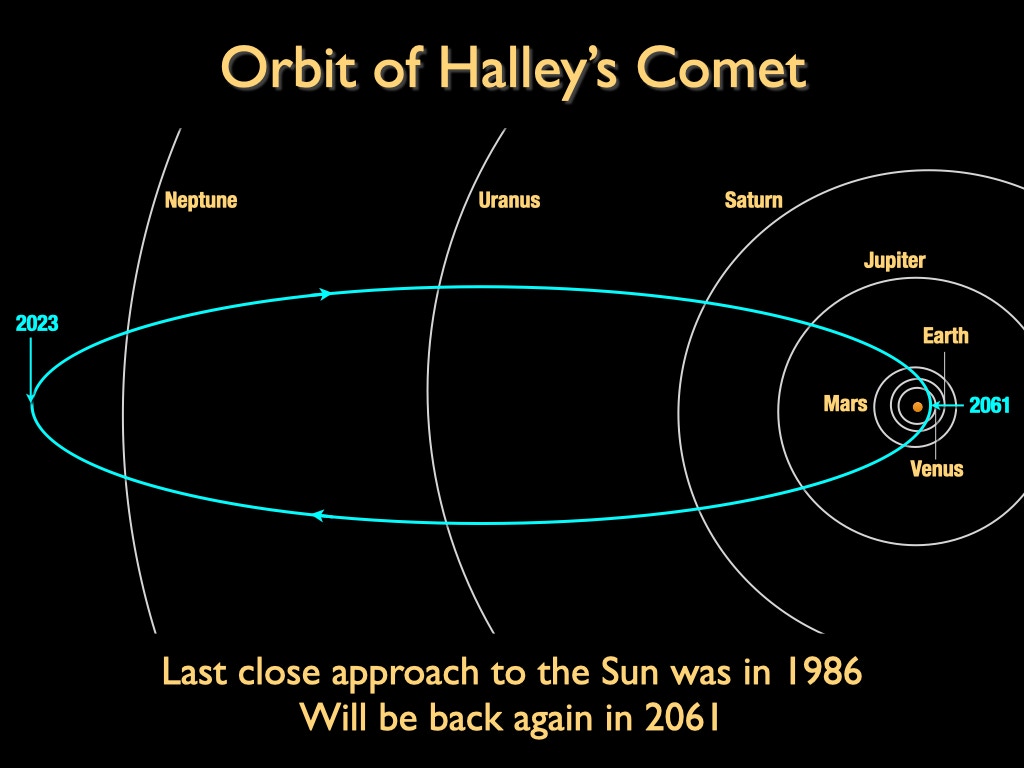
Halley’s Comet takes an average of 76 years to orbit the Sun, covering 11,500 million kilometres in the process, but in practice the intervals between successive returns can be a few years longer or shorter than this due to the gravitational pulls of the planets which sometimes speed it up and sometimes slow it down.
Measured from one perihelion to the next, Halley’s quickest return was after 74.4 years, from 1835 November to 1910 April, while the longest interval was 79.25 years, from 451 June to 530 September. At its most distant (aphelion) the Comet retreats to 5,300 million kilometres from the Sun, beyond the orbit of Neptune. At its closest (perihelion) it passes 88 million kilometres from the Sun, between the orbits of Venus and Mercury. In accordance with the laws of planetary motion, when farthest from the Sun the Comet is moving slowest, at 3,280 kilometres per hour, while at its closest it is moving most quickly, at 196,000 kilometres per hour (on each orbit the exact figures differ slightly).
One fear can be dispelled immediately: there is no chance of a collision of the Comet with the Earth, or any other planet for that matter. The closest that the Earth comes to the Comet’s present orbit is 10 million km.
For an interactive orbit diagram at NASA/JPL, go to this link and click ‘show’ next to the heading Orbit Viewer. ☄