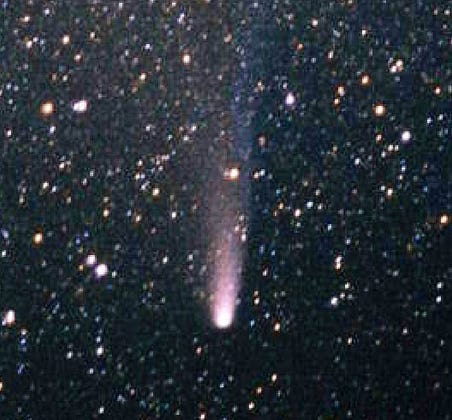
A BRIEF HISTORY OF HALLEY’S COMET
Revised extracts from A Comet Called Halley by Ian Ridpath
(Cambridge University Press, 1985)
Understanding comets
Understanding comets
Comet fever reached new heights in the fifteenth and sixteenth centuries, when a total of 21 comets was seen. Ever alert, prophets of doom began to churn out lurid pamphlets predicting all manner of associated evils. They have been at it ever since.
But this was also the time when cometary science began to take tentative steps forward. One of the contributory factors was Halley’s Comet, although no one knew it by that name at that time. A German astronomer, Peter Apian (also known in Latin as Petrus Apianus), observed Halley’s Comet in 1531 and reported that its tail always stretched away from the Sun. Apian’s observations, printed in a book with beautiful hand-coloured drawings, made a great impression. Comet tails do indeed flee from the Sun, no matter in which direction the comet is travelling, but the full explanation had to await twentieth-century physics.
In 1577 Tycho Brahe, the greatest observer of the pre-telescopic era, made a breakthrough that was literally shattering. From his observatory on the Danish island of Ven, Tycho demonstrated that the bright comet of 1577 lay far beyond the Moon and in the realm of the planets, in contradiction to the teachings of Aristotle.
Tycho was not a man to worry about stepping on the toes of authority. As he watched the comet take its course through the heavens from night to night, somewhere in his imagination he must have heard the sound of breaking glass – the crystal spheres of Aristotle that the comet had shattered. It was an impressive example of observation overthrowing a theory.
Comets and planets
But what paths did comets follow through space? It would have helped if astronomers had known how the planets moved. At that time there was still confusion over whether the Sun and planets went around the Earth, as in the old system of Aristotle and Ptolemy, or if the Earth and planets orbited around the Sun, the new theory due to Copernicus. In 1609 the German mathematician Johannes Kepler settled the matter by calculating, from the observations of Tycho Brahe, that the planets orbited the Sun along elliptical paths.
Kepler also turned his attention to comets following the appearance of one in 1607 (actually, Halley’s Comet again). Curiously, Kepler considered that comets moved through the Solar System in straight lines, although in fairness the observations available to him were insufficient to compute an accurate orbit. Despite this lapse, he had some astute ideas about the formation of comet tails: ‘The direct rays of the Sun strike upon it [the comet], penetrate its substance, draw away with them a portion of this matter, and issue thence to form the track of light we call the tail . . . In this manner the comet is consumed by breathing out is own tail.’ Comets, he surmised correctly, are as numerous as fish in the sea, but we see only a selection of them.
‘Blazeing starrs’
In 1664 and 1665 two bright comets appeared, and between them occurred an eclipse of the Moon. Such a triple omen was unique. One can almost hear the collective intake of breath in anticipation of the unparalleled disasters that surely must follow. Lest anyone be uncertain about the meaning of these omens, John Gadbury, an English astrologer, thoughtfully interpreted them in his book of 1665, De Cometis. ‘These Blazeing Starrs! Threaten the World with Famine, Plague, & Warrs,’ he trumpeted. ‘To Princes, Death: to Kingdoms, many Crises: to all Estates, inevitable Losses!’ He can hardly have believed his luck when London was hit by the Black Death in 1665 followed by the Great Fire the year after. Unwittingly, he had demonstrated a fact that modern-day astrologers know well: the laws of chance ensure you can’t be wrong all the time.
While London suffered, in Danzig one of the greatest astronomers of the day, Johannes Hevelius, was watching the comets with scientific detachment. He published his observations in 1668 in a volume entitled Cometographia in which he theorized that comets are thrown out by the planets, notably Jupiter and Saturn, and move past the Sun on boomerang-shaped curves. Unlike boomerangs, though, they never came back. One attractive feature of Hevelius’s book is a series of drawings of comets. To the untutored eye they may resemble the amputated tails of small furry mammals, but they were the most accurate renditions up to that time.
A number of astronomers began to suspect that comets orbited the Sun on paths like exaggerated versions of the planets’ orbits, but no one could prove it. The time was ripe for the emergence of a man who, in the words of Seneca, could tell the paths of the comets. In fact, it took not one man but two: Isaac Newton and Edmond Halley. ☄
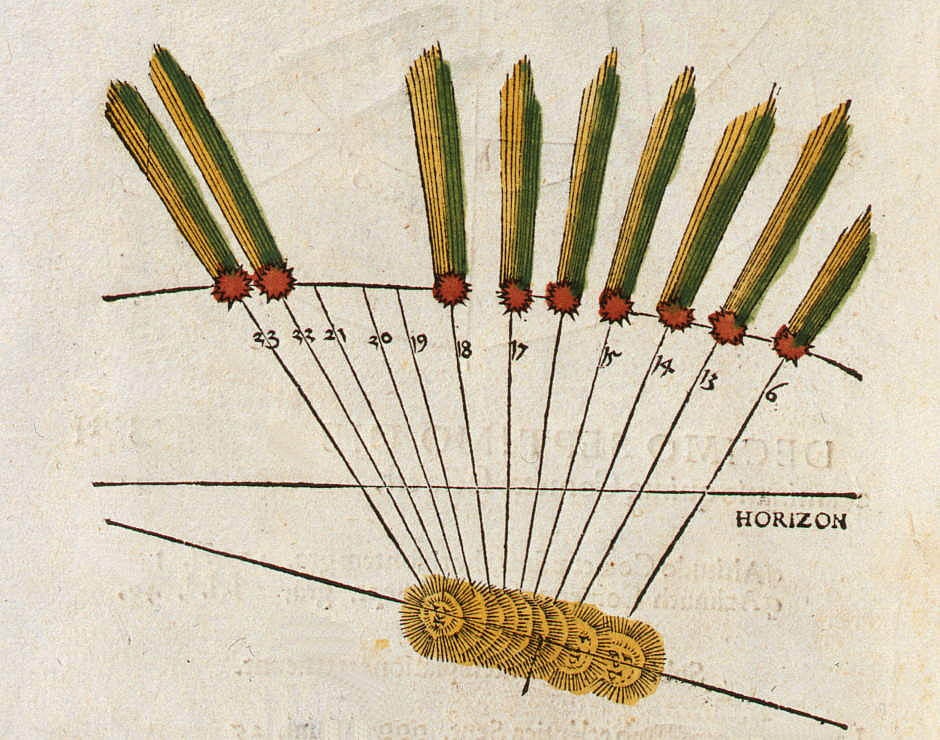
Diagram by Peter Apian from his book Astronomicum Caesareum (1540) demonstrating that a comet’s tail points away from the Sun. The comet he depicted was that of 1531, which we now know as Halley’s Comet.
Image courtesy Royal Astronomical Society.