A BRIEF HISTORY OF HALLEY’S COMET
Revised extracts from A Comet Called Halley by Ian Ridpath
(Cambridge University Press, 1985)
The return of 1910
The return of 1910
Before Comet Halley’s appearance in 1910, the German Astronomical Association, the Astronomische Gesellschaft, offered a prize of 1,000 Marks (then worth £50) for the best prediction of the comet’s forthcoming passage past the Sun. To ensure impartiality in judging, entries were to be sent in anonymously, with the name of the author sealed in an accompanying envelope. Each entry was to be identified only by a motto at its head.
At the Royal Observatory in Greenwich, Philip H. Cowell and Andrew C. D. Crommelin took up the German challenge. They predicted a return to perihelion on 1910 April 16. They sent in their entry to the Astronomische Gesellschaft under the motto Isti Mirantur Stellam, ‘They marvel at the star’, the legend on the Bayeux Tapestry.
Observatories around the world raced each other to sight the returning comet. Max Wolf of Heidelberg spotted it first, on a photograph he took early on the morning of 1909 September 12. The first visual observations were made with the 40-inch refractor at Yerkes Observatory three nights later. Now the predictions could be judged against the actual path of the comet. When the sealed envelopes were opened, the winners were Cowell and Crommelin.
‘Unrecognized forces’
Not content, the two Greenwich astronomers continued to refine their calculations, taking the gravitational effects of all the planets into account, and published their results in an 84-page book. Their revised date of perihelion was for early on April 17. But, despite their best efforts, the comet actually got to perihelion three days later than they predicted. Cowell and Crommelin concluded: ‘There are forces of an unrecognized kind influencing the comet’s motion’.
What these mysterious forces were was not known for certain until 1950, when they were explained by the American astronomer Fred Whipple, progenitor of the dirty snowball theory of comet nuclei. Puffs of gas escaping from the nucleus produce a rocket effect, like the manoeuvring jets of a spacecraft, which pushes the comet slightly off course. Astronomers term these effects non-gravitational forces, and they now take them into account when calculating the path of a comet. ☄
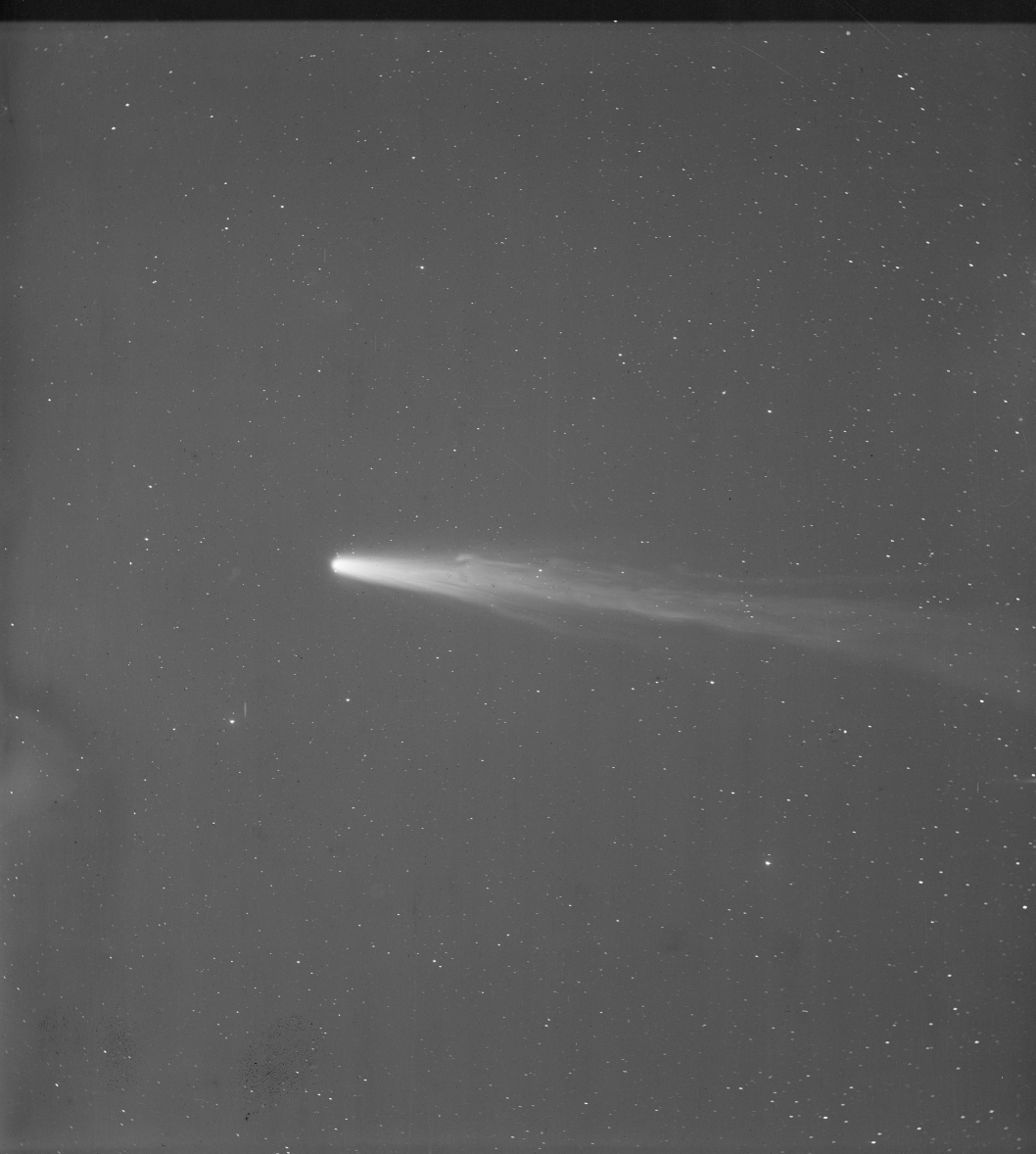
Halley’s Comet photographed on 1910 April 21 from Arequipa, Peru.
(Image from Harvard College Observatory.)