Celestial Atlas
by
Alexander Jamieson
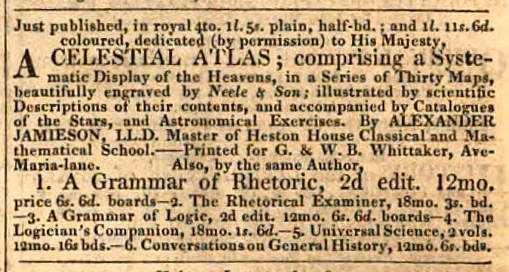
Alexander Jamieson’s Celestial Atlas appeared in February 1822, with a second edition following in September that same year. For all the fame that the Atlas achieved, its author remains little known. He evidently had a wide knowledge of science, mathematics, and languages, for he wrote a number of educational works on subjects as diverse as cartography, logic, rhetoric, algebra, mechanics, and hydrostatics as well as editing a Latin dictionary and running a series of private schools. No obituary of him was ever published, and this page is a partial attempt to rectify that.
Early life
Jamieson was born in Rothesay on the Isle of Bute, west Scotland, in 1782, the son of a wheelwright. He obtained MA and LLD degrees from Marischal College, Aberdeen, in 1821 and 1823. In 1825 he became a mature student at St John’s College Cambridge but there is no record that he ever resided there or obtained any degree. In fact, he seems to have spent most of his working life in and around London as a writer, teacher, and finally an actuary.
His first major book, A Treatise on the Construction of Maps, appeared in 1814. In its Preface he gives his address as Wells Street, off Oxford Street in central London. In 1820 he married Frances Thurtle (1779–1870) in Kensington, an upmarket area of west central London. Frances was an author of travel and historical books, and they both had the same London publisher. It is while he was at Kensington that we first hear of him running his own school.
Jamieson the schoolmaster
Jamieson was still living and teaching at Kensington in 1822 when he published his Celestial Atlas, but he and his school were soon on the move. In 1824, he described himself as Master of Heston House Classical and Mathematical School near Hounslow, in Middlesex, just west of London. An advertisement for the school emphasized strict discipline and a strong work ethic combined with religious and moral instruction, no doubt indicative of Jamieson’s own upbringing.
In 1826 he had moved again, a few miles east from Heston to Wyke House in Sion Hill (the modern-day Syon Lane), southeast of Osterley Park, to set up Wyke House School, where he remained for the next twelve years. This account of an examination of the scholars for the annual prizegiving tells us more about Wyke House and its activities. An advertisement for the school in January 1838 announces: ‘Dr Jamieson boards and educates young gentlemen in the Greek and Roman Classics, the various branches of pure and mixed Mathematics, Commercial, Geographical and Astronomical Science, and General Literature, with all the necessary parts of a liberal, intellectual, and systematic education.’
Unfortunately, this attempt to attract more pupils was already too late because Jamieson was declared bankrupt in March that year. He left Wyke House, which became a mental hospital. Jamieson subsequently worked as an actuary with a series of life assurance companies but did not seem to stay in any post for long. However, this experience led to his final book, Report on the constitution and operations of life assurance societies (1841). He later moved to Belgium and died in Bruges in July 1850.
The Celestial Atlas – editions
Of all Jamieson’s many publications, it is his Celestial Atlas that is best remembered. By the time it appeared Jamieson was evidently well connected for he obtained royal approval to dedicate it to the king of England, George IV. Two editions were produced in rapid succession, one dated February 1822 and the other September 1822. The star charts in both editions appear identical – even obvious labelling errors such as ‘Herscelii’ for Herschelii on Plate 4 and ‘Fyxis’ for Pyxis on Plate 26 went uncorrected. The only significant change seems to have been the insertion of an unnumbered plate after the Preface illustrating Egyptian and Hindu zodiacs.
The second edition was later reprinted on thinner paper and with a somewhat smaller page size (earlier printings had had overly generous margins). No date is given for this reprint, but on its title page Jamieson’s name has the post-nominal letters LLD in place of the previous AM, so he had evidently obtained his doctorate of law in the meantime. An advertisement for the Celestial Atlas in the London Literary Gazette of 7 February 1824 describes it as ‘just published’, so a date of late 1823 or early 1824 seems probable. Confusingly, though, the title page of this reprint still bears the date of first publication, i.e. 1 February 1822.
The Celestial Atlas – charts
Jamieson’s Celestial Atlas was an attempt to produce a British version of the highly popular atlases of Jean-Baptiste Fortin in France and Johann Bode in Germany, and it followed the same plan as those (for more on these other atlases see my page here). Twenty six plates cover the sky down to declinations between –37° and –42° (the southern limit varies from chart to chart, the most southerly of all being on Chart 27, the tail of Hydra). Two more plates are complete celestial hemispheres, another shows only the brightest stars in the northern hemisphere to aid direction-finding, and the last contains diagrams of the Moon, Venus, Jupiter, and Saturn. The plates were engraved by the firm of Neele and Son who were trade engravers in The Strand, London.
Jamieson explains in the Preface that he had originally planned much larger charts, but had to reduce them in size because of cost. As published, they are the same size as the charts in the atlases of Fortin and Bode, i.e. approximately 9 inches wide by 7 inches high (22.5 by 17.5 cm) with slight variations from plate to plate. Jamieson also adopted Bode’s innovation of drawing boundary lines snaking freeform between the constellation figures.
Where Jamieson’s charts differed most noticeably from those of Fortin and Bode was in his modelling of the constellation figures. Fortin and Bode closely followed the depictions in Flamsteed’s Atlas Coelestis, but Jamieson allowed himself greater artistic freedom. His figures were more realistically drawn, notably in his improvements on Flamsteed’s unconvincing portrayals of Lacerta, Lynx, Cancer, Scorpius, and the frankly ugly Canis Major. Overall, Jamieson’s figures are more appealing than those of his predecessors.
Three new constellations
More than 100 constellations are included, mostly the same as those shown by Bode. Jamieson also introduced three constellations of his own devising: , a rod held by Aquarius, for measuring the depth of the Nile (i.e. a Nilometer); , the owl, which took the place of the Solitaire; while on his chart of the southern skies he quietly replaced Lacaille’s Reticulum with , the sundial. Facsimiles of Jamieson’s charts were published in 1989 as part of a book called Men, Monsters and the Modern Universe by George Lovi and Wil Tirion.
As well as the charts, Jamieson’s Atlas contained a substantial amount of text including descriptions of the constellations, lists of the main stars with positions for the year 1820, and exercises for students. A scan of the first edition from the US Naval Observatory’s collection can be seen here, while charts from the second edition can be seen here. The thumbnails at the bottom of this page link to the US Naval Observatory scans held on Wikimedia Commons. Thanks to them all for making these scans freely available.
Follow-up
In 1824 Jamieson published a follow-up called An Atlas of Outline Maps of the Heavens. This consisted of 28 charts the same size as those in his Celestial Atlas (26 constellation charts and two hemispheres) depicting the outlines of the constellation figures only, with no stars. Students were expected to position the stars on the charts for themselves by reference to his Celestial Atlas. The idea seems not to have caught on and this star-free atlas remains a little-known curiosity.
Jamieson’s Atlas inspired an attractive set of constellation cards called Urania’s Mirror which appeared around 1825. These cards are now better known than the original Atlas. I have written about them on a separate page. Elijah Hinsdale Burritt (1794-1838), an American amateur astronomer and educator, also copied Jamieson’s figures for his popular Atlas Designed to Illustrate The Geography of the Heavens (1835 and many subsequent editions). Hence Jamieson’s atlas spawned at least two major derivatives even if he was not given the credit he was due.
It is a pleasure to thank Elizabeth Dolan of Manly, Queensland, Australia, and Fiona Colbert, biographical librarian of St John’s College Cambridge, for their help with research into the life of Alexander Jamieson.
© Ian Ridpath. All rights reserved
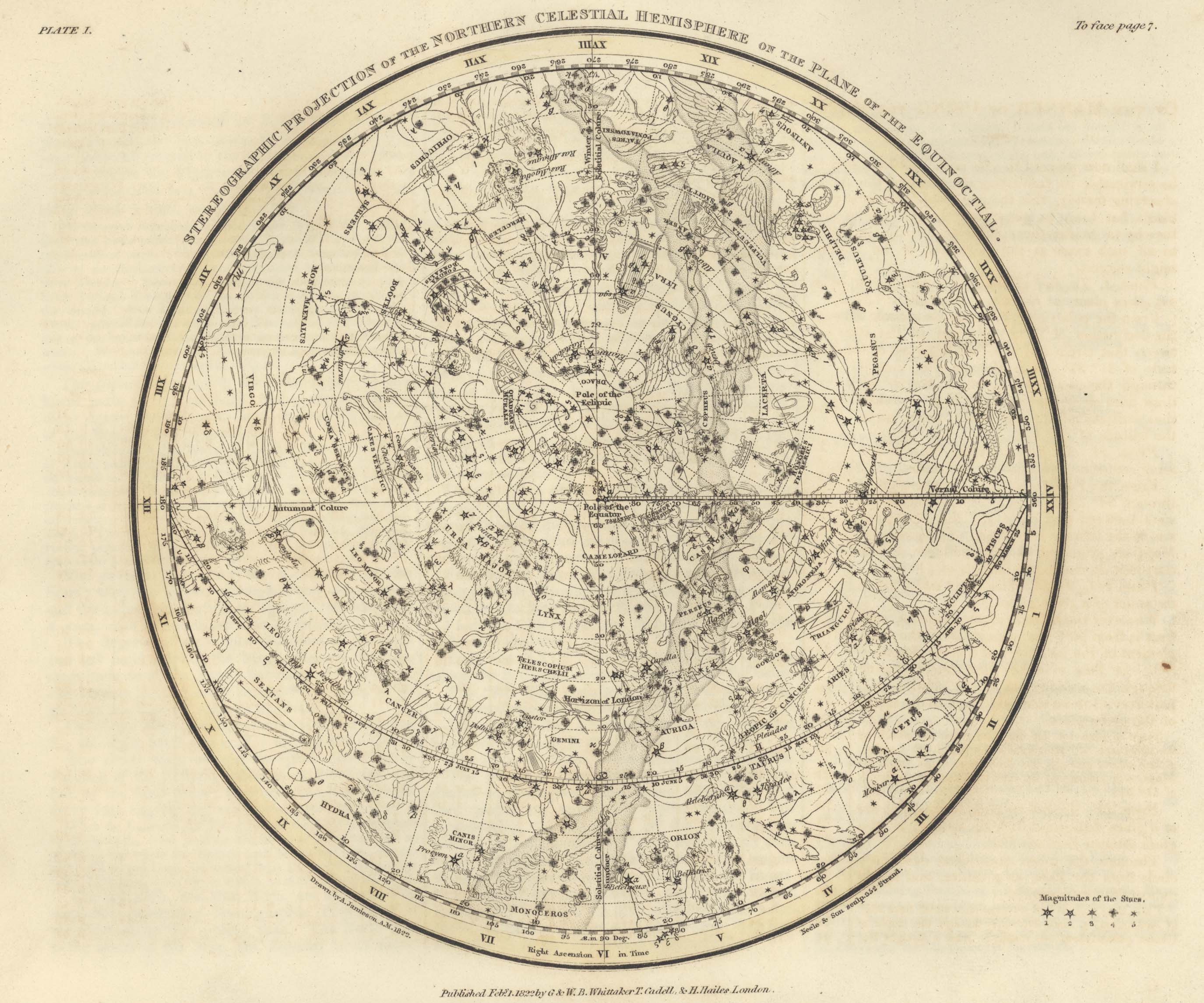
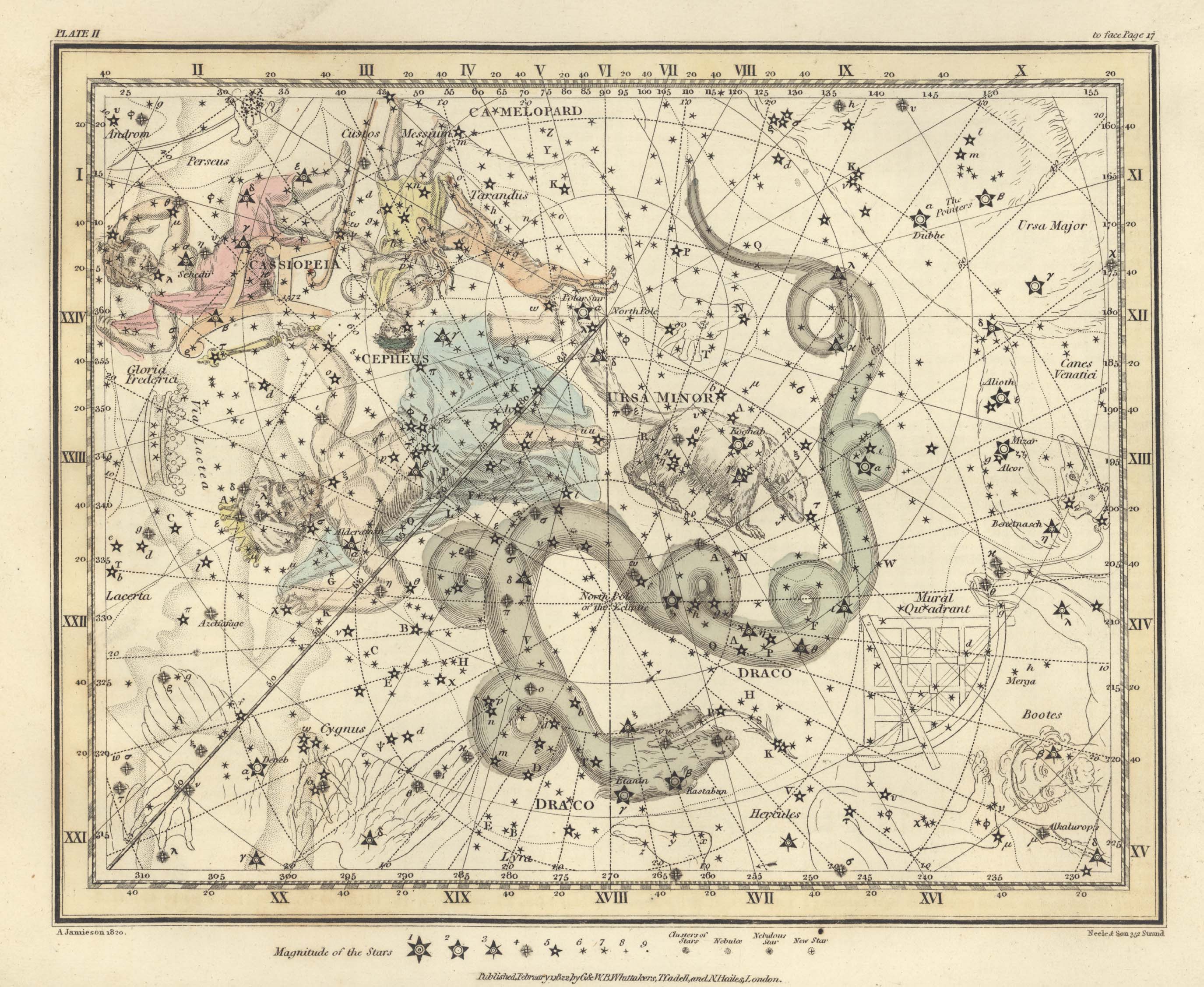
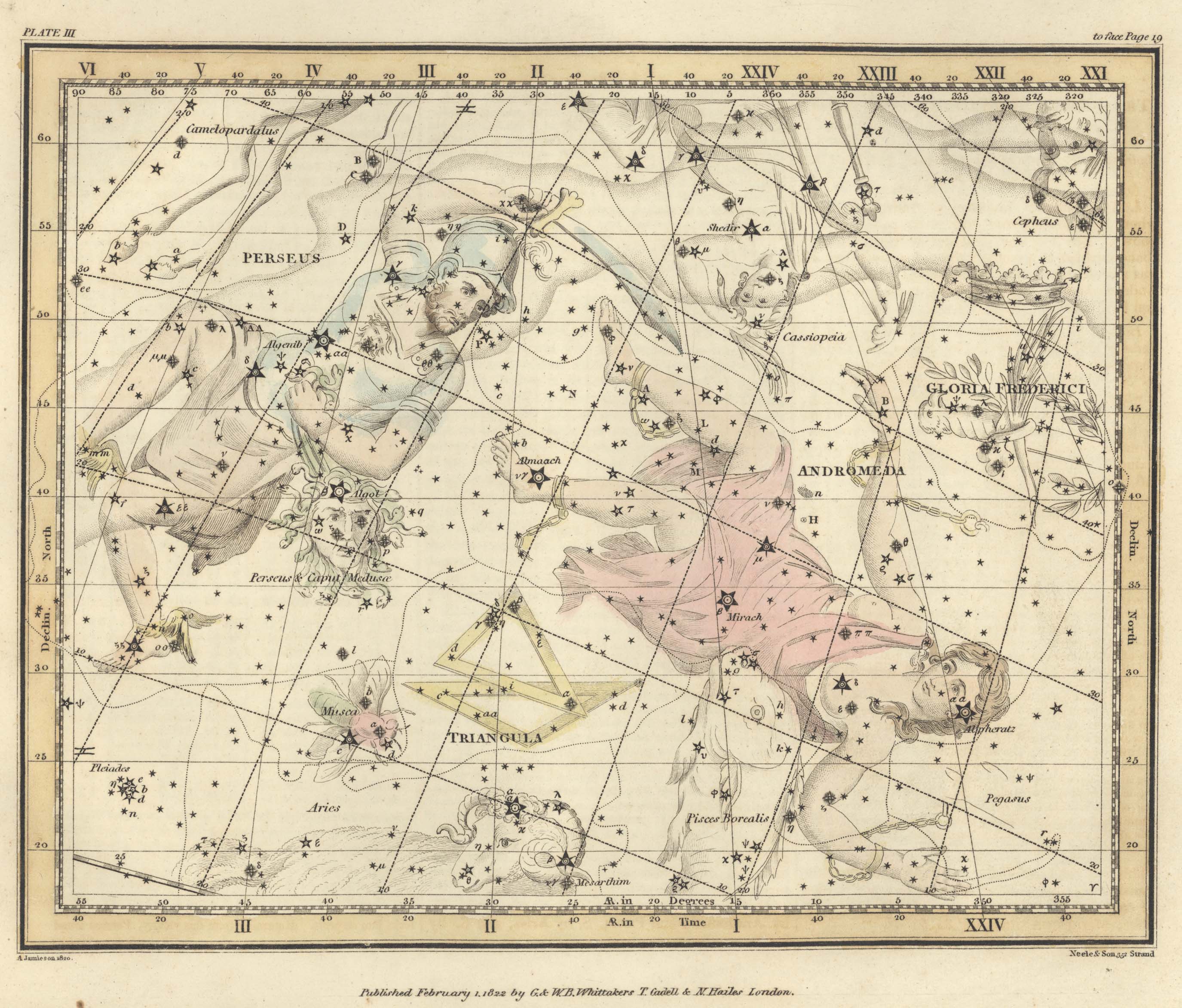

Plate 1
Northern Hemisphere
Plate 2
Ursa Minor, Cassiopeia, Tarandus, Cepheus, Draco, Custos Messium
Plate 3
Andromeda, Perseus and Caput Medusae, Triangula, Gloria Frederici
Plate 4
Auriga, Camelopardalis, Telescopium Herschelii
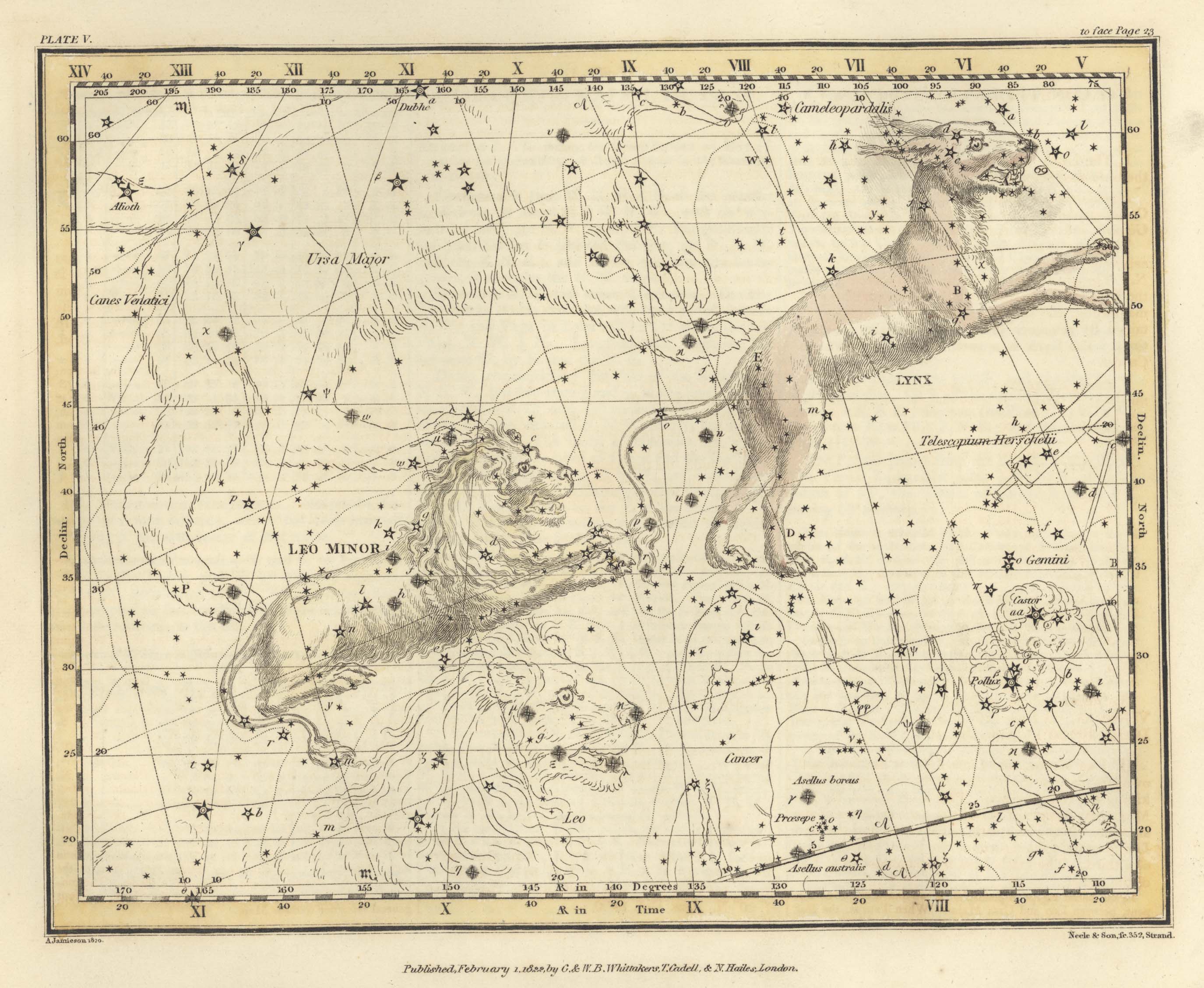
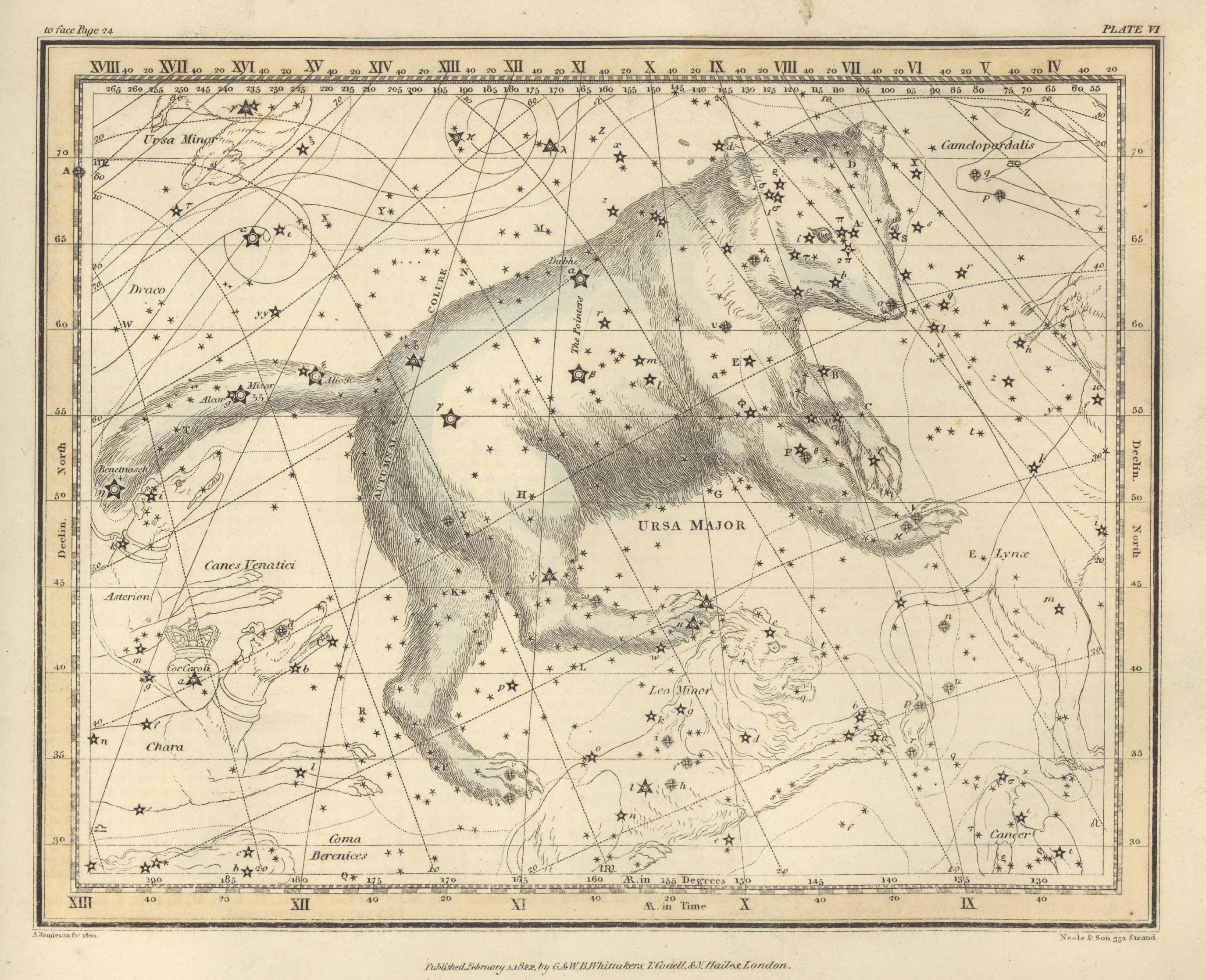


Plate 5
Lynx, Leo Minor
Plate 6
Ursa Major
Plate 7
Boötes and Mons Maenalus, Canes Venatici,
Coma Berenices,
Quadrans Muralis
Plate 8
Corona Borealis,
Hercules and Cerberus,
Lyra


Plate 9
Ophiuchus, Serpens
Plate 10
Aquila and Antinous,
Scutum Sobieski,
Taurus Poniatowski, Sagitta, Vulpecula and Anser, Delphinus
Plate 11
Cygnus, Lacerta, Lyra
Plate 12
Pegasus, Equuleus


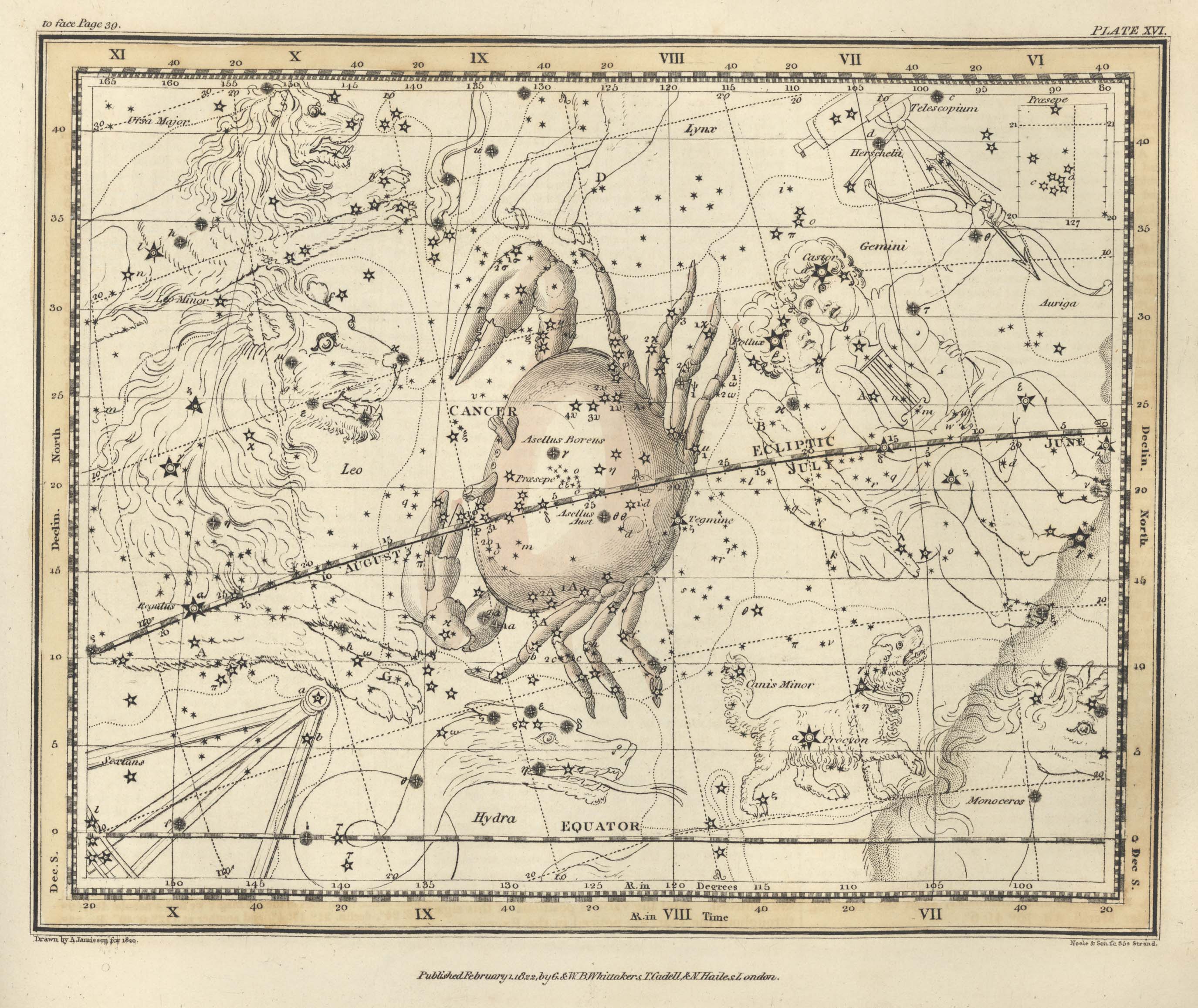
Plate 13
Aries, Musca Borealis
Plate 14
Taurus
Plate 15
Gemini
Plate 16
Cancer

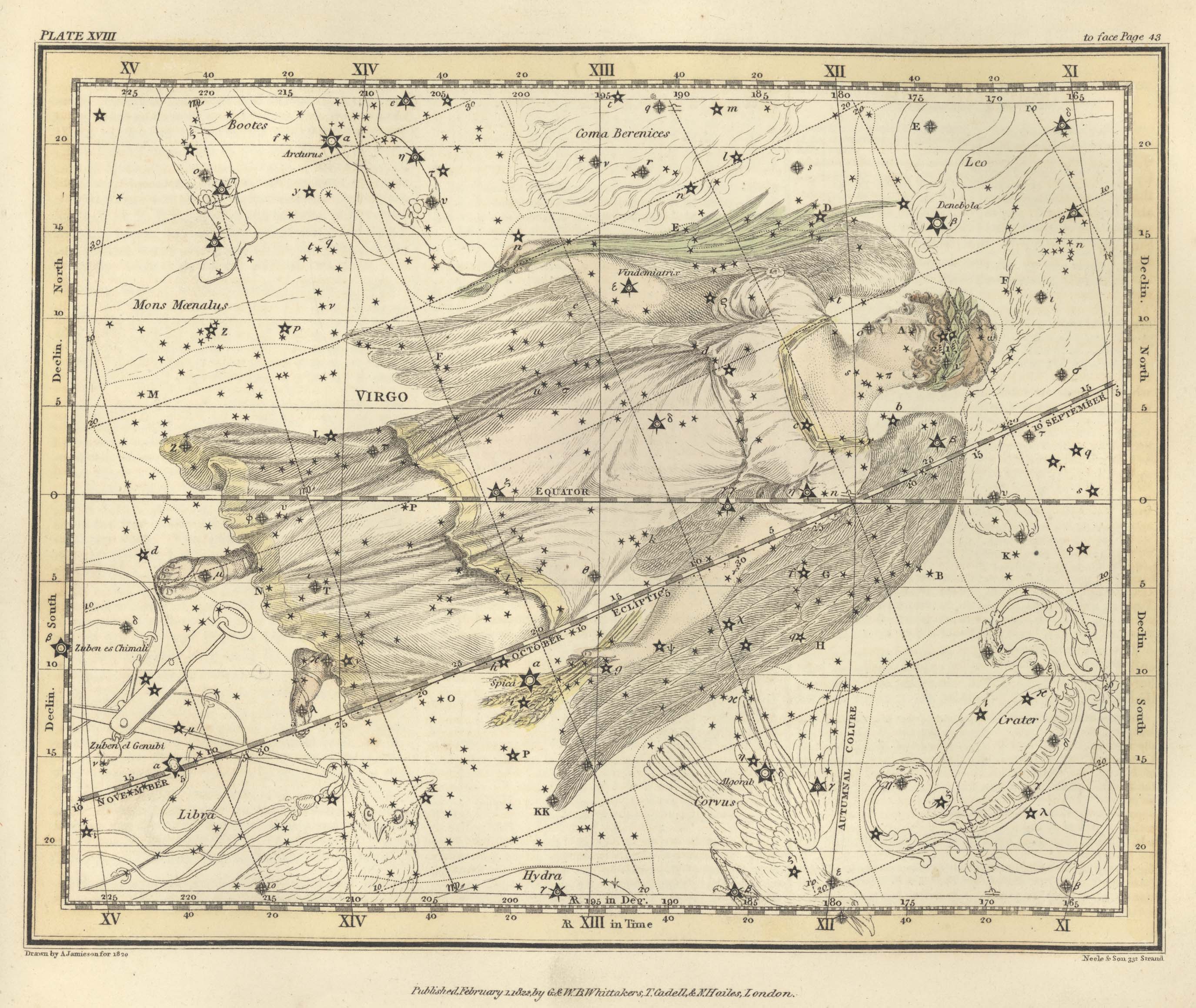
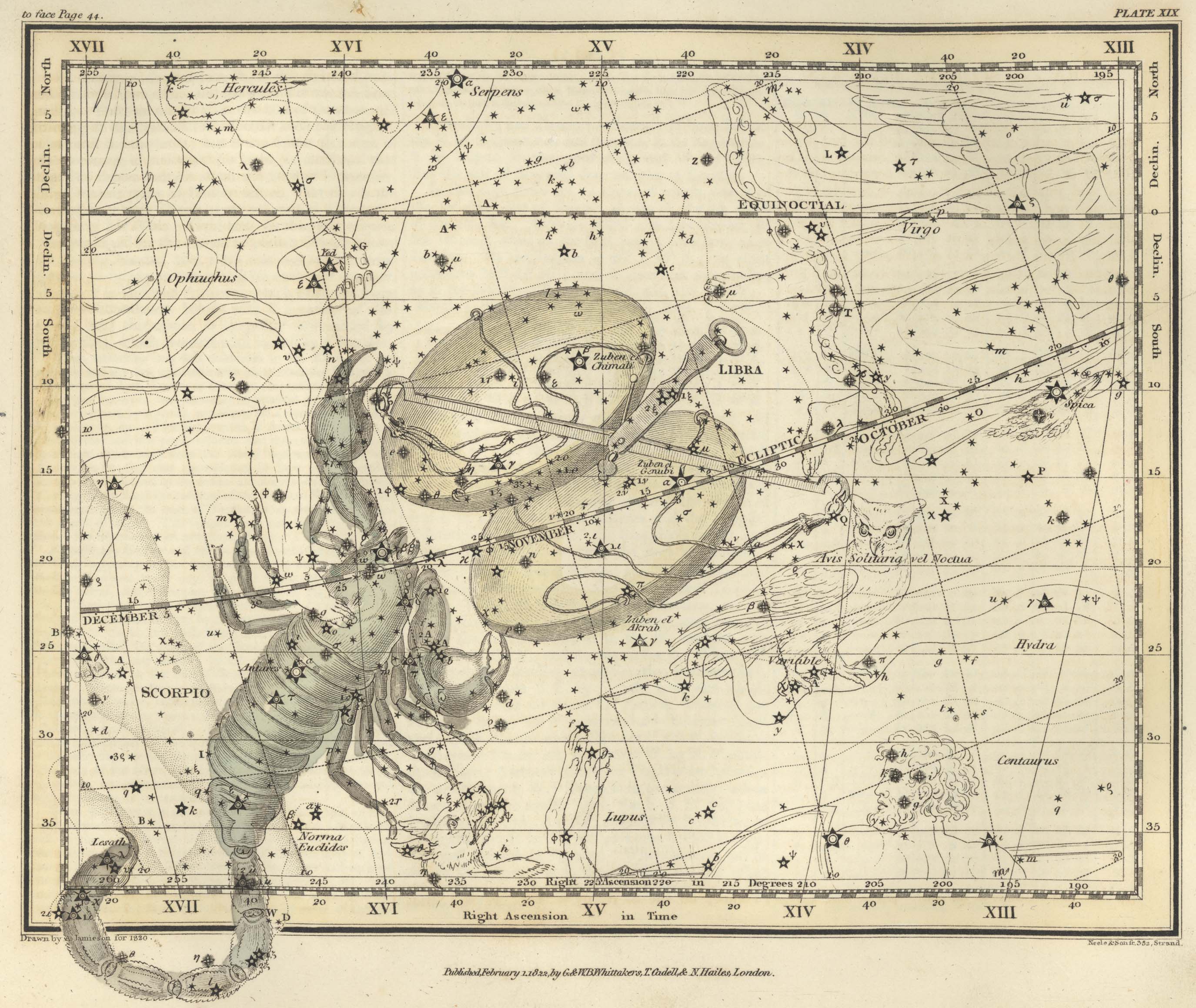
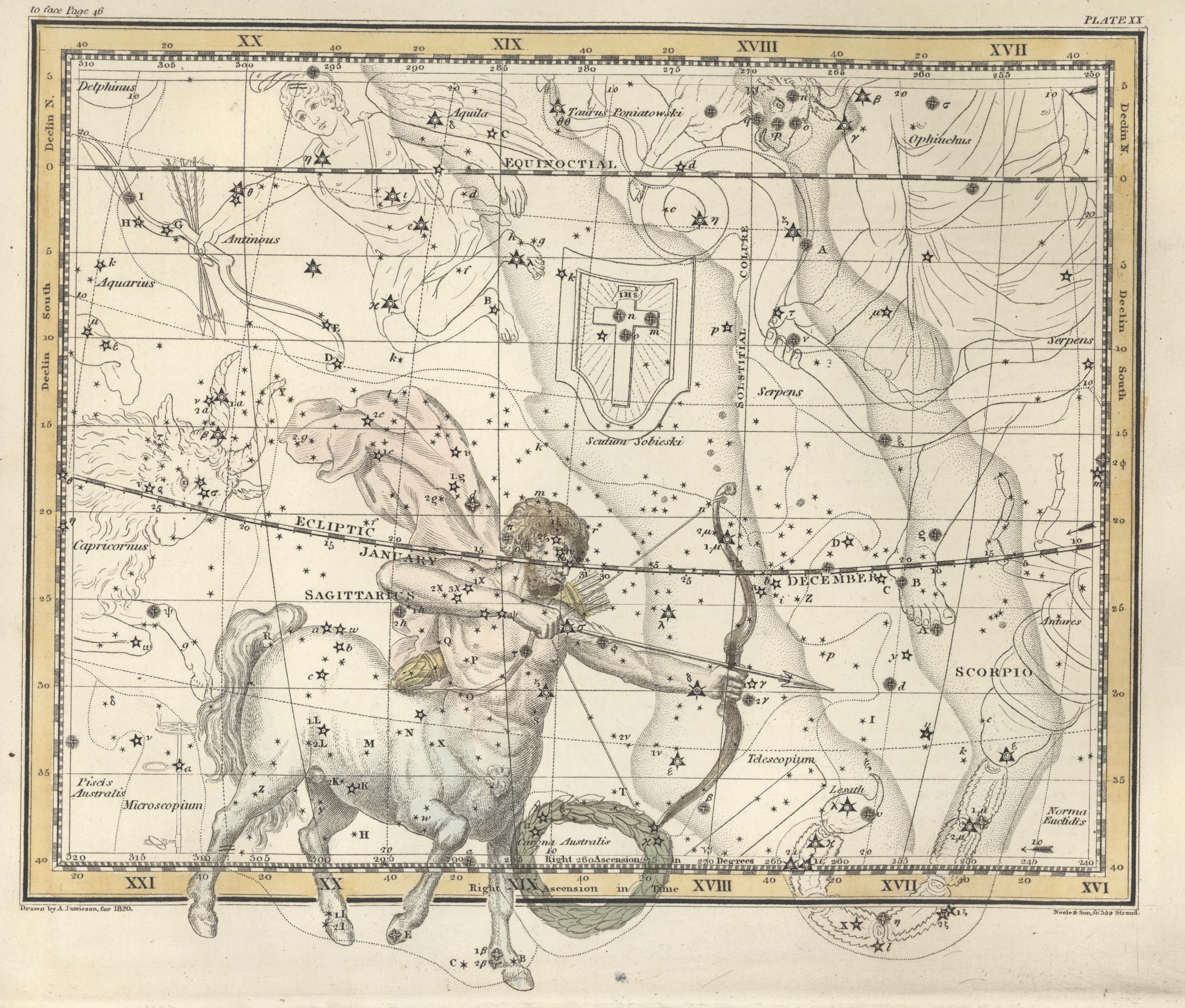
Plate 17
Leo
Plate 18
Virgo
Plate 19
Libra, Scorpio
Plate 20
Sagittarius,
Corona Australis


Plate 21
Capricornus, Aquarius,
Le Ballon Aerostatique, Piscis Australis, Microscopium
Plate 22
Pisces
Plate 23
Cetus, Apparatus Sculptoris, Machina Electrica,
Officina Chemica
Plate 24
Eridanus, Orion, Lepus, Columba, Cela Sculptoris, Psalterium Georgii, Sceptrum Brandenburgium


Plate 25
Canis Major, Canis Minor, Monoceros, Argo Navis, l’Atelier de l’Imprimeur, Pyxis Nautica
Plate 26
Hydra, Sextans, Crater,
Felis, Antlia Pneumatica
Plate 27
Hydra (continued), Corvus, Noctua, Centaurus, Lupus
Plate 28
Southern Hemisphere
Norma Nilotica, a measuring rod for the Nile held by Aquarius, on Plate 21 of Alexander Jamieson’s Celestial Atlas. Its brightest star was 4th-magnitude 3 Aquarii, labelled K on the chart.